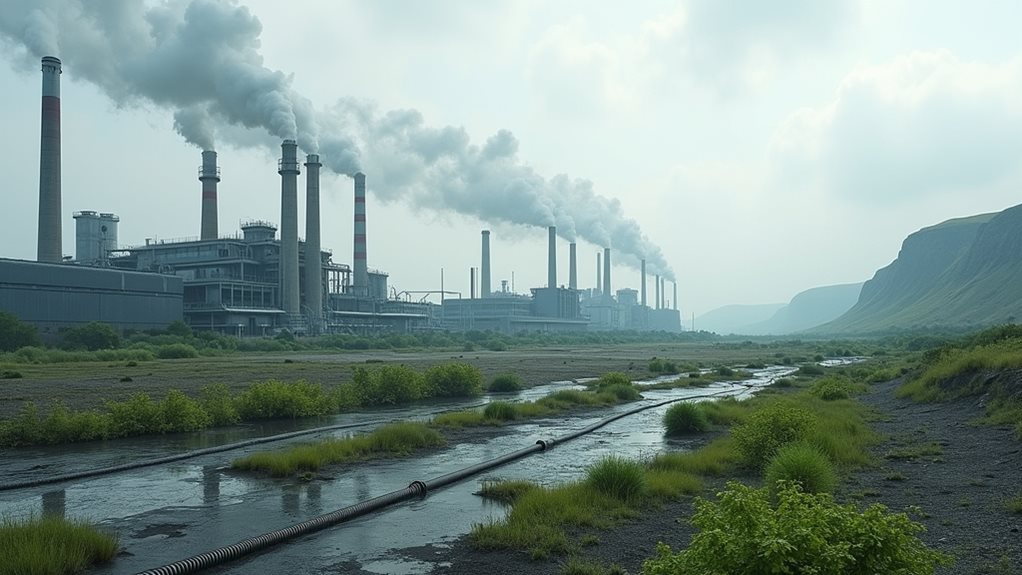

Betting big on carbon capture and storage (CCS) might feel like the shiny new toy in the climate fight, but it can distract from established heroes like solar and wind power. While CCS captures over 90% of emissions, it’s still unproven and costly compared to more effective renewables. Think of CCS as the high-tech promise with the hefty price tag, risking diverting funds from solutions already in play. Stick around, and you’ll uncover the full picture of this complex energy puzzle.
The Promise and Pitfalls of Carbon Capture
Why bet big on carbon capture?
With the world racing toward ambitious net-zero targets by 2050, carbon capture and storage (CCS) has emerged as a star player.
This technology can snag over 90% of CO₂ emissions from power plants and industrial sites, making it a darling of decarbonization strategies worldwide.
CCS captures over 90% of CO₂ emissions, becoming a favorite in global decarbonization efforts.
Imagine retrofitting an old car to run cleaner; CCS offers that same hope for existing fossil fuel infrastructure, particularly for those stubborn industries like steel and cement that resist easy fixes.
Yet, this high-tech solution isn’t without its quirks.
CCS involves a complex dance of CO₂ separation, compression, and transport, akin to a high-stakes relay race where every leg counts.
The main method? A chemical scrubbing process that sounds like something out of a mad scientist’s lab.
But don’t be fooled; it’s not just a plug-and-play scenario.
Each capture method has its own pros and cons, and achieving the right CO₂ purity is critical for safe transport and storage.
Then there’s the infrastructure.
Large-scale CCS requires extensive pipeline networks and geological storage sites, not to mention the hefty price tag for retrofitting and new builds. Deep underground geological formations are crucial for the safe storage of CO₂, ensuring it remains isolated from the atmosphere. Additionally, CCS stores nearly 45 million tons of CO₂ yearly, equivalent to emissions from 10 million cars.
It’s like trying to build a rollercoaster while ensuring it’s safe for thrill-seekers—quite the task!
Monitoring for leaks is mandatory, and the public’s acceptance remains a moving target.
Direct air capture technologies represent one of the most innovative approaches, extracting CO₂ directly from the atmosphere rather than from point sources.
Now, let’s talk dollars and sense.
CCS projects often come with sky-high costs compared to other climate solutions, like solar or wind.
Critics argue that pouring money into CCS might starve proven renewables of funding, as if we’re prioritizing the old-school VHS player over sleek streaming services.
The reality? CCS isn’t yet commercially mature or widely deployed, and betting big on it could overshadow more immediate, effective climate solutions.