
Mining in Canada’s Ring of Fire is like a chaotic dance, leaving biodiversity holding the wrong end of the stick. Supposed ‘remediation’ efforts often resemble an amateur magic trick—distracting, but hardly transformative. Despite strategies that promise land restoration and protected habitats, mineral claims still wreak havoc. It’s akin to repairing your car with duct tape; functional but far from perfect. Traversing this complex landscape could reveal more about improving these efforts for nature’s sake.
Quick Overview
- Northern Ontario’s Ring of Fire mining claims cause significant habitat destruction impacting local biodiversity.
- Current regulatory frameworks for mining remediation often lack effectiveness and enforcement.
- Innovative reclamation efforts fail to address the cumulative impacts on biodiversity and ecosystems.
- Conventional remediation strategies require a shift towards sustainable and regenerative approaches to enhance biodiversity.
- Programs like Towards Sustainable Mining aim to reduce the ecological footprints and protect biodiversity in mining areas.
How Mining Activities Threaten Canadian Biodiversity
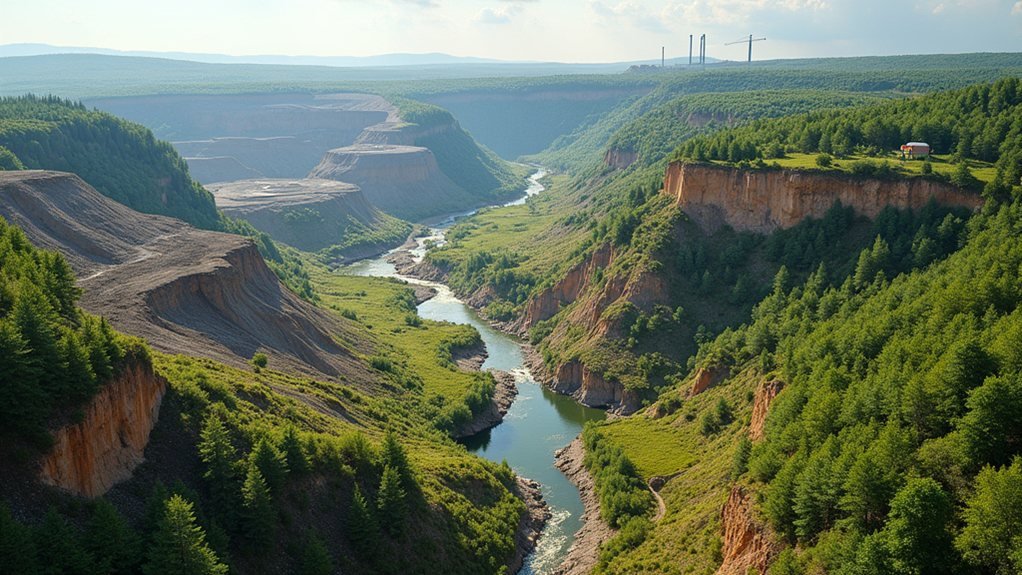
The world of mining in Canada is like an intriguing mystery novel, where each chapter reveals unexpected plots and challenges to biodiversity. The rising metal demand has transformed regions like Northern Ontario’s Ring of Fire into a playground for land disturbance with over 31,000 mineral claims stretching across vast wilderness. This isn’t just another field trip; it’s a cosmic jam session of habitat destruction and ecosystem jazz. With tales of habitat fragmentation, ecological disruption, and toxic tongue twisters elevating land disturbance, the plot thickens. Tailings? They’re the villains that keep growing. Meanwhile, toxic waste threatens watersheds like a mischievous sibling. Responsible mine site rehabilitation practices, including the careful restoration of native vegetation and soil stabilization, are critical to reversing damage and returning disturbed lands to functional ecosystems. As the frequency of extreme climate events such as catastrophic flooding increases, the risk to vulnerable ecosystems becomes even greater. Canada’s commitment to sustainability, demonstrated through initiatives like the Towards Sustainable Mining program, aims to tackle these environmental challenges by promoting responsible exploration and reducing the mining sector’s ecological footprint.
Assessing Effectiveness of Current Remediation Efforts for Biodiversity
Environmental challenges in Canada require an in-depth exploration into how effective current remediation efforts really are for biodiversity conservation. With a regulatory framework that’s more tangled than a spaghetti noodle, Canada’s mining sector often misses the mark. Policies exist, but enforcement? Now that’s a rare species! While industry standards like TSM gain ground, actual improvements lag, akin to a snail on a marathon track. Even innovative reclamation efforts, attempting to play Mother Nature, fall short with cumulative impacts sneaking under the radar. Metrics show progress slowing—turns out, good intentions can’t cross the finish line if commitment takes a nap. The use of natural methods in comprehensive reclamation research provides an eco-friendly approach that aims at reintegrating native species and restoring habitats effectively. Moreover, protected areas often receive exceptions for mining activities, undermining efforts to safeguard these vital ecosystems. Shifting from conventional remediation to regenerative approaches that actively restore ecosystem function and enhance biodiversity offers a more promising pathway for Canada’s mining sector to achieve lasting environmental recovery.
Improving Biodiversity Protection Strategies in Mining Remediation
Imagine this: you’re an orchestra conductor tasked with creating harmony between mining operations and Mother Nature’s delicate symphony. To achieve this, the mitigation hierarchy plays the role of a maestro’s baton, guiding efforts to avoid sensitive spots altogether. Early identification of biodiversity impacts acts like a composer anticipating discordant notes. Coordination and creativity are key, especially with nature-based solutions—think of restoring habitats like re-tuning a grand piano, stabilizing slopes, and reviving topsoil to support the native ensemble. Just as the urgency for comprehensive biodiversity strategies increases, mining companies must recognize that biodiversity loss translates into material business threats, impacting operational capacities and the ability to conduct their business effectively. Protecting species diversity and habitats is not only an ecological imperative but a proven safeguard against the cascading risks that ecosystem degradation poses to long-term industrial viability. With guidance from the ICMM’s new technical resource, mining sectors are now better equipped to align operations with no net loss of biodiversity, ensuring that efforts are both effective and transparent.