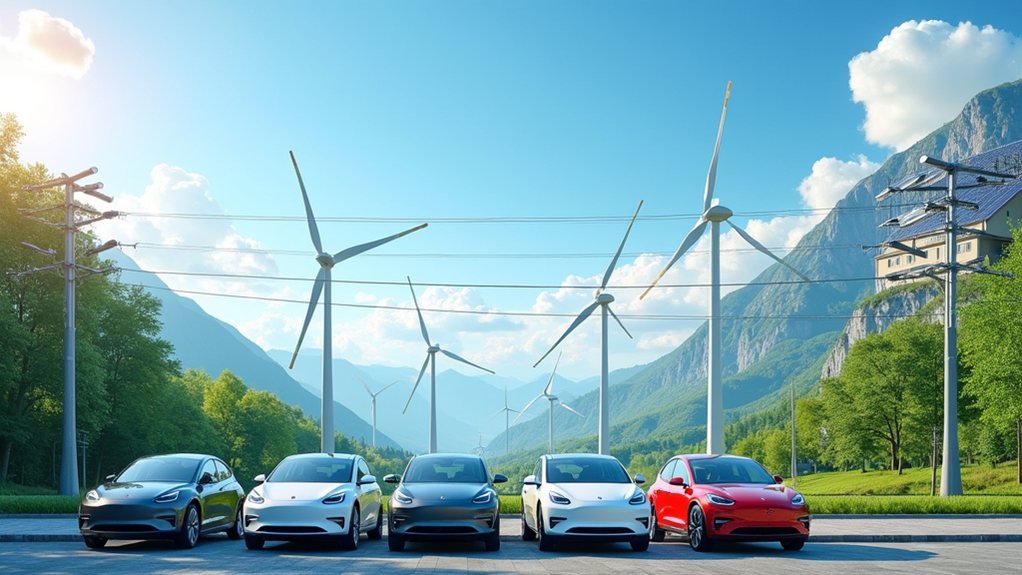

The Canada-China Clean Energy Trade Deal greatly alters the landscape for electric vehicle (EV) tariffs by slashing them from a hefty 106.1% to just 6.1%. This agreement allows for 49,000 Chinese-made EVs annually, aiming to make cars under $35,000 CAD more accessible. With plans for joint ventures and a stronger renewable energy synergy, both countries stand to benefit economically and environmentally. Who knew a trade deal could be the spark igniting a cleaner, greener carpool? Keep watching; there’s more innovation on the horizon!
Quick Overview
- The Canada-China Clean Energy Trade Deal allows 49,000 Chinese-made electric vehicles (EVs) annually, with a significant focus on affordability.
- EV tariffs in Canada have been reduced from a 100% surtax plus 6.1% to just 6.1% for eligible imports.
- Over half of the Chinese EVs are expected to be priced under $35,000 CAD by 2030, promoting sustainable transportation.
- The agreement aims to strengthen Canada’s EV supply chain and enhance local manufacturing through partnerships with Chinese companies.
- The deal includes tariff reductions on Canadian agricultural exports, fostering broader economic cooperation alongside clean energy initiatives.
Overview of the Canada-China Clean Energy Trade Deal’s Key Elements
The Canada-China Clean Energy Trade Deal is like a carefully crafted recipe, blending various ingredients to create a dish that aims to satisfy both countries’ appetites for economic growth and environmental sustainability. At its core, the deal features a quota for 49,000 Chinese-made electric vehicles (EVs), with a special focus on affordability—half reserved for models under $35,000 CAD. It also fosters collaboration on clean energy through investments in solar, wind, and energy storage. Notably, Canada and China are recognized as energy superpowers, enhancing two-way energy cooperation. This partnership highlights the cost advantages of renewable energy sources, making them increasingly competitive with conventional power generation. With tariff reductions on Canadian canola and a strategic framework covering trade and cultural ties, this deal is a multi-layered approach to modernizing trade relations. Additionally, the agreement allows for up to 49,000 Chinese-made EVs annually, which is a significant step towards balancing trade and promoting green technology.
How the Canada-China Trade Deal Transforms EV Tariffs in Canada
While many might view the Canada-China Clean Energy Trade Deal as just another bureaucratic agreement, it’s actually a game-changer for electric vehicle (EV) tariffs in Canada.
The deal slashed EV tariffs from a jaw-dropping 100% surtax plus 6.1% to just 6.1%, allowing up to 49,000 Chinese EVs annually without the hefty surtax. This trade deal aims to enhance bilateral relations and economic collaboration between Canada and China.
The agreement drastically reduced EV tariffs, permitting 49,000 Chinese models annually at just 6.1%.
This quota, under 3% of Canada’s new vehicle market, aims to introduce affordable options and stimulate local manufacturing. Notably, over half of these EVs are expected to be priced under affordable options $35,000 CAD by 2030.
This agreement represents a significant step toward sustainable future as Canada transitions from carbon-intensive transportation to cleaner alternatives.
With a focus on clean energy and job protection, this agreement is more than a trade deal; it’s a roadmap for Canada’s electric future, leaving tariffs in the dust.
Future Prospects for Clean Energy and EV Cooperation in Canada-China Relations
As Canada and China commence on this clean energy journey together, the excitement in the air is palpable, akin to the buzz before a big concert. Joint ventures between Canadian and Chinese companies promise to create new auto manufacturing careers while bolstering Canada’s EV supply chain. Additionally, both countries will enhance two-way energy cooperation to reduce emissions and promote sustainable practices. These partnerships align with IEA projections showing accelerated growth in clean energy investments globally. With the establishment of a Joint Economic and Trade Commission, expect a flood of affordable Chinese EVs, shaking up the market. With a ministerial dialogue fostering collaboration on renewable technologies, Canada is poised to learn from Chinese expertise. As they dance towards a low-carbon future, both nations are set to turn their ambitions into reality, energizing economies and consumers alike.