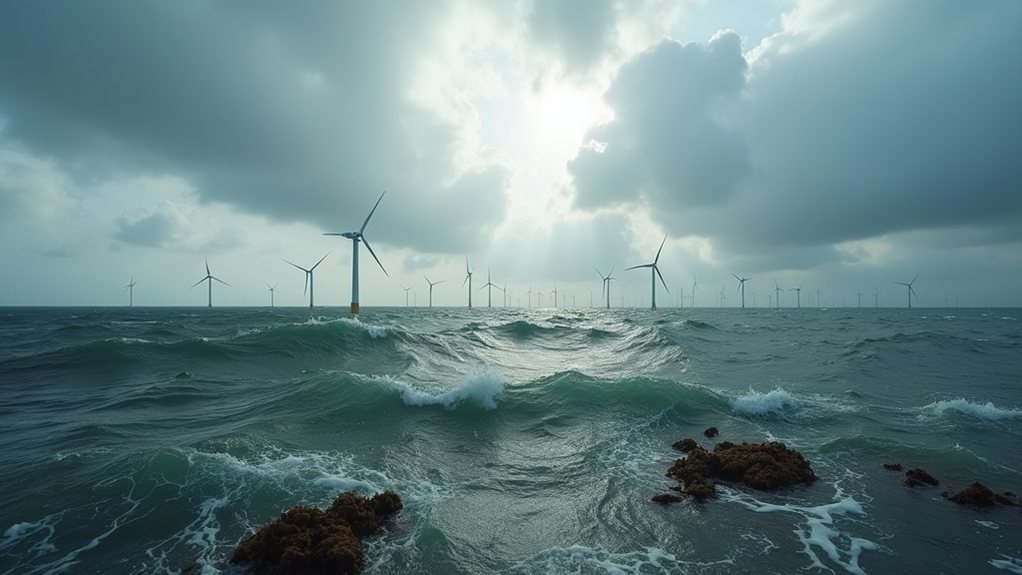

Steering through UK offshore wind energy projects feels like trying to solve a jigsaw puzzle where the pieces keep changing shape. With regulatory frameworks like Planning Act 2008, steering these waters without getting caught in the red tape whirlpool is tricky. As if that’s not enough, policy uncertainty keeps investors on the edge, while grid access problems add to the fun. Tackling these issues could turbocharge the sector’s growth. Stick around to uncover more twists in this tale!
Quick Overview
- Multiple legislative frameworks complicate the permitting process for offshore wind projects.
- Jurisdictional devolution leads to prolonged pre-application timelines for project approval.
- Complex marine licence requirements vary significantly by location in UK waters.
- Policy inconsistencies and complex eligibility criteria deter investment in offshore wind projects.
- There is an urgent need for regulatory clarity and action to reduce permitting delays.
Key Permitting Challenges in UK Offshore Wind
Steering through the regulatory waters of UK offshore wind projects can feel like trying to solve a Rubik’s cube blindfolded—complex and occasionally frustrating, yet immensely rewarding when everything clicks into place.
The UK’s permitting gauntlet involves multiple legislative hoops: Planning Act 2008 in England, the Electricity Act 1989 in Scotland, and NSIP in Wales. Then, there’s the marine licence maze, differing by location.
Navigating UK wind project permits: England’s hoops, Scotland’s hurdles, Wales’ twists, and the marine licence labyrinth.
With jurisdictional devolution, developers face a tri-national tidy, each demanding its unique brand of paperwork dance. Pre-applications stretch timelines, like waiting for ice cream to melt in winter—painfully slow. Despite these challenges, the UK is positioned to be a global leader in Offshore Wind, driven by its significant deployment and innovation. Urgent action is required on investment, permitting, and port upgrades to avoid missing targets.
Expect delays, but anticipate eventual triumph. Offshore wind infrastructure increasingly incorporates sustainable construction practices to minimise environmental impact, drawing from green building principles such as responsible materials selection and energy-efficient design.
How Policy Uncertainty Impacts Wind Project Financing
Steering through the financial seas of UK offshore wind projects can feel like trying to stay upright on a seesaw—one moment you’re up, the next you’re down. Policy uncertainty is the mischievous wind tilting the balance. The failed 2023 CfD auction due to market unpredictability left investors clutching their wallets tighter than misers in a windstorm. Despite promises of supporting lub-dub with government grants, eligibility criteria still resemble a cryptic crossword. Multiple funding sources dance tantalizingly out of reach, while inconsistent policy songs deter investors from stepping up with scaled commitments. New ecosystem monitoring tech can reduce consenting time by at least 40%, possibly providing a smoother ride for investors willing to navigate the choppy waters ahead. Responsible stewardship of offshore wind development ensures that natural resource availability is preserved so that energy infrastructure can continue to benefit communities well beyond the current generation. Considering the UK’s plan to increase wind power capacity, coordinated financing between government and businesses is essential for achieving 80GW by 2030. Ah, wind projects—profit potential looms, risk winks.
Overcoming Grid Access Issues in Wind Projects
While the winds of change whistle through the UK’s renewable energy landscape, the challenges of grid access sit like a stubborn knot in an otherwise flowing tapestry. The UK faces a grid connection backlog, with over 1,700 applications clogging the system like rush hour traffic. It seems as if the infrastructure is trying out for a Cirque du Soleil act—stretched beyond limits. Transmission capacity is overwhelmed, and even high-temperature superconducting (HTS) cables, touted as the sleek heroes of underground electricity transport, can’t come soon enough. The need to urgently transition from research to substantial field testing of HTS cables has become a priority to alleviate grid bottlenecks. Compounding these issues, local grids and community-owned installations are growing, putting additional pressure on an already strained network. Modern smart grid technologies can help balance supply and demand more dynamically, offering a pathway to manage the increasing complexity of integrating offshore wind into the national network. The timeline to untangle this knot? A hefty decade-plus, unless these super cables perform magic.