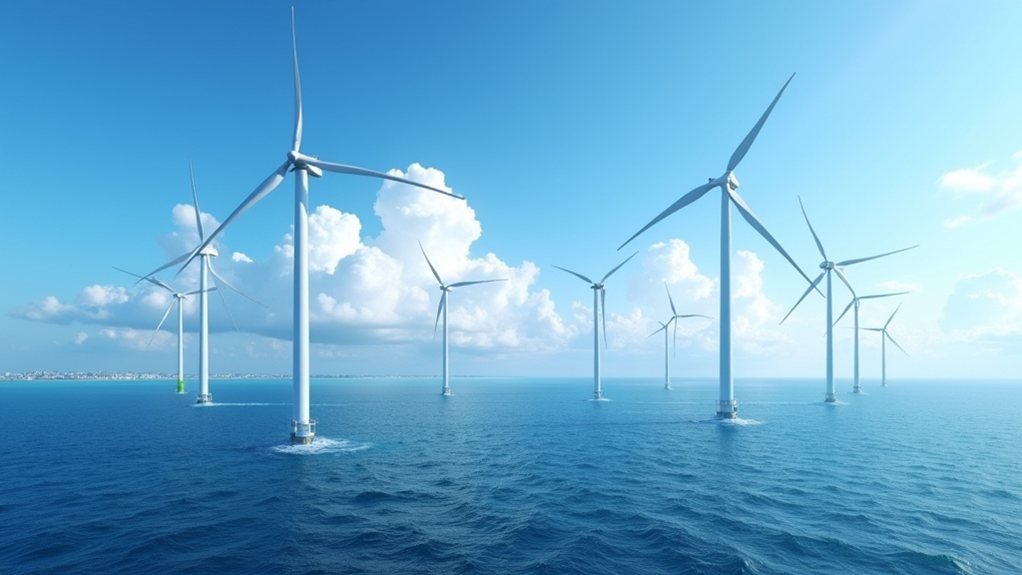

The recent U.K. offshore wind auction is a game-changer, set to power over 12 million homes while making energy cheaper. With bids averaging £91/MWh, that’s 40% less than traditional gas plants—talk about saving a penny! Major projects from companies like RWE and SSE promise to add up to 8.4 GW of capacity. Plus, this booming industry is expected to create over 100,000 jobs. Curious about the impact on local economies and energy independence? There’s more to uncover!
Quick Overview
- The U.K. offshore wind auction awarded 8.4 GW of capacity, enough to power 12 million homes.
- The strike price of £91/MWh is significantly cheaper than gas plants, enhancing affordability.
- RWE and SSE Renewables are leading projects, contributing over 8 GW to the grid.
- The investment of $28–$57 billion by 2030 will create over 100,000 manufacturing jobs.
- The offshore wind industry will bolster local economies through job creation and infrastructure funding.
Why the Recent Offshore Wind Auction Matters
As the winds of change swirl through the energy sector, the recent offshore wind auction in the U.K. stands out like a lighthouse guiding ships through murky waters.
This auction, heralding 8.4 GW of offshore wind capacity, signals a robust step towards energy independence, reducing reliance on petrostates. With a strike price of £91/MWh—40% cheaper than gas plants—it’s a financial win. The record 19 projects that were eligible to bid showcase the intense competition in this auction. The Contracts for Difference system guarantees stability, protecting developers from price swings. This significant achievement in securing 8.4 GW of new offshore wind capacity positions the U.K. as a leader in renewable energy investment, and it underscores the broader shift toward renewable energy adoption in the economy.
Impactful Offshore Wind Projects From the Auction
With the winds of opportunity at their backs, several impactful offshore wind projects emerged from the recent U.K. auction, showcasing a blend of innovation and ambition.
RWE’s five projects, including the massive Dogger Bank South phase, promise up to 6.9 GW of renewable energy. Meanwhile, SSE Renewables’ Berwick Bank adds a solid 1.38 GW to Scotland’s grid, sporting a competitive strike price. Record-breaking capacity from the auction indicates a significant boost for offshore wind in the U.K. Additionally, the 8.4 GW of new offshore wind capacity announced marks the largest-ever offshore wind procurement in the U.K.
Floating wind projects like Pentland and Erebus hint at a future where wind turbines dance gracefully on the waves.
These ventures not only represent technological advancement but also position the U.K. as a leader in offshore wind energy. This momentum is supported by renewable energy policy and investment patterns fueling these developments.
Economic Benefits of Offshore Wind Energy for Consumers and Jobs
Offshore wind energy isn’t just a breezy concept; it’s rapidly becoming a cornerstone of economic growth and job creation in the U.S.
With a projected investment of $28–$57 billion by 2030, it’s like a financial windfall, generating over 100,000 new manufacturing jobs. Anticipated operational capacity of 20,000 to 30,000 megawatts (MW) by 2030 will significantly enhance the supply of clean energy. Furthermore, the generation from these farms is projected to significantly reduce natural gas and coal-fueled generation.
Imagine a world where energy bills drop, thanks to offshore wind farms taking the edge off natural gas prices—an estimated 14 to 1 benefit-to-cost ratio!
This industry not only spurs local economies but also funds schools and infrastructure. Global energy trends point toward expanding renewable capacity as a driver of regional development and resilience.