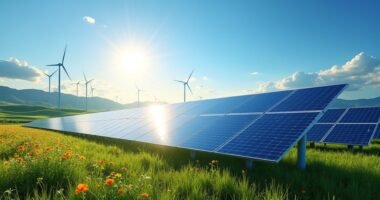
Canada is investing billions in clean energy, aiming for a future that’s both affordable and sustainable. With projects like the Site C Clean Energy Project and the Northvolt Battery Gigafactory, the nation is turning the tide on its energy landscape. Economic impacts are notable, with projections of $107 billion in clean energy contributions by 2030. Canadians might even spend 12% less on energy by 2050—talk about a win-win! Curious about what’s next? The energy shift is just heating up!
Quick Overview
- Canada is projected to invest $58 billion in clean energy projects, supporting the transition to affordable renewable energy sources.
- The clean technology sector contributed $81 billion to the economy in 2023, highlighting the financial benefits of renewable investments.
- Renewable energy projects, including the Site C project and Northvolt Gigafactory, are pivotal to Canada’s clean energy strategy.
- Clean energy job creation is expected to reach 639,000 by 2030, bolstering economic growth alongside renewable investments.
- Canada aims for net-zero emissions by 2050, reflecting a strong commitment to sustainable and affordable energy solutions.
Key Renewable Energy Projects and Their Funding in Canada
As Canada dives headfirst into the clean energy revolution, it’s hard not to feel a tingle of excitement about the impressive renewable projects sprouting up across the country.
The Site C Clean Energy Project in British Columbia, for example, aims to pump out 1,100 megawatts, boosting the province’s electricity supply by 8 percent.
The Site C Clean Energy Project will generate 1,100 megawatts, enhancing British Columbia’s electricity supply by 8 percent.
Meanwhile, Quebec’s Northvolt Battery Gigafactory is gearing up to produce EV batteries, essential for reducing global supply hiccups. Furthermore, the country has developed a comprehensive renewable energy projects database that showcases initiatives equal to or greater than 1 MW.
With renewable fuels like hydropower and wind energy on the rise, Canada is positioning itself as a leader in sustainable energy solutions. Canada is also prioritizing energy efficiency measures alongside new generation to lower overall demand and emissions.
With 155 electricity projects valued at a staggering $108 billion in the works, Canada is truly electrifying its energy landscape—one megawatt at a time, and it’s not just a shocking development!
Economic Impacts of Clean Energy in Canada
Clean energy is not just a buzzword; it’s a booming sector reshaping Canada’s economic landscape.
The environmental and clean technology sector contributed $81 billion to the economy in 2023, despite a slight dip. By 2030, this sector could grow to $107 billion under federal climate plans. Additionally, clean energy projects have generated $3.75 billion in Alberta since 2019, showcasing the tangible economic benefits of this transition. Furthermore, the clean energy GDP is projected to rise from $68 billion in 2020 to $95 billion by 2030 under current policies.
Job creation is equally impressive, with projections of 639,000 clean energy jobs by 2030. Investment is ramping up, too, with funding expected to reach $58 billion. Governments and industry are also aligning with international commitments like COP29 to accelerate deployment and financing.
As renewables become the cheapest source of power, Canadians will spend 12% less on energy by 2050—making clean energy not just smart, but downright wallet-friendly!
What to Look Forward to in Canada’s Energy Transition?
What exciting changes are on the horizon for Canada’s energy landscape? Canada is gearing up for a clean energy revolution, with ambitious goals like fully decarbonizing electricity grids by 2035 and achieving net-zero emissions by 2050.
Innovations like small modular reactors (SMRs) are set to make a splash, while provinces are adopting energy-efficient building codes faster than you can say “green energy.” Additionally, the NBC 2020 introduced a tiered performance framework for housing and small buildings, further promoting energy efficiency across the country. The commitment to emissions-reduction targets under the Paris Agreement is vital for both the economy and environment.
With investments flowing into rural renewables and smart grid technology, Canada is not just talking the talk but walking the walk toward a sustainable future. The shift is supported by emerging grid modernization technologies that enable higher renewable penetration and improved system efficiency.
Get ready; the energy landscape is about to get a whole lot greener!