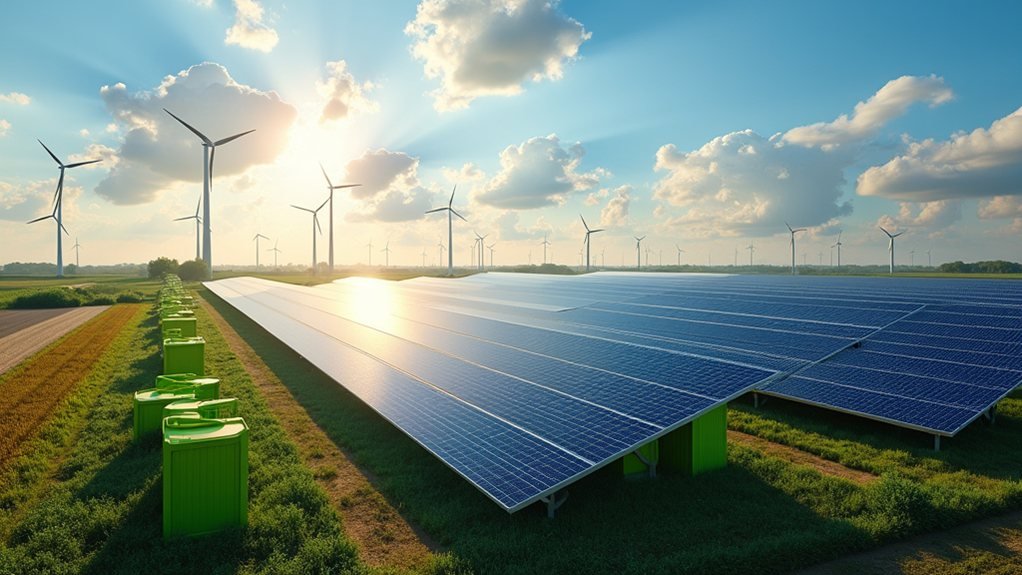

The U.S. energy landscape is gearing up for a stunning shift, with solar, wind, and storage technologies projected to make up a whopping 99% of new power installations. Solar power is already dominating, claiming 72% of new capacity recently. Wind energy loves the night, while solar shines during the day, creating a perfect duet. Plus, advancements in energy storage, like lithium-ion batteries, promise to match demand with supply, leading to a vibrant renewable future. Curious about the implications?
Quick Overview
- Solar energy accounted for 72% of new electricity capacity in November 2025, indicating a strong growth trend in renewable sources.
- Utility-scale solar capacity reached 27.668 GW in November 2025, reflecting increased investment in solar infrastructure.
- The complementarity of solar and wind energy enhances grid reliability, with solar peaking during the day and wind often dominating at night.
- Advances in energy storage, including lithium-ion batteries and alternative technologies, are critical for balancing supply and demand effectively.
- Federal incentives and strategic planning support the rapid deployment of solar and wind energy, aiming for a cleaner, resilient power grid.
Solar Power Growth: Key Statistics and Projections
Solar power is rapidly transforming the landscape of energy generation in the United States, much like a superhero emerging from the shadows to save the day—only this time, it’s armed with panels and the power of the sun.
In November 2025, solar accounted for an impressive 72% of new electricity capacity, adding 2.879 GW, including the notable 484.6-MW Parliament Solar Project.
By then, utility-scale solar surged to 27.668 GW, a significant leap from the previous year. Solar represented 72% of new generating capacity in November and for the entire year of 2025. The cumulative global solar capacity is projected to triple from nearly 3 TW to almost 8 TW by 2034, showcasing the long-term commitment to renewable energy sources.
With projections forecasting a 65% increase in annual solar generation by 2030, the sun is clearly shining brighter than ever in America’s energy future. The ongoing growth is supported by federal incentives, long-term deployment planning, and expanding storage capabilities that help balance grid demand and reliability.
How Solar and Wind Complement Each Other in Renewables?
When considering the vast world of renewable energy, it becomes clear that solar and wind power are like the dynamic duo of the electricity game, each bringing unique strengths to the table. Solar shines brightest during the day, while wind often swoops in to save the night, especially in regions like Germany, where winter winds align with peak demand. Notable disparities in complementarity are observed when comparing northern regions like Germany to southern regions such as Greece. Despite occasional “Dunkelflaute” moments, their negative correlation means they often fill each other’s gaps, making them a perfect pairing. Together, they create a more reliable energy mix, ensuring that while one is taking a break, the other is hard at work. The renewable energy generation in Australia increased by 126% over the last decade, demonstrating the growing reliance on these complementary sources. A 1-4 word phrase
Advancements in Energy Storage: Enabling a Clean Power Grid
Revolutionizing the energy landscape, advancements in energy storage are akin to finding the perfect recipe for a delicious dish; each ingredient plays a crucial role in achieving a balanced and satisfying outcome.
Lithium-ion batteries dominate, boasting a staggering 85% cost drop since 2010 and an impressive efficiency of 90-95%. As a result, grid scale storage is becoming critical for maintaining a stable supply that matches demand, especially with the rise of intermittent renewable energy sources. Moreover, massive energy storage systems provide stability services that further enhance grid reliability.
Meanwhile, alternative technologies like flow batteries and hydrogen storage offer unique benefits, ensuring that energy is available when needed most.
As utilities increasingly embrace these innovations, grid reliability enhances, allowing for smoother integration of renewables.
With these advancements, a cleaner, more resilient power grid is no longer a dream—it’s becoming reality. Energy storage integration further enables decarbonization at scale.