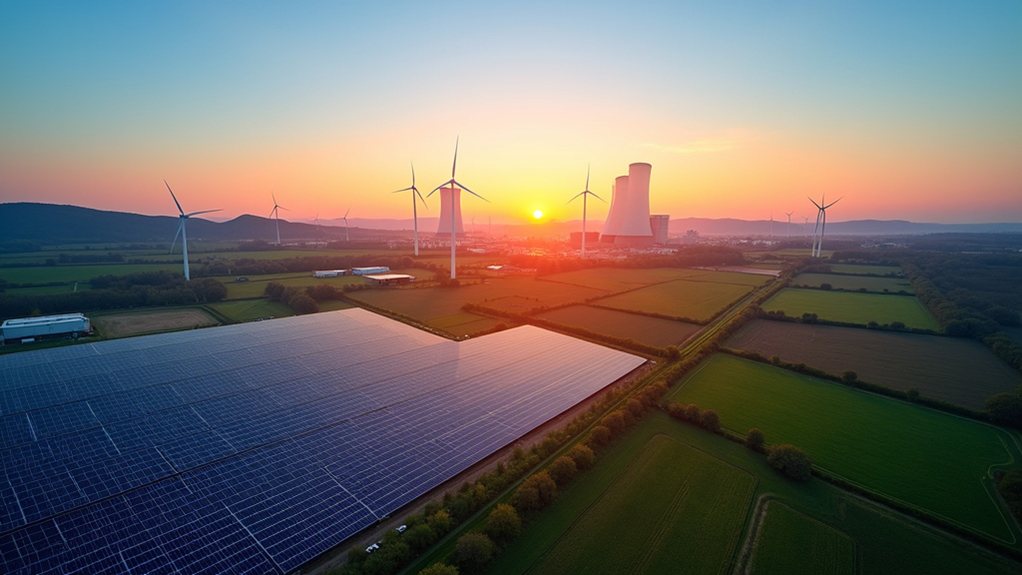
The International Energy Agency (IEA) has laid out a fascinating roadmap, declaring that meeting the ambitious 1.5°C climate target doesn’t actually require new oil or gas projects. Instead, energy investments are projected to soar, with renewables capturing a staggering 67%. Think of it as upgrading your old flip phone to a smartphone—it’s all about harnessing clean energy like solar and nuclear. And if you think that’s intriguing, there’s a lot more to unpack about our energy future!
Quick Overview
- The IEA’s roadmap emphasizes that achieving the 1.5°C climate target requires no new investments in oil or gas.
- A projected $3.3 trillion in global energy investment by 2025 will focus on clean energy initiatives.
- Clean energy is expected to capture 67% of total investments, highlighting a significant shift away from fossil fuels.
- Advanced technologies like smart grids and energy storage are essential for integrating renewables into the energy mix.
- Nuclear power plays a critical role, providing low-carbon baseload power necessary for meeting growing electricity demand.
Global Investment Trends in Clean Energy
In the field of clean energy, a fascinating transformation is underway, akin to watching a caterpillar morph into a vibrant butterfly.
By 2025, global energy investment is projected to hit a staggering $3.3 trillion, with clean energy snagging a whopping $2.2 trillion—67% of the total pie. Electricity investments exceed fossil fuel investments as solar PV is like the star quarterback, leading with $450 billion, while battery storage is stealing the show, soon to outshine pumped hydro. Clean energy investments total $2.2 trillion USD, twice the amount for fossil fuels.
By 2025, clean energy is set to capture an impressive 67% of the global $3.3 trillion energy investment!
Investors are buzzing, with 72% ramping up their energy shift bets.
But hold your horses! Challenges like grid investment and permitting delays could throw a wrench in this eco-friendly party. Recent geopolitical tensions are creating additional hurdles for the rapid deployment of renewable energy technologies across borders.
Regional Dynamics and Shifts in Energy Capital
A new chapter in the energy story is being written, and it’s all about where the cash is flowing.
Investment is gravitating towards regions championing renewable energy, with Europe leading a spectacular offshore wind surge, while the US takes a breather. Meanwhile, Asia, particularly China and India, is becoming a clean energy powerhouse, raking in investments like it’s Black Friday. This geographical shift away from oil-rich nations illustrates a pivotal change; countries are now prioritizing renewables. With total renewable investments gaining momentum, energy storage solutions and smart grid upgrades are gaining traction, the landscape is evolving—one gigawatt at a time, and it’s electrifying! In fact, 72% of investors report acceleration in energy transition assets amid geopolitical volatility and fluctuating interest rates. Advanced electrical grid technologies are proving crucial to accommodate the growing integration of renewable energy sources and maximize overall system efficiency.
The Role of Nuclear Power and Energy Security in Future Investments
How can nuclear power, often overshadowed by the glitz of renewables like solar and wind, play a pivotal role in securing the future of energy investments?
As global electricity demand skyrockets, nuclear emerges as a reliable backbone, providing low-carbon baseload power. With electricity demand projected to reach 15,000 gigawatts by 2050, it’s clear that renewables projected to increase by 240% globally will play a significant role in the energy mix.
Nuclear stands out as a crucial, low-carbon powerhouse amidst soaring global electricity demand.
With countries like France and India ramping up their nuclear portfolios, it’s clear that energy security is in the spotlight. Innovations like Small Modular Reactors promise flexibility and enhanced resilience. Recent coal-to-nuclear conversion projects demonstrate innovative pathways for repurposing existing infrastructure while advancing decarbonization goals.
While some still cling to fossil fuels, failing to embrace nuclear could inflate costs and sabotage climate goals—turning a bright future into a dark, power-less reality.