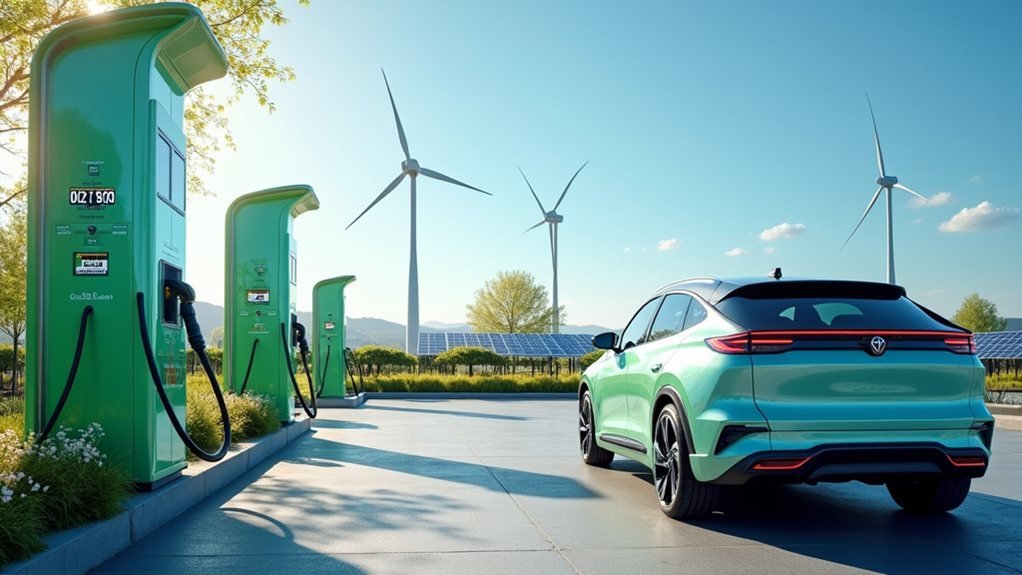

Hydrogen fuel cell costs are taking a nosedive, thanks to cutting-edge tech and government policies that make green hydrogen cheaper. By 2026, experts predict production could hit just $2 per kilogram, comparable to traditional fuels. This drop means fuel cell vehicles will finally become wallet-friendly! Picture a future where clean energy fuels not just cars but entire industries. Interested in how this could change everything for consumers and businesses alike? There’s even more to explore!
Quick Overview
- Hydrogen production costs are projected to drop to $2/kg by 2026, enhancing fuel cell vehicle affordability.
- Technological advancements in electrolyzers promise significant efficiency improvements and lower production costs.
- Increased demand for fuel cell vehicles is anticipated as hydrogen prices approach conventional fuel costs.
- Green hydrogen is becoming competitive with blue hydrogen, encouraging broader industry adoption and investment.
- A hydrogen revolution is on the horizon, supported by strategic investments and evolving renewable energy policies.
Current Trends in Hydrogen Fuel Prices
As the world gears up for a greener future, hydrogen fuel prices are experiencing a transformation that is nothing short of electrifying.
The green hydrogen market is projected to leap from a modest $2.79 billion in 2025 to a staggering $247.26 billion by 2035. With production expected to skyrocket from under 1 million tonnes to up to 138 million tonnes in twelve years, the cost competitiveness of renewable hydrogen is approaching conventional alternatives. By 2030, it may even rival blue hydrogen in favorable regions. This shift hints at a future where hydrogen isn’t just a dream—it’s a tangible, affordable reality. As production volumes are projected to grow from under 1 million tonnes in 2024 to between 100-138 million tonnes by 2036, the market is poised for unprecedented expansion. Renewables-driven policies are accelerating deployment and driving down costs through economies of scale and technology improvements.
Technological Innovations and Policies Lowering Hydrogen Production Costs
While many might think of hydrogen fuel as a futuristic concept reserved for sci-fi flicks, recent technological innovations and supportive policies are turning that notion on its head.
The U.S. Department of Energy’s ambitious funding and goals aim to slash hydrogen production costs to $2/kg by 2026, with cutting-edge electrolyzer tech promising efficiency boosts. Cost reduction is essential for the hydrogen economy and decarbonized energy systems. Additionally, the funding initiative includes $300 million for low-cost electrolyzer manufacturing, which is expected to significantly enhance production capabilities.
Learning curves, like a video game where players level up, indicate costs could dip below 1,000 yuan/kW by 2031.
With strategic investments and clever policies, the hydrogen landscape is rapidly evolving, making the fuel not just a dream but a practical reality for the near future. The integration of advanced grid technologies can enable more efficient renewable integration and support hydrogen deployment at scale.
How Lower Hydrogen Prices Will Impact Consumers and Industry
Lower hydrogen prices could dramatically reshape both consumer experiences and industry dynamics, much like a game-changing plot twist in a movie. Should hydrogen drop to $2/kg, consumers may finally see fuel cell vehicles (FCVs) become affordable, shaking off the stigma of being three times the cost per mile compared to gasoline. This affordability boost could stir demand, reigniting sales and expanding the FCV market. In fact, hydrogen prices in California have been approximately $14/kg since 2014, highlighting the significant potential for change as costs decrease. Furthermore, achieving the hydrogen production cost target of $2/kg by 2026 could accelerate the transition to cleaner transportation options. Wider adoption would also encourage more investment in distributed renewable energy systems and storage. Industries too would benefit, as green hydrogen becomes competitive. With a flourishing infrastructure, range anxiety might fade, allowing drivers to refuel without a second thought.
The stage is set for a hydrogen revolution—if prices continue to plummet.