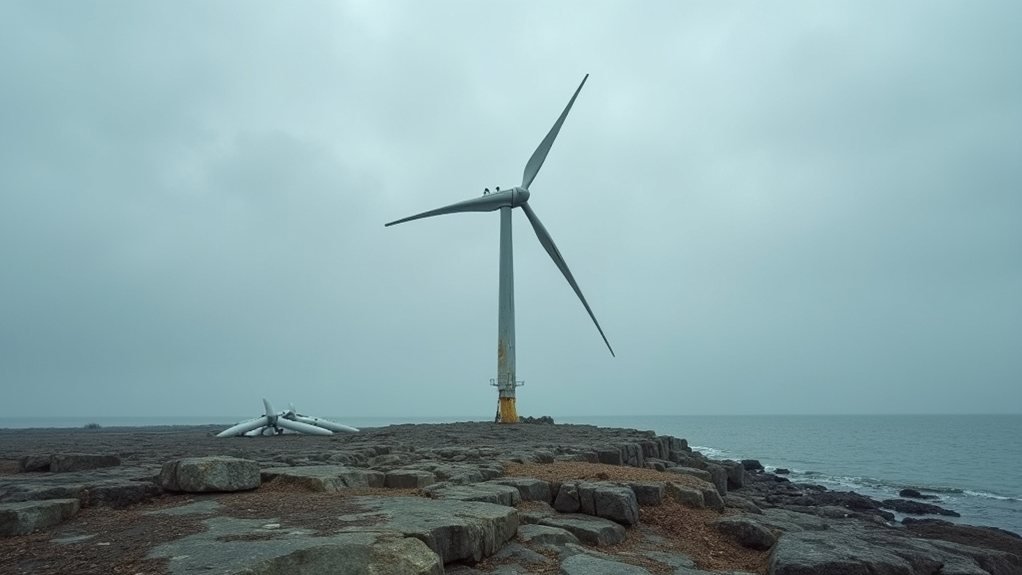

The U.S. government has hit pause on five major offshore wind projects, stirring up waves of concern about clean energy’s future. These initiatives could generate a whopping 6 gigawatts of power, enough to fuel a small city, but national security worries—like radar disruptions and cyber vulnerabilities—have put them on hold. This freeze could lead to rising energy prices and impact investor confidence as we navigate a tricky energy landscape. Curious about what’s next for these essential projects?
Quick Overview
- The U.S. Department of the Interior has paused five major offshore wind leases due to national security concerns, impacting project timelines.
- Key offshore wind projects like Sunrise Wind and Vineyard Wind 1 face significant delays, jeopardizing their contributions to clean energy capacity.
- The freeze on these projects could lead to rising electricity prices as dependency on less sustainable energy sources increases during peak demand.
- Legal and regulatory challenges complicate the development of offshore wind projects, undermining investor confidence and future energy infrastructure.
- National security risks, including radar disruptions and cyber vulnerabilities, necessitate a cautious approach to offshore wind development.
Overview: Key Frozen Offshore Wind Projects and Their Capacities
In the ever-evolving landscape of renewable energy, offshore wind projects have taken center stage, like a band headlining a summer music festival.
Notable players include Sunrise Wind, boasting 924 megawatts to power 600,000 New York homes, yet facing a December 2025 suspension. Ongoing scrutiny from Interior Secretary Doug Burgum raises concerns about the future of offshore wind under the current administration.
Vineyard Wind 1, with 800 megawatts, energizes 400,000 homes, while 44 turbines are already spinning. Vineyard Wind is the first commercial-scale offshore wind farm in the U.S.
Revolution Wind, at 700 megawatts, aims to serve Connecticut and Rhode Island with 65 turbines.
Empire Wind and Coastal Virginia Offshore Wind are also in the mix, each with significant capacities but caught in legal entanglements, highlighting the turbulent winds of progress in renewable energy. Nearby transmission and permitting challenges emphasize permitting timelines intersect with project development, underscoring the complexity of scaled offshore wind deployment.
What’s Behind the National Security Concerns for Offshore Wind?
Concerns about national security swirl around offshore wind projects like storm clouds on a sunny day, casting a shadow over the renewable energy revolution. The massive turbine blades and reflective towers disrupt radar systems, creating blind spots that jeopardize aviation safety and military readiness. The U.S. Department of Defense warns that these projects could compromise essential training and response operations, with turbines obstructing Coast Guard rescue missions. Offshore wind installations may introduce vulnerabilities to the electrical grid, including cyberattacks. To top it off, classified reports flag emerging risks from adversarial technologies. With such stakes, a pause on these projects seems less like a delay and more like a necessary precaution for national safety. Furthermore, the DOI’s action to pause five specific leases underscores the urgency of addressing these national security risks. In addition, international greenhouse reporting standards provide a framework for measuring and communicating environmental impact that can inform how deployment decisions align with resilience and security considerations.
Impact on Energy Prices and Reliability Due to Offshore Wind Project Halts
While it may seem like a simple pause in construction, the halting of offshore wind projects is sending shockwaves through energy prices and reliability that could leave consumers feeling as if they’re stuck in a never-ending game of musical chairs.
With 6 gigawatts of clean energy capacity sidelined, electricity prices are bound to rise as dependency shifts to pricier alternatives, especially during peak demand. The loss hits hardest in winter, when offshore wind is most effective. Additionally, the five major offshore wind projects have faced significant delays, which further complicates the energy landscape. Furthermore, the pause undermines investor confidence, casting doubt on future energy infrastructure, while billions already invested by ratepayers hang in limbo, raising eyebrows and bills alike. Large offshore wind turbines may have been essential for meeting future energy demands, but their halt now threatens to disrupt the projected growth trajectory in the offshore sector.