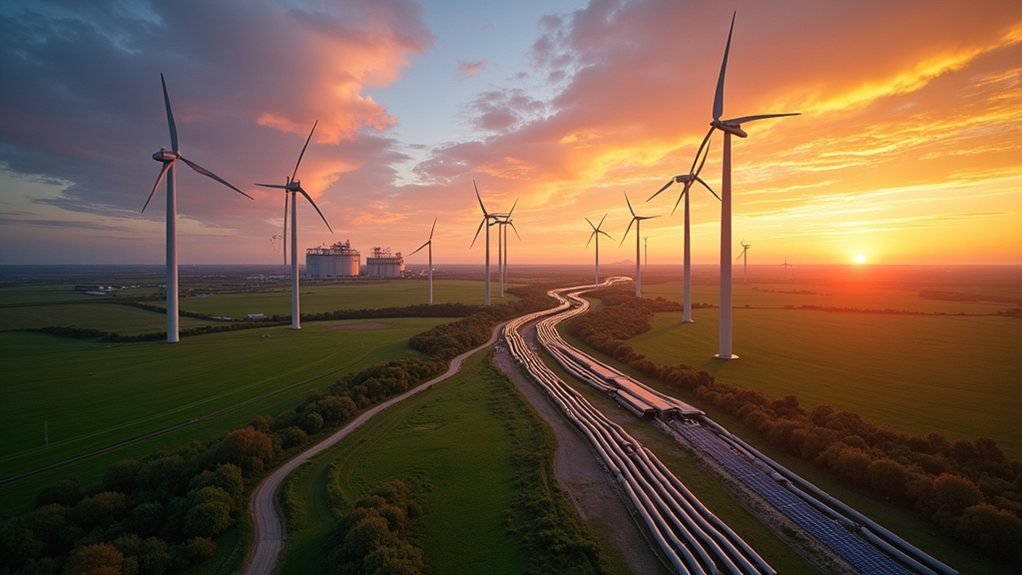

Europe’s sprint towards renewable energy is putting the brakes on North America’s gas export dreams. Their renewable charm offensive includes harnessing wind and sunlight, which are as abundant in their benefits as grandma’s cookies at Christmas. Meanwhile, North America grapples with pipeline headaches and bureaucratic snags, like a kid stuck in a molasses mudpie. While Europe dances to a green tune, North America is learning the two-step of logistic twists. Stay tuned—there’s more to this energy ballet.
Quick Overview
- Europe’s shift to renewables reduces its demand for imported North American LNG.
- Diversification strategies in Europe lessen reliance on North American gas exports.
- Increased European LNG infrastructure may not significantly boost North American export capacity.
- Regulatory challenges in North America delay LNG terminal development, affecting supply alignment.
- Europe’s renewable growth offers more competitive energy solutions, impacting North American gas demand.
How Europe’s Renewable Energy Push Reshapes Gas Imports
While Europe’s fascination with renewable energy might seem a bit like asking your favorite old-school rock band to change its genre to pop, the reality is a slick transformation that reshapes gas imports with the finesse of a maestro. With renewables composing over 46.9% of EU electricity by 2024, Europe’s solar and wind upsurge effectively trims their fossil gas appetite. Imagine wind turbines swooping in like superheroes, cutting European gas demand by 20%. As these renewable champions power households continent-wide, the natural gas market shrinks, nudging Europe’s ambitious goal of a 90% emission reduction by 2040 closer, without missing a beat. Solar energy alone offers the added advantage of reduced electricity costs for consumers over time, as sunlight remains free and maintenance expenses for panels continue to decline. Despite the concerns regarding EU energy security, the push towards renewables serves as a strategic pivot away from overreliance on any single supplier. Europe’s clean energy transition not only strengthens its energy security, reducing exposure to global energy shocks, but also diminishes the EU’s reliance on imported fossil fuels.
Europe’s Strategic Energy Moves: Diversifying Supplies
Europe’s ongoing drive to diversify its energy supplies is much akin to a strategic chess match, where every move is meant to outmaneuver potential pitfalls and fortify its energy security. The EU’s REPowerEU plan sheds Russian gas like a snake’s old skin, embracing alternative suppliers with a Mediterranean flair. Picture Southern Europe’s gas hub as a midnight rendezvous for resources from Algeria and beyond, a neighborhood barbecue of sorts. Political whispers with North African and Eastern Mediterranean allies guarantee a supply buffet. As natural gas infrastructure remains vital for energy diversification, despite indigenous production declines, substantial gas discoveries in Cyprus, Egypt, and Israel are crucial for European energy security. Europe is now the largest importer of LNG globally, showcasing its expanded power generation capabilities and dedication to securing diversified energy sources. Meanwhile, LNG terminals pop up like trendy cafes, with promising plans in the Baltic region reminding us that synchronization is key. Alongside these efforts, Europe has accelerated investment in solar and wind energy to reduce long-term dependence on fossil fuels and meet its ambitious climate targets.
North American Gas Export Hurdles
As Europe orchestrates its strategic energy maneuvers akin to a chess grandmaster, North America finds itself facing a different kind of game. Imagine a symphony of hurdles where infrastructure is the off-beat drummer in the band: pipeline delays jam up Gulf Coast LNG terminals, creating bottlenecks tighter than a skinny jeans convention. North American LNG export capacity is expected to double by 2030, indicating significant growth plans in the region. Permitting? It’s like waiting for a bus that never comes, thanks to policy red tape and courtroom drama worthy of a TV series. Add to this the great distance act where Marcellus sends gas to the Gulf, akin to sending postcards by pigeon. Domestic initiatives must ensure interconnected North American markets for price stability and trade accessibility. Regulatory hoops and regional misalignments only add to the choreography. Building supply chain resilience against climate-related disruptions and geopolitical trade shifts is increasingly essential for energy exporters navigating these compounding pressures. North America, meet your tangled tango.