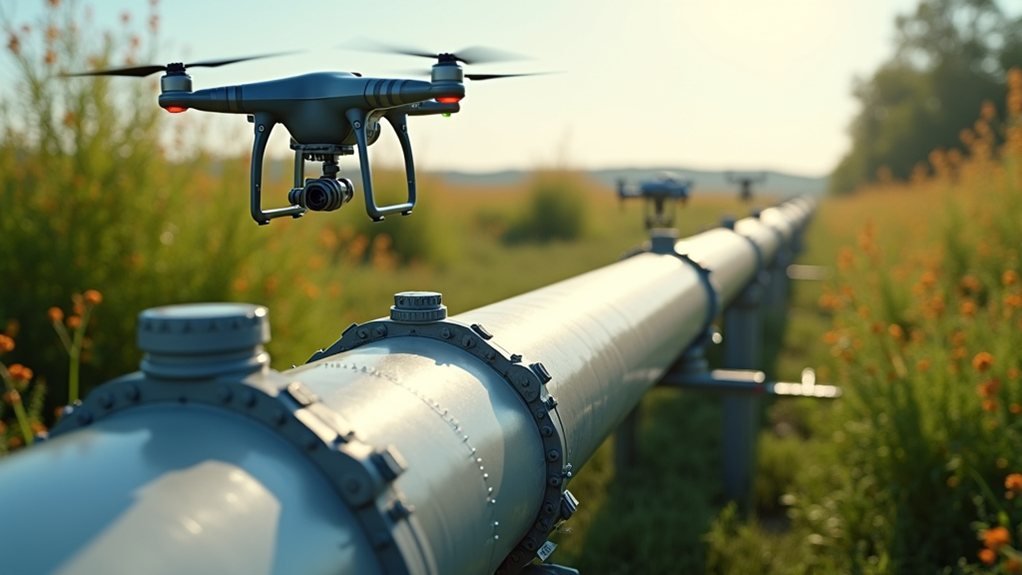

Tech integration in pipeline monitoring is like giving the oil and gas industry a high-tech magnifying glass. Imagine drones swooping over pipelines, using fancy tools like TDLAS and Laser Falcons to spot methane leaks quicker than a cat pouncing on a laser dot. Meanwhile, AI and machine learning are the brainy pals helping to sort out the data, improving accuracy immensely. This combo promises smarter leak detection and could give Mother Nature the break she deserves. Curious about more magic tricks?
Quick Overview
- TDLAS technology detects methane levels as low as 1 ppm, enhancing leak detection capabilities.
- Drone-mounted Laser Falcons enable rapid methane monitoring across extensive pipeline networks.
- Integrated platforms provide real-time data, ensuring timely identification and resolution of leaks.
- Machine learning models improve accuracy in detecting methane emissions with advanced spectral analysis.
- Continuous monitoring supports proactive management and compliance with environmental regulations.
Detecting Methane Leaks: Innovative Sensors and Drone Technologies
Imagine trying to catch a whiff of methane in an open field—it’s like playing hide and seek with your nose blindfolded. This dilemma is why innovative sensors and drones are game changers in methane detection. Tunable Diode Laser Absorption Spectroscopy (TDLAS) flaunts a spectacular sensitivity, like having eagle eyes for gas, spotting as little as 1 ppm. Meanwhile, drone-mounted Laser Falcons soar over pipelines, reading methane levels faster than you can finish a bag of popcorn. The oil and gas industry, as the largest source of U.S. methane emissions, greatly benefits from these advancements, ensuring tighter control and compliance with environmental regulations. Efficient and rapid deployment in tough environments signifies a leap forward, ensuring each methane molecule gets caught in this high-tech vigil. These sensors rely on continuous data sampling to provide real-time readings that can be analyzed and acted upon before leaks escalate into larger environmental hazards. The Nubo Sphere offers a compact and high-performing solution for continuous methane emissions monitoring, which makes it particularly valuable for industries like oil and gas that require reliable and comprehensive emissions management.
Enhancing Leak Detection With Imaging and Machine Learning
To enhance leak detection, one must dive headfirst into the world of imaging and machine learning techniques—a veritable rabbit hole worth exploring. With thermography hitting a homerun at 100% accuracy and deep learning tackling tricky spectral signatures, these technologies are redefining pipeline surveillance. Imagine machine learning models acting like super-sleuths in trench coats, promising AI insights and impressive accuracy rates—like achieving 99.79% with XGBoost and a respectable 88.19% with 1D-CNNs. Satellite images even become pipeline detectives, thanks to random forest models. Despite these advancements, challenges remain, as the limited availability of high-resolution imagery can impede accurate leak detection. These advancements, akin to revealing a new level in a video game, transform leak detection into an art form. Integrating trees and vegetation buffers alongside pipeline corridors can support soil stabilization and erosion control, reducing ground movement that may stress pipeline infrastructure over time. Water leakage poses significant economic, social, and environmental concerns, underscoring the critical necessity for innovative detection methods.
Simplifying Compliance With Integrated Monitoring Platforms
In the evolving landscape of pipeline monitoring, compliance can often feel like steering through a labyrinth, but integrated monitoring platforms are here to play the hero. Imagine software that wraps its arms around every regulation like a well-fitted suit, turning tedious tasks into smooth sailing. These platforms streamline data collection, analysis, and reporting, alleviating the headache of deciphering endless regulatory texts. By centralizing information, companies maneuver through compliance checks like a nimble gymnast. Furthermore, these platforms ensure continuous monitoring, providing real-time compliance assurance vital for avoiding non-compliance issues. Unlike the drama of a missed penalty kick, these systems guarantee nothing slips through the cracks, achieving compliance with the finesse usually reserved for ballet dancers. This approach reflects the principles of systems thinking, recognizing that pipeline monitoring exists within an interconnected web of environmental, operational, and regulatory components that must be managed holistically. With tools that feature AI-driven alerts and continuous monitoring, companies can swiftly identify and address anomalies, ensuring proactive compliance management.