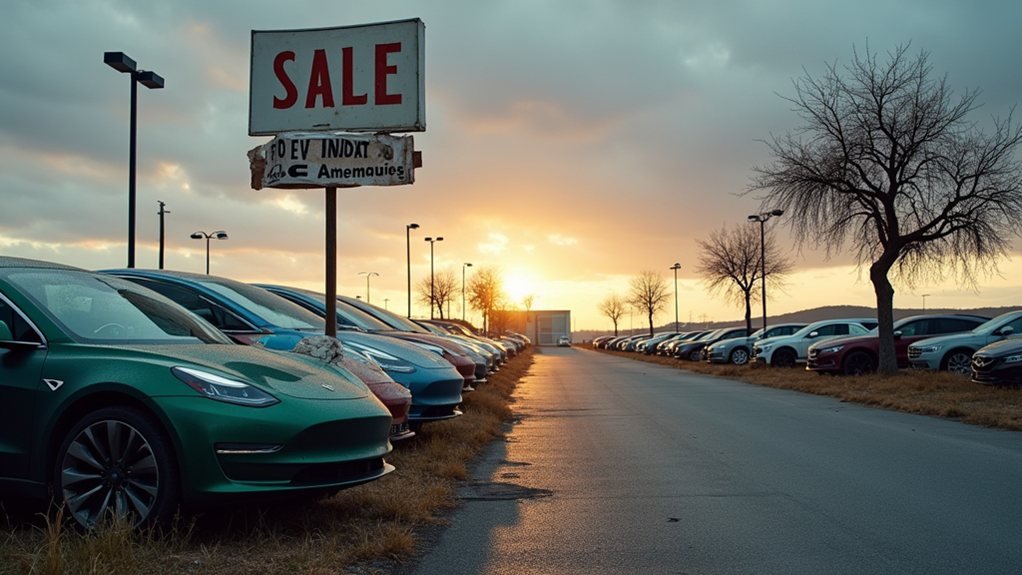

Canada’s electric vehicle (EV) incentive program has hit a wall after running out of funds, leaving future buyers in a bit of a pickle. This sudden end has already led to a slump in EV sales, plummeting from 13.9% to a meager 5.4%. Quebec, in particular, saw over half its sales vanish! The good news? Talks are brewing about potentially reviving the program, which might just get the EV party started again. Stick around to see what’s cooking next!
Quick Overview
- Canada’s federal iZEV Program, offering up to $5,000 for EVs, faced fund depletion by 2025, halting new incentives.
- Post-incentive, EV sales dropped significantly from 13.9% to 5.4%, especially in provinces like Quebec.
- Economic uncertainty and reduced consumer confidence have shifted interest towards hybrid vehicles.
- The government is considering reinstating the iZEV program with proposed funding between $900 million to $1.7 billion.
- Continued investment in EV infrastructure and incentives is vital for meeting climate goals and promoting renewable energy use.
What Happened to Canada’s EV Incentives?
As Canada rolled out its electric vehicle (EV) incentives, one might have imagined a scene straight out of a motivational movie—think of the underdog charging ahead against the odds.
Launched in 2019, the federal iZEV Program promised up to $5,000 for battery-electric vehicles (BEVs) and shorter-range hybrids. Provinces joined the party, offering their own rebates, creating a veritable buffet of incentives. However, by 2025, funds ran dry, leaving many potential buyers in the lurch. It was a classic case of “too good to last,” leaving Canadians wondering what happened to their electric dreams amid the dwindling dollars. As a result of the incentive programs, over 546,000 ZEV sales nationwide were attributed to these efforts. The need for zero emissions vehicles has never been more critical, as the transportation sector contributes significantly to Canada’s greenhouse gas emissions. This highlights the broader need to accelerate the transition to renewable energy to reduce reliance on fossil fuels.
Impact of Incentive Program End on EV Sales
With the end of Canada’s electric vehicle (EV) incentives, a sudden shift in the market landscape became inevitable, leaving many potential buyers feeling like they were left out in the cold without a jacket. Sales of zero-emission vehicles plummeted from 13.9% to just 5.4% in mere months. In Quebec, the recent cuts to incentives slashed EV sales by over 50%. As the federal ZEV mandate requires 20% of new light-duty vehicle sales to be ZEVs by 2026, the pressure on automakers to adapt is intensifying. Additionally, the steady growth in Canada’s ZEV market share observed in recent years has made this downturn particularly concerning. With economic uncertainty and dwindling consumer confidence, even hybrid vehicles surged in popularity. As automakers grapple with regulatory challenges and a shrinking market, the future of EV sales hangs precariously in the balance, reminiscent of a rollercoaster ride with no safety bar. Analysts note that this shift contrasts with recent IEA projections forecasting continued global EV uptake.
Reinstating EV Incentives: What’s Next?
While the fate of Canada’s electric vehicle (EV) incentives remains uncertain, the government is clearly revving up to reinstate the iZEV program, a move that has the potential to ignite the EV market once again. Industry Minister Mélanie Joly has made it a top priority, aiming for lower prices for Canadians. However, Tesla’s inclusion hangs in the balance due to U.S. tariffs. With no timeline yet, the excitement is tempered by uncertainty. Proposed funding suggestions range from $900 million to $1.7 billion, as provinces like Quebec take action. The revival of the iZEV program is expected to provide significant support for electric vehicle adoption. The iZEV program previously facilitated the purchase of 560,000 electric and plug-in hybrid vehicles. The wheels are in motion, but the road ahead is still hazy. Transitioning to electric vehicles is complemented by solar and wind power, which can lower lifecycle emissions when charging.