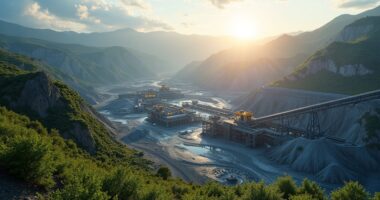
A startling 20% of Canadian mining projects are skirting the essential Environmental Impact Assessment (EIA) data, leaving a notable gap in transparency that raises eyebrows. It’s like trying to bake a cake without knowing the recipe—things could go wrong! This lack of information can muddle predictions about environmental impacts, making decision-making a game of chance. For those curious about improving transparency and responsible mining practices, there’s a lot more to explore and understand!
Quick Overview
- 20% of Canadian mining project files lack essential Environmental Impact Assessment (EIA) information, undermining regulatory transparency and public trust.
- The gaps in EIA data span 13 jurisdictions and affect various commodities, highlighting systemic oversight failures.
- Incomplete data clouds environmental impact predictions, making decision-making uncertain and unreliable for stakeholders.
- Legal mandates for transparency in environmental assessments are not being met, limiting societal cooperation on industrial developments.
- Strategies to enhance transparency include mandatory EAs for private ventures and robust public registries to address information gaps.
The Hidden Impact of EIA Data Gaps in Canadian Mining
Although one might assume that the impact assessments for Canadian mining projects are as thorough as a well-cooked poutine, the reality is quite different—especially when it comes to the hidden gaps in Environmental Impact Assessment (EIA) data.
Researchers from Dalhousie University unearthed a striking 20% of project files lacking essential information, despite legal mandates for transparency. This inconsistency spans 13 jurisdictions and includes a variety of commodities. Furthermore, the database compiled by Dalhousie researchers covers 266 impact assessments for mining and quarrying projects from 1974 to 2023. Additionally, the comprehensive environmental regulatory framework in Canada is meant to enforce stringent standards, yet these gaps indicate a failure in oversight.
With federal and provincial assessments often at odds—like a miscommunication between two friends—it highlights a fragmented system. These gaps may constitute violations of compliance requirements established under major environmental protection laws. The result? Critical information slips through the cracks, jeopardizing informed decision-making in mining operations.
Consequences of EIA Data Gaps
When it comes to the consequences of data gaps in Environmental Impact Assessments (EIA) for Canadian mining projects, the stakes are as high as a mountain of unmined gold. Incomplete data clouds predictions of environmental impacts, leaving regulators fumbling in the dark. With 60% of paired assessments showing discrepancies, decision-making becomes a game of chance rather than informed judgment. Moreover, the first-ever national database tracking these assessments reveals that 20% of projects have incomplete or unavailable assessment information. This patchwork of inconsistencies not only raises eyebrows but also limits societal cooperation on industrial developments. Early evaluation of environmental effects is crucial for preventing costly damages before projects begin implementation. As transparency wanes, so does public trust, making it harder for Canada to shine as a beacon of responsible mining in a world craving clean energy solutions. The urgency to assess Sámi land rights in mining contexts underscores the need for better data integration.
How Can We Boost Transparency in Mining Projects?
How can transparency in mining projects become as clear as a mountain stream? To boost clarity, mandatory Environmental Assessments (EAs) for private mining ventures are essential. Establishing robust public registries, like those in British Columbia, can bridge transparency gaps. Incorporating Free, Prior, Informed Consent (FPIC) for Indigenous communities will guarantee all voices are heard. Additionally, creating guidelines for public disclosure of EA decisions can demystify the process. Finally, separating mining promotion from regulation will eliminate conflicts of interest, paving the way for responsible practices. The lack of mandatory EAs in Ontario highlights the urgent need for reform in assessing mining projects. Implementing site rehabilitation protocols ensures mining companies restore ecosystems to their natural state after operations conclude. Moreover, Canada acts as a global leader in the mining industry, setting a precedent for transparency and accountability that other regions should follow.