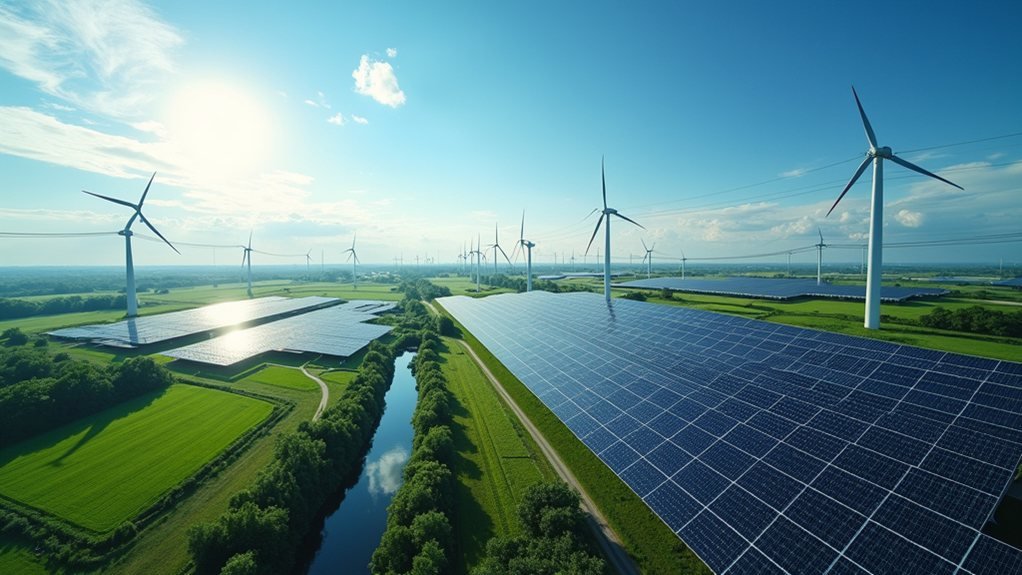

The new federal law sets ambitious goals for a net-zero electricity grid by 2035, aiming for 100% carbon pollution-free energy. Utilities will ramp up low-emission sources including renewables and nuclear, while fossil fuels will need a carbon-capturing sidekick. This shift isn’t just about clean air; it’s expected to create millions of jobs and save families billions on electricity bills. So, buckle up—there’s plenty more intriguing information about this electric revolution ahead!
Quick Overview
- The federal mandate aims for a net-zero carbon pollution-free electricity grid by 2035, requiring significant clean energy capacity increases.
- Utilities must enhance their share of low-emission resources, including renewables, nuclear, and fossil fuels with carbon capture.
- The initiative is projected to create millions of jobs, with 500,000 new positions anticipated by 2035 in the clean energy sector.
- To meet 2035 goals, annual clean capacity must reach 70–125 GW, emphasizing wind, solar, and advanced storage technologies.
- Challenges include recent renewable permitting pauses and the need for streamlined processes to support rapid clean energy deployment.
Federal Clean Electricity Standard Goals
As the world grapples with climate change, the United States is setting its sights on ambitious goals for clean electricity, and it’s not just a lofty dream; it’s backed by serious federal resolve.
The federal Clean Electricity Standard (CES) aims for 100% carbon pollution-free electricity by 2035, with mandatory requirements for utilities to increase their share of low-emission resources.
The Clean Electricity Standard mandates utilities to achieve 100% carbon-free electricity by 2035, boosting low-emission resources along the way.
Think of it as a gym membership for power plants—they’re required to step up their game! This framework, combining renewables, nuclear, and even fossil fuels with carbon capture, is designed to cut greenhouse gas emissions considerably and align with state initiatives, ensuring a wider range of clean energy technologies for a cleaner energy future. The transition to these sustainable alternatives represents a crucial step toward reducing our carbon footprint while meeting growing energy demands. By setting aggregate targets for clean electricity sales, the CES fosters competition and innovation among various low-carbon resources.
Economic Benefits and Job Growth
While the shift to clean electricity may seem like a lofty goal, it is quickly becoming a powerhouse for economic benefits and job growth across the nation.
The Clean Electricity Payment Program is set to create millions of good-paying jobs, with projections of 500,000 new positions by 2035. This change not only shields consumers from fossil fuel price swings but also slashes electricity costs, saving families billions. Additionally, the transition to zero-carbon sources is projected to reach only 55% by 2035 without new policies, highlighting the urgent need for robust federal action.
Plus, with over $450 billion in private investments, the clean energy sector is buzzing like a well-oiled machine. Those interested in joining this growing workforce can explore numerous sustainability careers in renewable energy, conservation, and circular economy fields.
In short, clean electricity is not just good for the planet; it’s a boon for the economy too!
Technology and Policy Framework for Clean Energy
Steering through the intricacies of clean energy technology and policy feels a bit like trying to solve a Rubik’s Cube while riding a roller coaster—exciting yet complex.
The federal mandate aims for a net-zero grid by 2035, pushing for a whopping 70–125 GW of clean capacity annually. Wind, solar, and advanced storage technologies are the stars of this show, while fossil-fuel emissions will face stricter regulations. To keep the lights on, innovations in low-carbon resources are essential. With market reforms and streamlined permitting, the path to a cleaner grid is set, albeit with a few thrilling twists and turns ahead. Additionally, the recent pause in renewable permitting by the U.S. Army Corps of Engineers adds another layer of uncertainty for project timelines. Moreover, to meet these ambitious goals, transmission capacity must double within regions and increase four-fold between regions by 2035. Implementing these renewable energy sources offers significant environmental benefits while reducing dependence on finite fossil fuel resources.