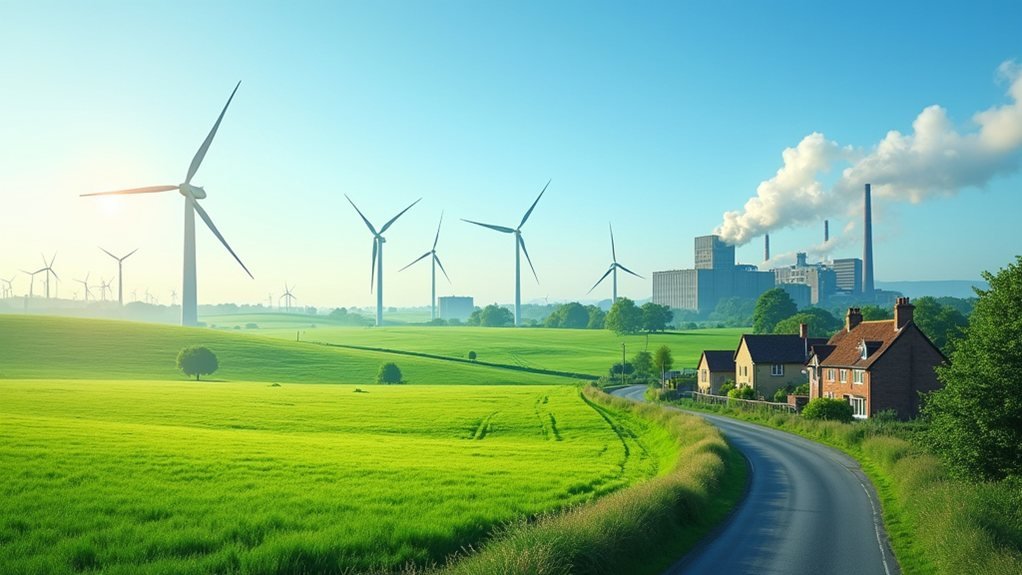

The UK’s emissions are on the decline, led by leaps in the power and industrial sectors, while the home and aviation sectors seem to be stuck in neutral. Currently, power sources like renewables and nuclear are like the star players in a championship game, contributing substantially to the country’s carbon reduction targets. However, with residential emissions lagging and aviation still burning up carbon, there’s a noticeable gap in the game plan. Discover how these trends influence future goals.
Quick Overview
- UK greenhouse gas emissions are projected to be 54.2% below 1990 levels by 2024, primarily driven by the power sector’s decarbonisation.
- Renewable and nuclear sources now supply 73.8% of Great Britain’s electricity, with wind energy contributing 26% in August 2025.
- Residential buildings account for about 18% of total emissions, with stagnation in household decarbonisation and only 1% adoption of heat pumps.
- The aviation sector’s emissions continue to rise, posing a threat to the UK’s climate goals despite overall progress in other sectors.
- Significant policy gaps in electricity pricing and EV infrastructure hinder the achievement of the legally binding net zero goal by 2050.
Decarbonisation Achievements in Power and Industry
The UK’s journey toward decarbonisation in power and industry is like watching a thrilling race where the finish line keeps moving, but the runners are getting faster every year.
By 2024, greenhouse gas emissions plummeted to 54.2% below 1990 levels, largely thanks to a massive shift to clean electricity.
Imagine this: 73.8% of Great Britain’s power now comes from renewables and nuclear, with wind and solar outpacing gas for the first time. In August 2025, wind supplied 26% of electricity, highlighting its enduring leadership despite a decline from previous years.
As coal plants close, the UK aims for a fully decarbonised power sector by 2030.
The global push toward renewable energy landscape continues to influence the UK’s decarbonization strategy, despite geopolitical challenges affecting implementation timelines.
Additionally, the 2025 edition of GHG conversion factors reflects ongoing shifts in energy sources.
It’s a race against time, and the runners are sprinting ahead!
Challenges in Residential Emissions and Aviation
As the UK celebrates its victories in decarbonising power and industry, a more complicated challenge looms over residential emissions and aviation, two sectors where progress has faltered.
Residential buildings contribute about 18% of emissions, yet household decarbonisation remains stagnant. With 1.77 tonnes CO2e per head of emissions in Q1 2025, the shift to heat pumps is painfully slow—only 1% adoption so far! Meanwhile, aviation struggles with its own emissions, as flying remains a popular pastime. Without decisive action, these sectors risk undermining the UK’s broader climate goals, reminding us that not all heroes wear capes—some are just trying to stay warm. Implementing passive design strategies could significantly reduce household energy needs without requiring major technological investments. Furthermore, the UK’s 68% emissions reduction target by 2030 emphasizes the urgent need for improvements in these challenging areas.
Future Targets and Policy Gaps in the UK
What will it take for the UK to bridge the widening gap between ambitious climate targets and the reality of policy delivery?
With legally binding goals like net zero by 2050 and a 68% emissions cut by 2030, the stakes are high. Yet, over 80% of emissions reductions must come from lagging sectors like transport and buildings. The Clean Power 2030 Action Plan demands a rapid uptick in renewable energy, but policy gaps remain—think of electricity pricing and infrastructure for electric vehicles. Significant gaps between targets and policy trajectories highlight the urgency for comprehensive action. Bridging these gaps is essential; otherwise, these targets may be as elusive as a unicorn at a corporate retreat! To meet these goals, a global reduction of 60% cut in emissions by 2035 from 2019 levels is necessary.