A recently unearthed report suggests the government kept essential climate security risks under wraps. The findings indicate that our food systems, fragile ecosystems, and potential migrations are on the brink of chaos. As ecosystems collapse and food prices soar, the prospect of political upheaval and mass migrations looms large. If you think this sounds like a blockbuster movie plot, guess again; it’s real life. Stick around to discover how these threats could shake things up even more.
Quick Overview
- A recently suppressed report reveals imminent climate risks threatening national security, including food system collapse and ecosystem degradation.
- The report highlights potential mass migration and geopolitical tensions stemming from resource scarcity and climate-induced disasters.
- Rising food prices and political instability are predicted as climate change exacerbates food insecurity among low-income families.
- Urgent ecosystem restoration and sustainable practices are essential to mitigate the compounded risks outlined in the report.
- The government’s concealment of these risks raises concerns about transparency and preparedness for climate-related challenges.
What Did the Blocked Report Reveal About Climate Risks to You?
As the veil was slowly lifted from a report that had been kept under wraps, it became clear that climate risks are not just distant threats; they are looming realities, much like that one friend who always shows up uninvited. The report hinted at a potential food system collapse, with Britain’s heavy reliance on imports leaving it vulnerable. Deforestation and drying rivers could trigger migration and political upheaval. The findings revealed that multiple ecosystem collapses could lead to dire implications for national security. With escalating tensions among nations, eco-terrorism surging, and critical ecosystems at risk, the message was clear: without action, the future could resemble a chaotic buffet where everyone fights over the last slice of bread. Protecting species diversity and restoring habitats through ecosystem restoration efforts are essential to reduce these compounded risks. The government warned that ecosystem loss could lead to increased conflict and mass migration, further amplifying the urgency for decisive measures.
Major Climate Security Risks Identified in the Report
The unsealed report paints a stark picture of the climate security risks that loom on the horizon, and it’s not just a passing storm cloud.
Global ecosystem degradation threatens the UK’s prosperity, with critical ecosystems collapsing and triggering water insecurity and reduced crop yields. Sustainable food practices can help reduce pressure on vulnerable ecosystems by lowering demand for intensive agricultural inputs.
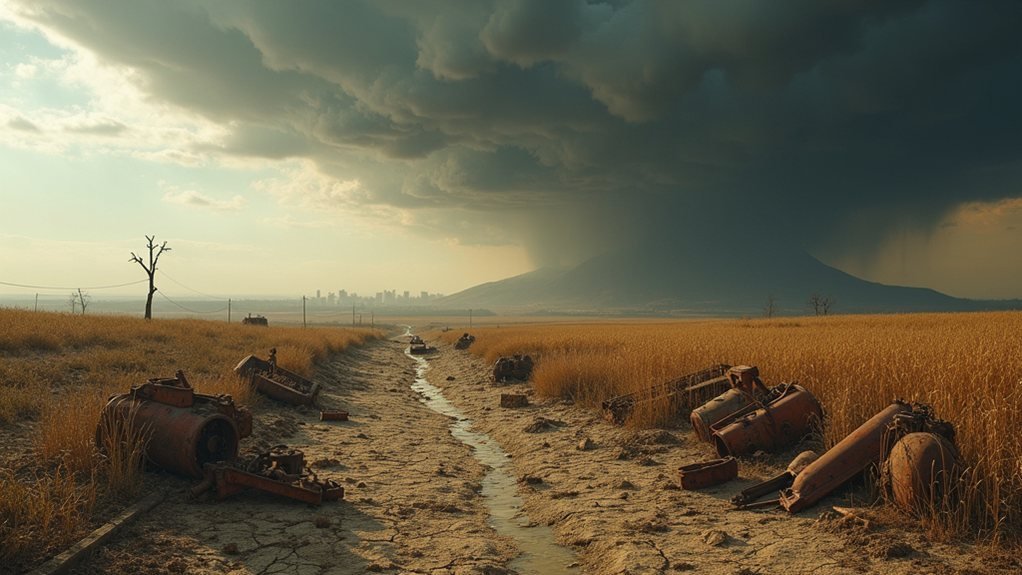
Imagine a world where arable land shrinks, and fisheries vanish—sounds like a dystopian novel, right? But it’s real.
The report warns of potential mass migration and geopolitical tensions, especially between nuclear powers. Ecosystem collapse is highlighted as a direct threat to national and international stability.
The looming threat of mass migration and escalating geopolitical tensions could ignite conflict among nuclear powers.
As countries scramble for dwindling resources, the UK could face political polarization and soaring food prices.
It’s a recipe for chaos, not just a stormy forecast.
How Will Climate Security Risks Impact Food Security and Migration?
Rising temperatures and extreme weather are like uninvited guests crashing a dinner party—disrupting food production and driving prices up. Crop yields for staples like maize and wheat are already suffering, especially in vulnerable regions. As prices climb, low-income families could find themselves scavenging for scraps, while the threat of hunger pushes millions to relocate. With farmland turning to dust and supply chains cracking under pressure, the world may soon resemble a dystopian novel where food security is a luxury and migration becomes a desperate quest for survival. In the past decade, over 1.7 billion people have been affected by climate-related disasters, highlighting the urgent need for action to mitigate these impacts. As food systems contribute approximately one-quarter of all human-caused heat-trapping pollution, the connection between climate change and food price inflation becomes increasingly clear. Practical measures across the supply chain can reduce losses and ease pressure on food availability, such as improving storage and distribution to prevent food waste.