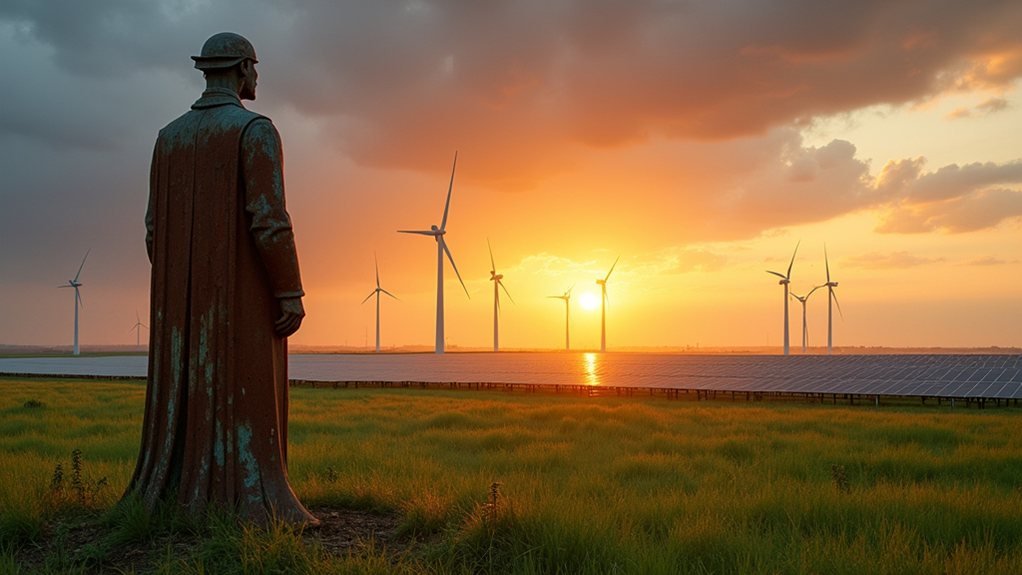

China’s green energy revolution is leaving the U.S. in the dust, thanks in part to Trump-era climate policies that cooled the renewable sector. With a staggering 3.79 billion kW in renewable capacity and a virtual monopoly on solar components, China is like the “cool kid” at the energy playground. Meanwhile, U.S. EV sales have stumbled and public support for renewables has dipped. Curious about the ripple effects on U.S.-China climate dynamics? Let’s unpack this further!
Quick Overview
- Trump’s climate policies have stifled renewable energy growth in the U.S., contrasting China’s rapid advancements in green energy.
- A pause on new wind and solar permits has hindered the U.S. from keeping pace with China’s renewable capacity expansion.
- The elimination of electric vehicle subsidies in the U.S. has led to a decrease in EV sales, while China continues to lead in production.
- China’s dominance in clean energy exports positions it advantageously, while the U.S. risks falling behind due to current policy challenges.
- Collaboration between public and private sectors is essential for the U.S. to regain momentum in the green energy sector.
How China’s Green Energy Advances Leave US Policies Behind
As the sun rises over the global energy landscape, it becomes increasingly clear that China is sprinting ahead in the green energy race, leaving U.S. policies in its wake like a tortoise trying to catch a cheetah.
By November 2025, China’s renewable capacity surged to 3.79 billion kW, with solar alone jumping 41.9%. China produces 90% of global PV polysilicon, wafers, and cells, which positions it as a leader in solar technology and innovation. With its non-hydro renewable energy share in total energy generation reaching 18% in 2024, the nation aims for 1,200 GW of wind and solar by 2030.
By November 2025, China’s renewable energy capacity soared to 3.79 billion kW, with solar power skyrocketing by 41.9%.
Meanwhile, the U.S. finds itself lagging, missing the chance to harness the momentum of technological innovations and investment that could reshape its own energy future. Many countries are turning to renewable energy as a long-term strategy for sustainable growth and energy security.
What Are the Effects of Trump’s Climate Policies on US Renewable Energy?
Trump’s climate policies have sent shockwaves through the renewable energy landscape in the United States, leaving many to wonder if the country is taking a step back in the race against climate change.
The pause on new wind and solar permits, coupled with the elimination of electric vehicle subsidies, has created a chilling effect. It’s as if the government decided to hit the brakes on a speeding eco-friendly train. Furthermore, U.S. EV sales decreased by 4% in 2025, highlighting the negative impact of these policies on electric vehicle adoption. Additionally, the U.S. withdrawal from the Paris Agreement has further isolated the nation from global climate commitments, intensifying concerns about the future of clean energy initiatives.
With declining public support for renewable energy and a renewed focus on fossil fuels, the future of clean energy appears dimmer, leaving many to question whether the U.S. can keep pace with global green initiatives. Businesses seeking to align with global priorities are increasingly looking to measure their contributions against the Sustainable Development Goals.
Future of US-China Climate Relations in Renewable Energy
While many might view the future of US-China climate relations in renewable energy as a tug-of-war between two giants, it’s more like a dance—albeit one where both partners occasionally step on each other’s toes. China, with its booming clean energy exports and unparalleled solar capacity of 1,200 GW, is leading the waltz. Meanwhile, the US, caught in a protective embrace, risks falling behind as it implements policies fostering domestic manufacturing. As China capitalizes on global markets, the US faces a “subsidy cliff.” Furthermore, global carbon pollution increased by about 1% in 2025, indicating that the competition in clean energy is more pressing than ever. Both nations will need to scale up renewable deployment to meet growing demand and cut emissions. The dance continues, but who will ultimately lead? Only time—and a few more missteps—will tell.