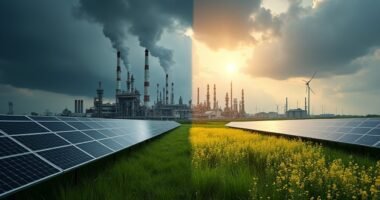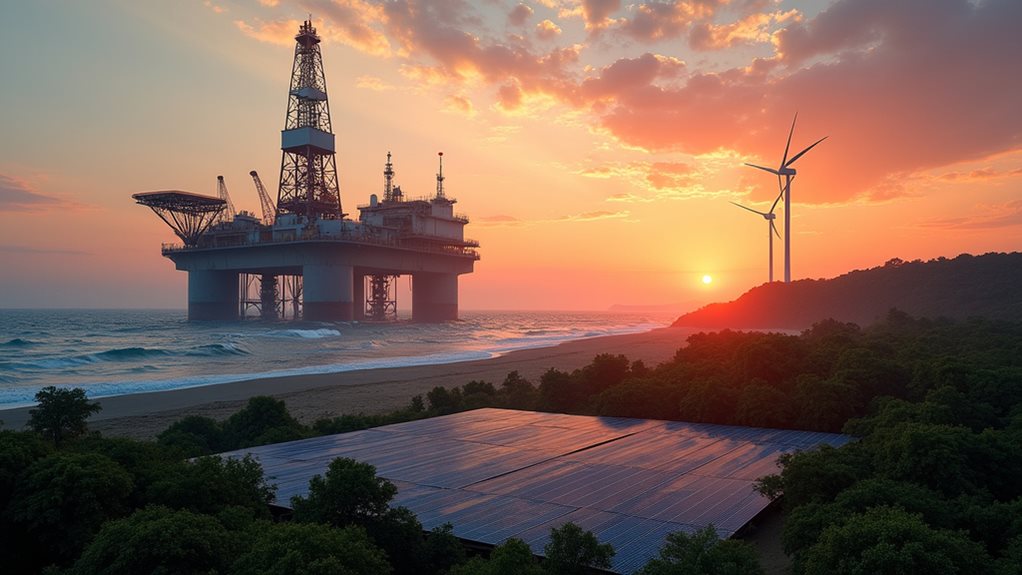

The upstream oil and gas industry stands at a crossroads, where adapting to decarbonization isn’t just smart—it’s essential. With methane emissions hitting hard and regulations shifting like a kaleidoscope, companies must innovate or risk extinction. Electric operations, carbon capture tech, and smart monitoring can keep them afloat. Investors are already judging companies on emissions performance, so it’s high noon for eco-friendly strategies. Buckle up; there’s a lot more to uncover about this transformation ahead!
Navigating the Path to Decarbonization
How do oil and gas companies navigate the complex labyrinth of decarbonization while keeping their operations afloat? The pressure is on, and it’s not just the weight of the oil rigs. With global climate goals demanding a staggering 50% reduction in emissions intensity by 2030, these companies find themselves at a crossroads.
Methane emissions, that sneaky little culprit accounting for 80% of greenhouse gases in their sector, are the proverbial monkey on their back. Tackling methane is urgent, but detection technologies still lag behind, leaving companies floundering like fish out of water.
Then there are the elusive Scope 3 emissions, which come into play when the end product is used. Controlling these emissions feels like trying to herd cats—nearly impossible. The path to decarbonization is littered with potential stranded assets and a challenging $600 billion price tag to halve operational emissions intensity. With inconsistent global regulations, the road ahead is anything but smooth.
However, hope is not lost. Companies are electrifying operations, with Norway leading the charge by electrifying 60% of its oil and gas production. Imagine flipping a switch and watching emissions drop! Furthermore, the International Energy Agency estimates that Oil provided 30% of global energy supplies in 2020, highlighting the industry’s significant role in the energy landscape. Managing distributed renewable energy is crucial for these companies to adapt their operations effectively.
Advanced monitoring technologies are also stepping up to minimize methane leakage and gas flaring. Meanwhile, renewable energy is becoming the new best friend, replacing gas turbines with solar and wind power.
Carbon capture and utilization technologies are set to grow, offering a glimmer of light in this dimly lit tunnel. Many companies are now investigating forest management as a natural carbon sink to complement their technological carbon capture strategies. And let’s not forget about the digital revolution; AI and IoT sensors are enhancing process optimization and emissions tracking.
With investors increasingly rewarding companies for strong emissions performance, adapting to low-carbon products like hydrogen is not just an option—it’s a necessity. The shift is challenging, but for the oil and gas sector, it might just be the ticket to remaining relevant in a rapidly changing world.