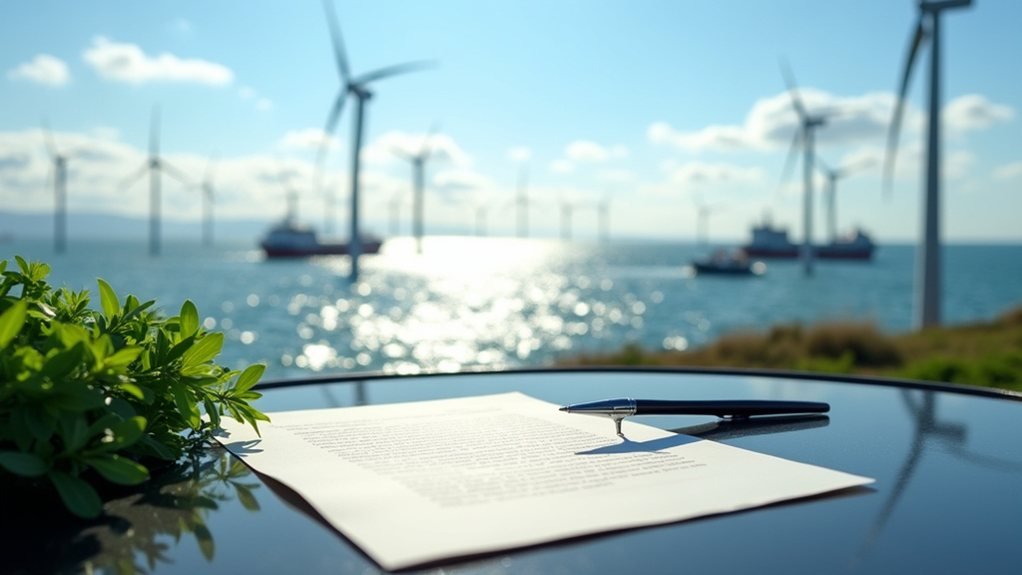

The North Sea Power Hub Declaration has been signed, making waves in the offshore wind energy sector. This ambitious plan aims to develop up to 100 GW of offshore wind power by 2040, transforming the North Sea into Europe’s clean energy heavyweight. With interconnected grids and international partnerships, this initiative promises lower electricity costs and enhanced energy security. It’s like building a giant renewable energy team, where everyone wins! Curious about how this impacts hydrogen production? Keep exploring!
Quick Overview
- The North Sea Power Hub aims to develop up to 100 GW of offshore wind capacity by 2040, enhancing energy security in Europe.
- Declarations signed at the Hamburg Summit focus on coordinated planning for cross-border offshore projects to support the energy transition.
- Joint investment pacts are established to mobilize capital for innovative offshore wind and hydrogen projects across participating nations.
- Enhanced grid infrastructure and advanced technologies will improve efficiency and reduce costs while ensuring timely project planning and permitting.
- The initiative promotes international cooperation to accelerate decarbonization and reduce reliance on fossil fuels, ultimately lowering electricity prices.
Key Offshore Wind and Hydrogen Commitments From the Summit
At the recent North Sea Power Hub Summit, a bold vision for the future of clean energy took center stage, making waves that could ripple across the entire continent. Leaders committed to developing up to 100 GW of offshore wind projects by 2040, turning the North Sea into the world’s largest clean power hub. These hybrid wind projects, connecting multiple countries, promise to lower electricity prices and boost supply security. Additionally, the integration of offshore hydrogen production aligns with the EU’s strategy, aiding industrial decarbonization. International cooperation was emphasized as a crucial element for achieving these ambitious goals, underscoring the summit’s potential to be a game-changer for Europe’s energy landscape. Furthermore, the 100 gigawatts commitment represents a significant step towards securing energy sources for the future. The plan also highlights the potential for shared grid infrastructure to improve efficiency and reduce costs across participating nations.
How We’re Boosting Energy Security and Strengthening Infrastructure
Leaders across the North Sea are not just dreaming about a clean energy future; they’re making bold moves to secure it. By signing declarations at the Hamburg Summit, they’re laying the groundwork for a stronger energy infrastructure. This includes coordinated planning for cross-border offshore projects, aiming for a whopping 100 GW of offshore wind. With enhanced security measures, they’re protecting essential energy systems from pesky cyber threats. Think of it as installing a high-tech security system for the region’s energy flow. The North Sea Summit has emphasized the importance of collaboration to accelerate decarbonisation and reduce dependence on fossil fuel imports. This initiative is crucial as the North Sea is home to various natural resources that can support Europe’s energy transition. The agreement also highlights the need for integrated grid planning to connect renewable generation across borders and manage variability.
Key Goals of the North Sea Power Hub Initiative
The North Sea Power Hub Initiative is all about setting ambitious goals that promise to reshape the energy landscape of the region. This bold endeavor aims for 100 GW of offshore wind by 2040, contributing to one-third of 300 GW by 2050. With an interconnected grid and cross-border cooperation, it seeks to lower electricity prices while enhancing supply security. The plan also includes joint investment pacts to mobilize capital for innovative projects, ensuring timely planning and permitting. Ultimately, these goals align with sustainability efforts, supporting hydrogen production and reducing reliance on fossil fuels—because who doesn’t want cleaner energy and lower bills? Additionally, the initiative supports joint offshore wind projects that connect multiple countries, facilitating a more efficient clean electricity flow. This work will rely on advanced grid technologies to integrate large amounts of renewable generation into the system.