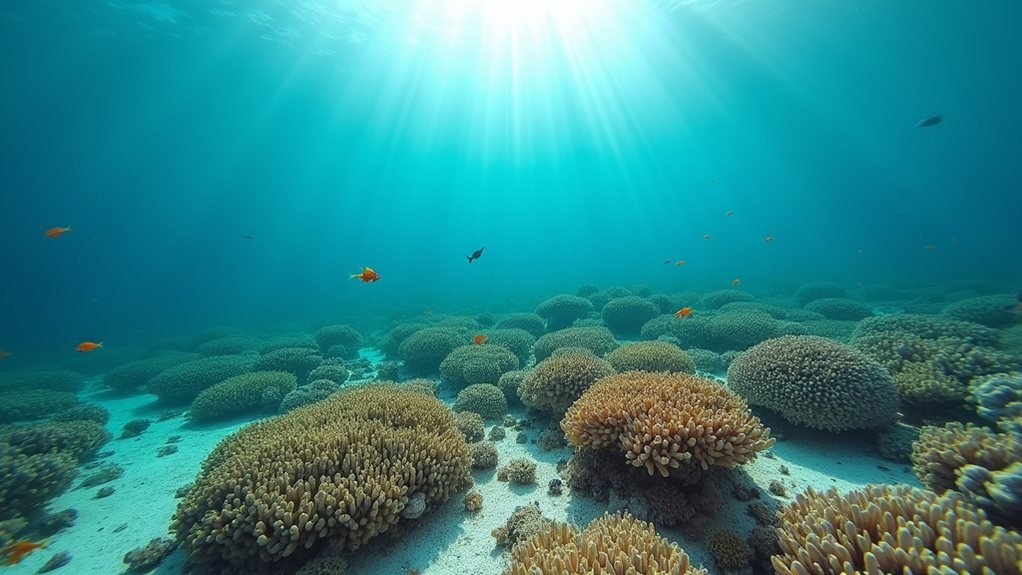

Florida’s 350-mile coral reef has been declared functionally extinct, a staggering outcome of a recent marine heat wave that cooked underwater habitats to a blistering 32.3°C. Nearly all coral colonies have bleached, leading to a drastic drop in biodiversity and threatening local fish populations. This degradation jeopardizes $8.5 billion in annual revenue tied to tourism and fisheries. The urgency for effective restoration efforts is palpable. Curious about how these efforts could turn the tide?
Quick Overview
- A marine heat wave in 2023 caused record temperatures, leading to widespread coral bleaching in Florida’s reefs.
- Nearly all staghorn and elkhorn corals are nearly extinct, jeopardizing the reef structure and associated marine life.
- Florida’s coral reefs contribute $8.5 billion annually and support over 70,000 jobs, highlighting their economic importance.
- Urgent restoration efforts and climate adaptation strategies are essential to mitigate further damage and restore coral health.
- Community involvement and global awareness are critical for successful conservation and combating climate change impacts on coral reefs.
The Alarming Impact of the 2023 Marine Heat Wave on Florida’s Coral Reefs
As the summer sun blazed down in 2023, a marine heat wave swept through Florida’s Coral Reef, turning the vibrant underwater paradise into a chilling scene reminiscent of a horror movie.
Temperatures soared to record highs, peaking at 32.3°C, leaving nearly all coral colonies bleached—a stark, ghostly white. Coral reefs in the Florida Keys generate $8.5 billion annually and support 70,400 jobs, underscoring the ecological and economic significance of these ecosystems. The alarming rise in temperatures has led to a 70-80% chance of continued above-average conditions until October 2023.
Temperatures reached a staggering 32.3°C, transforming vibrant coral colonies into haunting, ghostly white specters.
Imagine a party where every guest has left; that’s the reef now. With local extinctions looming and disease rates spiking, the once-thriving ecosystem faced severe degradation.
Scientists scrambled, relocating corals like precious artifacts, hoping to salvage what remained. The heat wave wasn’t just a summer fling; it was a catastrophic wake-up call. Emergency response efforts highlighted the urgency of rapid reef restoration and the need for robust climate adaptation strategies.
How Functional Extinction Affects Coral Reefs?
The chilling effects of functional extinction rippling through Florida’s Coral Reef paint a concerning picture for marine ecosystems.
With staghorn and elkhorn corals nearly wiped out, the reef’s natural architects are disappearing, leaving behind a flat landscape rather than a vibrant underwater city. This loss of structure spells trouble for fish populations, as their homes vanish like socks in a dryer. The functional extinction of these corals signifies a loss of ecosystem function that is critical for the health of the marine environment. Recent studies indicate that by March 2024, 97.8% to 100% mortality in coral colonies was observed in Florida Keys and Dry Tortugas, underscoring the urgency of the situation.
As biodiversity dwindles, ecosystem services falter—storm protection weakens and fisheries collapse. Fundamentally, Florida’s coral reefs are stuck in an extinction vortex, spiraling downwards, and leaving both marine life and coastal economies gasping for breath. Biodiversity loss can amplify vulnerability to climate shocks, compounding the impacts on reef resilience and coastal communities.
Future Restoration Efforts for Florida’s Coral Reefs
Write the entire MY ARTICLE SUBHEADING CONTENT word for word but follow these steps: