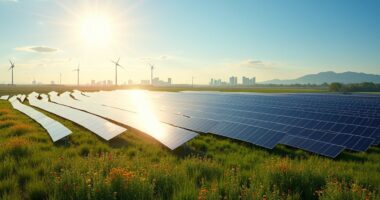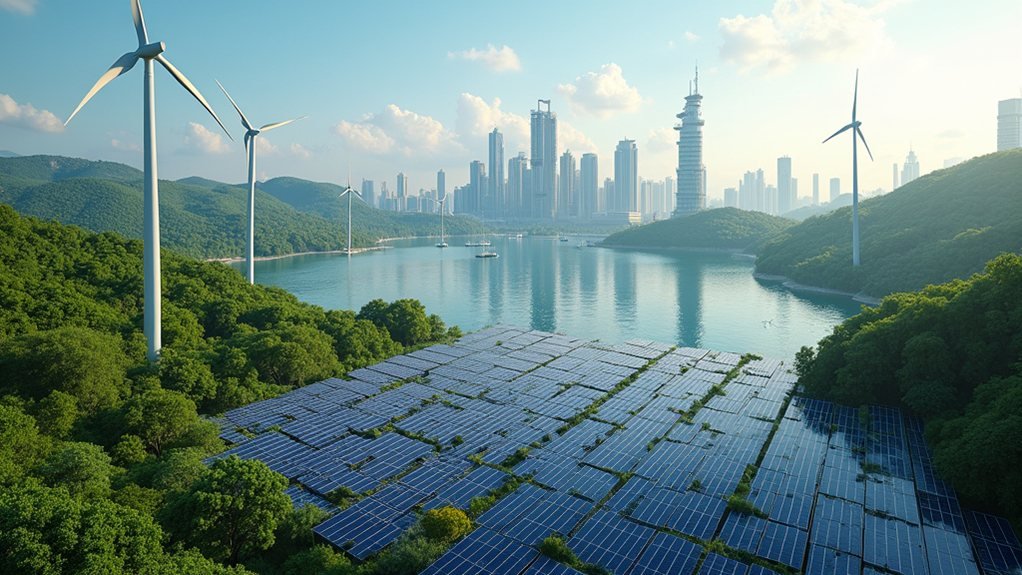

Global clean energy investment has soared to a staggering $2.3 trillion, fueled by political backing and market shifts. The U.S. Inflation Reduction Act alone sparked a 22% boost in investments, while regions like Asia Pacific lead with $800 billion. With electric transport and hydrogen technologies gaining traction, the energy landscape is rapidly evolving. It’s not just a number; it’s a move towards a sustainable future. Curious about the trends and policies behind this surge? There’s more to uncover!
Quick Overview
- Global clean energy investment reached a record $1.77 trillion in 2023, with projections hitting $2.3 trillion by 2025.
- The U.S. Inflation Reduction Act contributed to a 22% rise in clean energy investments.
- The Asia Pacific region leads with $800 billion in clean energy investment despite a decline in China’s renewable funding.
- The European Union increased clean energy investment by 18% to $455 billion, overcoming regulatory challenges.
- Emerging technologies like AI, hydrogen, and battery storage are driving efficiency and sustainability in the clean energy sector.
What’s Driving the $2.3 Trillion Surge in Clean Energy Investment?
In the ever-evolving landscape of clean energy, a remarkable surge of $2.3 trillion has gripped the attention of investors and policymakers alike. This financial frenzy is fueled by robust policies like the U.S. Inflation Reduction Act, boosting investments by 22%. Meanwhile, the European Union and Japan are rolling out plans that catalyze low-carbon initiatives. With electrified transport stealing the spotlight, hydrogen and energy storage investments are also skyrocketing. Global investment in clean energy reached $1.77 trillion in 2023, and it’s as if clean energy is the new rock star, outshining fossil fuels and drawing in enthusiastic investors, all while promising a greener future—like turning a high school science project into a billion-dollar idea! Electricity demand projected to rise significantly through 2050 further underscores the urgency and potential of this energy transition. Governments are also encouraging adoption through policy incentives that lower barriers and accelerate deployment.
Clean Energy Investment: Regional Contributions and Highlights
While the momentum of clean energy investment across various regions may seem like a whirlwind, it’s actually a carefully orchestrated dance of innovation and necessity.
The Asia Pacific leads, with China investing $800 billion, despite a rare dip in renewable funding. Meanwhile, India’s clean energy investment surged 15%, aligning with its ambitious grid upgrades. Notably, clean energy supply investment grew significantly, highlighting the shift towards sustainable sources. In addition, the overall clean energy investment in 2025 amounted to $2.3 trillion, reflecting a robust global commitment to sustainability. This surge is driven in part by rapid deployment of renewable technologies across multiple markets.
The European Union is not far behind, growing 18% to $455 billion, overcoming regulatory hurdles like a seasoned gymnast. The U.S. shows resilience, increasing investment 3.5% amid political pushback.
Other regions, like Latin America and Africa, lag behind, reminding us that the clean energy race has its uneven tracks.
Emerging Trends Shaping Future Clean Energy Investments
As the world grapples with the urgent need for cleaner energy solutions, a fascinating evolution is taking shape in the clean energy investment landscape. Emerging trends, like the surge in AI-driven demand, test grid limits while major tech firms scramble to meet net-zero commitments. Meanwhile, hydrogen and sustainable aviation fuel are rapidly expanding, with China leading the charge. Renewable technologies are increasingly being integrated into new energy systems, ensuring a more efficient response to rising electrification demands. The shift in supply chains is reshaping geopolitics, as nations diversify energy sources. Finally, advancements in battery storage promise to make renewable energy cheaper than fossil fuels. Investments in energy storage are critical for addressing challenges in grid management and backup generation costs. International commitments at climate conferences and projections from energy agencies are further accelerating investment flows into low-carbon projects, reflecting growing global policy support for clean energy.