
London’s mining finance scene is buzzing with regulations insisting on solid Environmental, Social, and Governance (ESG) practices. Think of it as needing a golden ticket to operate—clear climate impact disclosures and rigorous reporting are now non-negotiable. Companies must show that their ESG claims aren’t just hot air, but real, data-driven efforts. It’s like showing your homework to avoid detentions in class! Stick around, and there’s even more to uncover about the latest ESG trends in mining.
Quick Overview
- Compliance with IFRS S1 and S2 standards is essential for transparent climate impact disclosures in mining finance.
- The EU’s CSRD mandates rigorous ESG reporting, crucial for maintaining a license to operate in London’s mining sector.
- Community engagement is vital for fostering trust and avoiding conflicts, enhancing operational stability for mining firms.
- Sustainable practices, such as waste management and renewable energy use, are increasingly necessary for responsible mining operations.
- Technological innovations, like precision drilling and carbon capture, help mining companies meet regulatory requirements and improve their ESG performance.
Key Regulations Shaping ESG Mining Finance
As the world of mining increasingly intertwines with environmental, social, and governance (ESG) considerations, the regulations shaping this landscape are like the guiding stars in a sailor’s sky—absolutely essential for navigation.
The arrival of IFRS S1 and S2 standards, alongside GRI 14: Mining Sector 2024, mandates clearer disclosure on climate impacts. Meanwhile, the EU’s CSRD brings rigorous reporting requirements. As miners gear up for tougher scrutiny, they must now back bold claims with hard data. It’s a bit like claiming to run a marathon while barely jogging—eventually, the truth will out, and the regulators are watching closely. These regulatory frameworks are driving companies to evaluate their performance across all three ESG pillars to meet investor expectations and maintain market competitiveness. To thrive in this environment, companies must integrate geopolitical risk assessment into their strategic decision-making processes. Furthermore, the anticipated growth in sustainable finance underscores the importance of aligning mining operations with ESG principles to attract investment and support.
Exploring ESG Trends in London’s Mining Finance
What drives the current wave of ESG trends in London’s mining finance? A mix of political contention and a need for authenticity.
Mining companies are swapping flashy slogans for solid, data-backed claims, focusing on tangible issues that matter. With climate change wreaking havoc, from extreme weather to water stress, resilience is now a buzzword. Additionally, the projected supply deficits for critical minerals like lithium and copper are prompting companies to prioritize sustainable practices to secure their future. As operational complexity becomes a growing risk, firms must innovate and enhance productivity to maintain their license to operate.
Meanwhile, “greenhushing” has emerged—companies dialing down bold claims to dodge scrutiny. As regulations tighten, firms must sharpen their ESG messages, ensuring they align with actual practices.
In this landscape, clear communication isn’t just preferred; it’s essential for survival and, dare we say, thriving in the mining arena. Forward-thinking companies are implementing site rehabilitation techniques that restore ecosystems after extraction activities conclude, demonstrating genuine commitment to environmental stewardship.
Strategies for Sustainable ESG Mining Operations
In the quest for sustainable ESG mining operations, companies are traversing a landscape that requires not just compliance, but innovation and community engagement.
By embracing waste management strategies like tailings reuse, miners can reduce environmental impacts while boosting efficiency. Additionally, rare earth metals are essential for many technologies, highlighting the need for responsible sourcing and production practices in the industry. Implementing eco-friendly equipment and processes can further enhance sustainability by minimizing pollution and resource consumption.
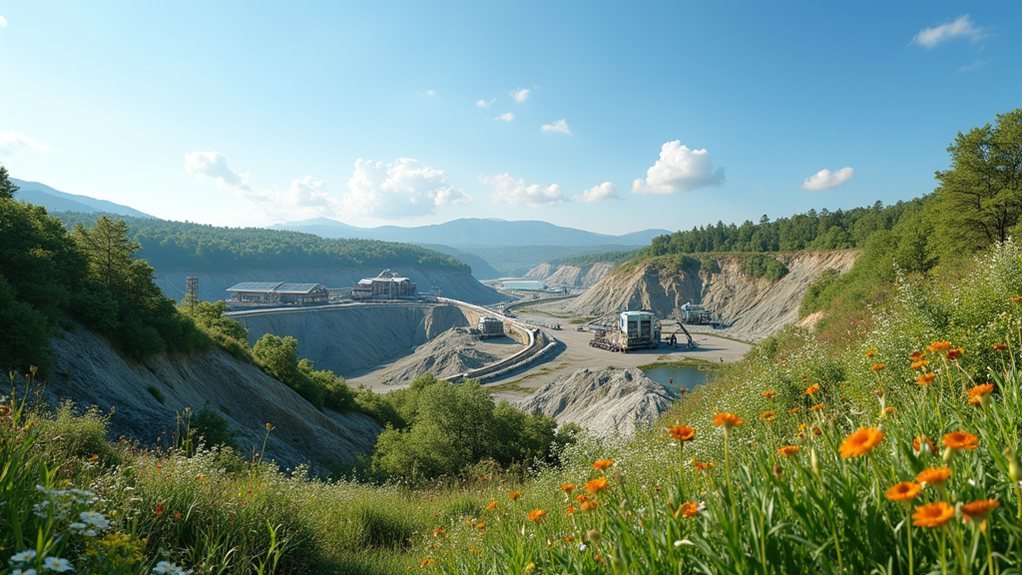
Post-mining land rehabilitation, including reforestation and biodiversity plans, helps restore ecosystems and local economies. Following the waste hierarchy principles can significantly reduce mining’s environmental footprint by prioritizing prevention and reuse over disposal methods.
Shifting to renewable energy sources cuts emissions, proving that mining can be eco-friendly.
Community engagement guarantees local voices are heard, preventing costly conflicts.
With technological innovations like precision drilling and carbon capture, mining is transforming into a responsible industry that respects both nature and its neighbors.