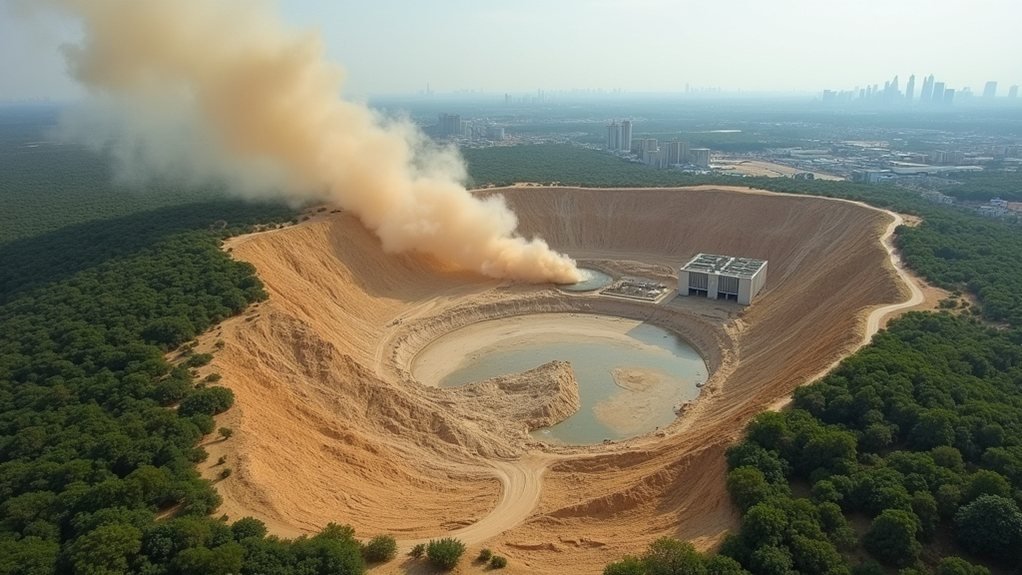

The recent exposure of gaps in Environmental Impact Assessments (EIA) highlights troubling oversights in the UK mining sector’s approach to climate duties. Issues like overlooked downstream emissions and neglected fugitive emissions resemble a chef forgetting key ingredients in a signature dish. Without rigorous assessments, the UK’s climate targets may slip through the cracks. It’s a bit like trying to build a sandcastle without a bucket – you might get something, but it certainly won’t hold up. Additional insights reveal why this matters even more.
Quick Overview
- Environmental Impact Assessments (EIA) often neglect downstream and fugitive emissions, creating significant compliance gaps in the UK’s climate commitments.
- Recent legal rulings highlight the oversight of combustion emissions in EIAs, undermining effective climate governance.
- Insufficient greenhouse gas assessments in projects strain renewable resources and hinder progress towards net zero targets.
- The lack of binding standards for emissions assessments limits accountability, affecting the reliability of climate commitments.
- Urgent need for comprehensive EIA processes to incorporate climate adaptation measures and address potential environmental impacts effectively.
EIA’s Role in UK Mining
While many might think of mining as simply digging holes in the ground, the reality is far more intricate, especially in the UK, where the Environmental Impact Assessment (EIA) plays a pivotal role. It’s not just about unearthing minerals; it’s about ensuring that these activities don’t wreak havoc on the environment. For sites over 25 hectares, an Environmental Statement is mandatory, like having a permission slip for a school trip. Local authorities scrutinize these documents, balancing mineral supply needs against community impact. This process includes public participation, making sure everyone gets a say—because nobody likes surprises, especially when it comes to their backyard. Furthermore, the Environmental Impact Assessment regulations differ across regions, ensuring localized compliance and effectiveness. The EIA process involves impact prediction and assessment, which is crucial for identifying potential adverse effects on the environment. These assessments serve as preventative measures to evaluate environmental consequences before project implementation begins.
Critical Shortcomings of EIA in Meeting UK Climate Targets
The effectiveness of Environmental Impact Assessments (EIAs) in achieving the UK’s ambitious climate targets can often feel like a game of Jenga, where one wrong move could bring the whole structure crashing down. Key shortcomings include neglecting downstream emissions, leaving a gaping hole in compliance. The Supreme Court’s ruling on combustion emissions highlights this oversight, yet many EIAs still fail to assess indirect impacts. In addition, fugitive emissions from coal mining are largely ignored, undermining the UK’s net zero ambitions. As the clock ticks towards 2050, these gaps could derail climate progress faster than a poorly planned mining project. Furthermore, the Coal Authority’s target to achieve net zero by 2030 underscores the urgency of addressing these shortcomings. To meet climate commitments, the UK needs to cut emissions by at least an additional 381 MtCO₂e, emphasizing the importance of robust EIA processes. A comprehensive approach must balance both climate mitigation strategies that reduce emissions and adaptation measures that prepare for unavoidable impacts.
Impacts of EIA Failures on UK Climate Policy
EIA failures ripple through the fabric of UK climate policy, much like a stone tossed into a serene pond, sending out waves that disrupt the entire ecosystem.
The government’s oversight in approving projects, like the Woodlands Park data center, highlights a troubling lack of accountability. With insufficient assessment of greenhouse gas emissions, vital climate commitments remain unaddressed. This oversight not only strains renewable energy resources but also exacerbates infrastructure vulnerabilities, such as urban heat management. Comprehensive scope reporting standards would improve the accuracy and completeness of emissions assessments in these critical evaluations. As adaptation efforts stall, the legal precedent set by the Supreme Court underscores the urgent need for binding standards to enforce environmental safeguards effectively. The recent government admission of a serious logical error in approving hyperscale data centres further emphasizes the critical need for thorough environmental evaluations. Additionally, heat-related deaths projected to exceed 10,000 annually by 2050 highlight the pressing need for effective climate adaptation measures in urban planning.