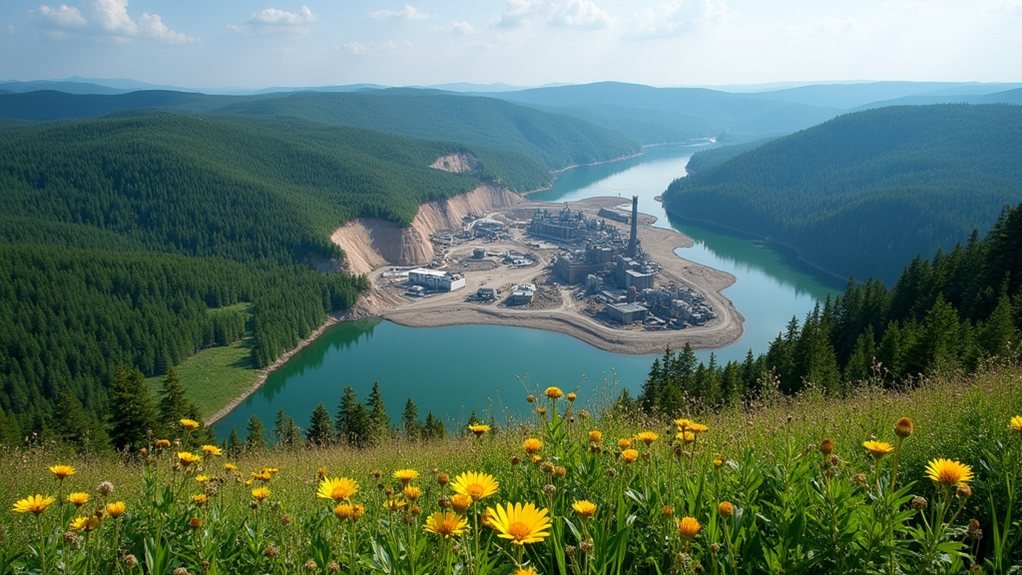

Canada’s mining scene is buzzing with action, teaming up with Australia and Indonesia to embrace sustainable practices. New ESG regulations are tightening the screws, demanding transparency on climate impacts—no more greenwashing! Community trust hangs in the balance, especially with 70% of Canadians seeing mining as essential for jobs and energy. Respecting Indigenous rights is key, too. The future is bright, and there’s much more unfolding in this intriguing tapestry of mining innovation and responsibility.
Quick Overview
- Canada is enhancing sustainable mining practices through partnerships with Australia and Indonesia, focusing on geothermal-powered mining and critical minerals.
- New ESG regulations require mining companies to conduct rigorous environmental assessments and disclose climate impacts to prevent greenwashing.
- Community engagement is essential, with 70% of Canadians recognizing the importance of mining for employment and the energy future.
- Indigenous rights are prioritized in mining operations, with over 16,500 Indigenous individuals employed and strengthened through Impact Benefit Agreements.
- As demand for critical minerals rises, mining firms must adapt to evolving regulations and sustainable practices for long-term success.
Who’s Teaming Up for Sustainable Mining in Canada?
What’s the secret recipe for sustainable mining in Canada? It’s all about teamwork!
Canada is joining forces with nations like Australia and Indonesia, creating a robust network focused on critical minerals. Recent partnerships, such as the Canada-Indonesia MoU, showcase Canadian expertise in sustainable practices, from geothermal-powered mining to battery-grade materials. Participation in the AICTD initiative provides Canadian companies with the opportunity to further enhance their impact in international markets. Furthermore, the G7 Critical Minerals Production Alliance aims to develop secure critical minerals supply chains with a total investment of $6.4 billion for projects, emphasizing graphite and rare earth elements.
These collaborative efforts prioritize resource conservation to ensure mineral supplies remain available for generations to come, balancing economic benefits with environmental responsibility.
It’s like a global potluck where every nation brings their best dish—Canada’s just happens to be a delectable blend of innovation, efficiency, and high ESG standards.
Recent Changes in ESG Mining Regulations in Canada
As the landscape of mining in Canada evolves, the recent tightening of Environmental, Social, and Governance (ESG) regulations is like a fresh coat of paint on an old barn—necessary and likely to draw more attention. The federal and provincial systems are beefing up, requiring rigorous environmental assessments for major projects. With new standards like the IFRS S1 and S2 demanding climate disclosures, companies must now prove they’re not just greenwashing. As Canada eyes a low-carbon future, mining firms are expected to adapt to stricter rules, turning critical minerals into both an opportunity and a responsibility for sustainable growth. The need for comprehensive environmental assessments ensures that mining operations consider their impact on ecosystems and communities. Mining companies must familiarize themselves with regulatory frameworks designed to protect natural resources while enabling responsible development. Furthermore, as the demand for critical minerals rises, aligning with ESG standards becomes even more crucial for attracting investment and fostering long-term viability.
Community Engagement and Indigenous Rights in Mining
While it may seem that mining companies operate in a world of their own, the reality is that community engagement and respect for Indigenous rights are becoming non-negotiable aspects of successful mining operations in Canada.
With nearly 70% of the public believing that mining contributes to climate change, companies need to step up their game. Additionally, a significant 70% of Canadians view critical minerals as essential for the country’s energy future, highlighting the importance of responsible mining practices. Furthermore, about 70% believe mining’s importance for employment and regional development underscores the need for companies to prioritize community wellbeing.
Indigenous Peoples, particularly First Nations, show higher trust when involved through Impact Benefit Agreements, employing over 16,500 Indigenous individuals. Ensuring procedural fairness and building community capacity are essential, like laying a solid foundation before constructing a skyscraper—without it, the whole operation risks toppling over. Mining operations must address environmental justice concerns to ensure both burdens and benefits are distributed equitably across all affected communities.