Canada’s critical minerals sector grapples with several environmental risks. Abandoned mines are like time bombs, leaking pollutants and costing taxpayers billions. Recent tailings management failures, such as the Mount Polley disaster, show how even the best-laid plans can go awry. Wildlife habitats are fragmented, threatening species like the Bathurst caribou. Regulatory delays and investment gaps only complicate matters, leaving communities and ecosystems in a precarious balance. Discovering sustainable practices and Indigenous partnerships could be key to a brighter future.
Quick Overview
- Abandoned mines in Canada pose significant pollution risks, with cleanup costs exceeding $10 billion for taxpayers.
- Tailings management failures, including recent dam incidents, threaten ecosystems and raise public safety concerns.
- Mining operations disrupt biodiversity, fragment habitats, and threaten species like the Bathurst caribou herd.
- Regulatory delays and investment gaps hinder timely development of critical mineral projects, exacerbating supply deficits.
- Indigenous partnerships are essential for ensuring sustainable mining practices and respecting local communities’ rights and traditions.
The Legacy of Abandoned Mines and Their Environmental Costs
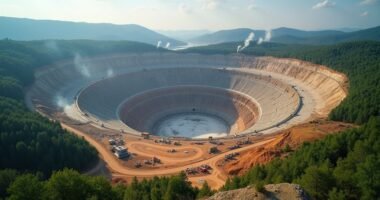
In Canada, the legacy of abandoned mines looms large, casting a shadow over both the landscape and the environment. With over 10,000 abandoned mines scattered across the country, these sites don’t just whisper of the past; they scream about ongoing pollution and hefty cleanup bills, estimated at over $10 billion for taxpayers. Picture a giant, unsealed jar of pickles left in the sun—over time, it just gets messier. Incomplete data from environmental assessments dating back over 50 years reveal systemic issues, making it clear that the mining industry’s footprint is still stepping on the toes of both nature and public health. Furthermore, many of these sites pose risks to health, safety, and economic stability of communities, highlighting the urgent need for effective remediation efforts. Addressing these abandoned mines requires implementing waste hierarchy principles to prevent further environmental degradation while prioritizing sustainable remediation approaches over conventional disposal methods.
Risks and Recent Failures in Tailings Management
Amid the longstanding issues of abandoned mines, the mining industry faces the pressing challenge of managing tailings—the leftover materials from ore processing that often resemble the messy aftermath of a toddler’s art project gone wrong.
Recent tailings dam failures, like the catastrophic Mount Polley incident, have drawn public concern, with millions of litres of toxic waste spilling into local ecosystems. As new mines encroach on remote areas and climate change stirs the pot, the risk of future failures looms large. With only two-thirds of facilities meeting industry standards, the question remains: how can the industry clean up its act before it’s too late? Compliance-based governance is becoming imperative as regulators increasingly focus on tailings management standards. Furthermore, the need for critical minerals is framed as essential for transitioning away from fossil fuels, which adds pressure to ensure mining practices do not compromise environmental safety. Implementing biodiversity conservation strategies in reclaimed mining sites could help restore ecosystem functions while mitigating some of the environmental damage caused by tailings management failures.
How Mining Disturbs Biodiversity in Pristine Environments
While the allure of critical minerals may sparkle like a freshly polished gem, the reality of mining in pristine environments often casts a shadow over biodiversity.
Mining operations fragment habitats, disrupting wildlife migration routes, such as those of the Bathurst caribou herd, whose numbers plummeted from 470,000 to a mere 6,240. Additionally, the extraction process drains wetlands, releasing carbon and threatening essential nesting grounds for shorebirds. Effective forest conservation strategies could help mitigate these impacts on wildlife populations and their habitats. With mining claims infringing on peatlands and protected areas, species like the woodland caribou face extinction. This is particularly concerning as current mining deregulation trends are leading to calls for the elimination of environmental assessments, further jeopardizing wildlife. As the global demand for critical minerals rises, the pressure on these fragile ecosystems intensifies, highlighting the urgent need for sustainable practices.
Without careful planning, the quest for minerals risks ecological collapse, proving that shiny gems come with heavy environmental costs.
Why Regulatory Delays Hurt Mining Projects?
Regulatory delays in the Canadian mining sector can feel like a stubborn traffic jam on a sunny Saturday afternoon—frustrating and seemingly endless. It typically takes 10 to 15 years to bring a new mine into production, putting Canada at a disadvantage. Long review processes create uncertainty, scaring away potential investors faster than a bear in a picnic area. While mining companies often blame regulations, economic factors are usually the real culprits. Complicated coordination among government levels adds to the chaos, leaving project proponents maneuvering through a maze. Companies are increasingly expected to implement supply chain assessments to demonstrate environmental and social sustainability throughout their operations. Ultimately, these delays can inflate costs and undermine the profitability of critical mineral projects, especially as global demand for critical minerals is projected to quadruple by 2040. The study highlights that only seven out of 27 mines opened on time by 2022, challenging the notion that regulation is the primary delay factor.
Investment Gaps and Their Environmental Consequences
Investment in critical minerals is essential for Canada’s economy, yet it often resembles a high-stakes game of poker where players are hesitant to raise their bets due to looming uncertainties. Billions in cleanup liabilities from abandoned mines like the Faro site haunt taxpayers, while inadequate funding leaves tailings management at risk of catastrophic failures. Cumulative biodiversity impacts remain a mystery, and the rush for critical minerals is jeopardizing commitments to environmental standards. With C$6.4 billion fast-tracked, many companies lack the cash to meet ESG expectations, making the stakes even higher. The real gamble? Our environment and future. Building resilient supply chains requires strategic environmental risk management to avoid costly disruptions while maintaining long-term sustainability. Moreover, the increased demand for critical minerals is heightening the urgency for sustainable practices in the mining sector. Additionally, Canada’s vast geological resources of critical minerals position the country as a key player in the global market, underscoring the need for responsible investment strategies.
Supply Chain Pressures in the Mining Sector
Steering through the supply chain in Canada’s mining sector can feel like trying to untangle a set of earbuds after they’ve been sitting in your pocket for too long—frustrating and complicated.
A classic chicken-and-egg scenario arises as miners need buyers before expanding supply, while end users hesitate until supply becomes visible.
With delays in infrastructure funding and geographic concentration of processing, critical mineral projects often stall.
Delays in infrastructure funding and concentrated processing hinder critical mineral projects, causing significant stagnation in the mining sector.
The result? A staggering 15 years or more from discovery to production.
As operational costs rise and ore grades decline, the urgency for solutions intensifies, making the race to meet global demand increasingly challenging. Furthermore, the anticipated supply deficit for critical minerals in 2026 adds additional pressure on miners to accelerate their projects.
Strategies for Sustainable Mining Practices in Canada
Steering through the complexities of Canada’s mining sector isn’t just about finding minerals; it’s about how those minerals are extracted and used sustainably.
With $1.5 billion earmarked for infrastructure, Canada is paving the way for greener mining practices. Innovative techniques like vectoring tools identify overlooked minerals, turning industry waste into treasure—who knew trash could be so valuable? Furthermore, the strategy includes $3.8 billion in funding aimed at capitalizing on generational opportunities within the industry. Utilizing existing mining operations enhances the ability to extract valuable metals while minimizing environmental impact.
Moreover, Indigenous partnerships guarantee local communities share in the benefits. By embracing Environmental and Social Governance (ESG) standards, Canada is not just a player in the global market; it’s leading the charge for responsible mining, making the earth a little happier one mineral at a time.