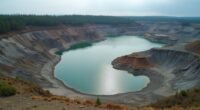
The Giant Mine showcases a cautionary tale in mining mismanagement, particularly with arsenic emissions. This notorious site spilled thousands of pounds of arsenic, leading to dire health risks, including lung cancer, and wreaked havoc on local ecosystems. With underground arsenic trioxide stored dangerously, the ongoing contamination presents a grim legacy. Canada can’t afford another Giant Mine. Addressing these failures and exploring safe, innovative practices is essential—just imagine what better mining could look like! Curious about those advancements?
Quick Overview
- Giant Mine’s arsenic trioxide storage poses ongoing contamination risks, threatening local ecosystems and public health.
- Oversight failures and lack of Indigenous consultation exacerbated the impacts of arsenic emissions on communities.
- Mining operations led to significant environmental disruptions, with long-term consequences for flora and fauna.
- Advanced safety protocols and community engagement are essential to prevent repeat disasters in mining practices.
- Regulatory frameworks must evolve to ensure strict compliance and accountability in mining operations to protect public health.
Health Risks From Arsenic Emissions: Understanding the Dangers
Health risks from arsenic emissions are, surprisingly often, not at the forefront of public health conversations, despite their serious implications.
Acute exposure can lead to respiratory issues like cough and chest pain, while chronic exposure sneaks in a far grimmer risk: lung cancer, especially for those near smelters or chemical factories.
Imagine this: if you breathe in just 0.7 ng/m³ of arsenic over a lifetime, you might be rolling the dice on cancer. It’s like playing a high-stakes game of roulette, but the stakes are your health. Atmospheric arsenic concentrations in regions like eastern China can be alarmingly high, further exacerbating these risks. Furthermore, airborne arsenic is primarily bound to fine particles, raising the danger even further for those exposed.
Breathing in just 0.7 ng/m³ of arsenic could gamble your health—it’s a risky game with lethal stakes.
These harmful particles contribute significantly to overall air quality index measurements in affected areas, often pushing readings into hazardous territory.
Awareness is essential; arsenic isn’t just a chemical—it’s a health hazard lurking in the air.
Environmental Contamination: Effects on Local Ecosystems
While it might be easy to overlook the impact of mining operations on local ecosystems, the reality is that the consequences are as profound as a thunderous avalanche rolling down a mountainside.
The 237,000 tonnes of arsenic trioxide stored underground pose significant risks, with water-soluble dust threatening to leach into the environment. Contaminated lakes and creeks are already feeling the sting of arsenic, while 643,000 m³ of tainted soil spreads its toxic embrace. This persistent poison doesn’t just vanish; it lingers like an unwelcome guest, potentially disrupting delicate ecosystems for thousands of years. Arsenic trioxide‘s deadly nature makes it a formidable challenge for environmental remediation efforts. Nature’s resilience faces a formidable challenge. The ongoing remediation efforts at Giant Mine aim to manage this hazardous waste and prevent further contamination. Modern site rehabilitation techniques offer hope for restoring damaged ecosystems while preventing similar environmental disasters in future mining operations.
What Are the Long-Term Effects of Giant Mine’s Arsenic Emissions?
Arsenic emissions from the Giant Mine loom like an ominous dark cloud over the health of local communities, casting a shadow that stretches far beyond the mine’s gates. Long-term exposure has been linked to serious health issues, including lung and skin cancers, with tragic incidents highlighting the dangers. Children and workers faced alarming levels of arsenic in their systems, while local water supplies showed contamination levels skyrocketing beyond safety thresholds. Furthermore, the high-temperature roasting of arsenopyrite formations resulted in thousands of tonnes of arsenic trioxide emitted into the environment daily, exacerbating the health crisis. Even the food chain felt the sting, as arsenic settled on crops and snow, threatening survival. Modern air quality monitoring equipment would have detected these dangerous emission levels well before they reached hazardous concentrations in the surrounding environment. The legacy of these emissions leaves an unsettling question: how long until the true cost is accounted? The Giant Mine became one of Canada’s most successful gold mines, producing seven million ounces of gold, but at an unimaginable environmental cost.
Key Lessons From Giant Mine’s Arsenic Management Failures
Key lessons learned from the tragic saga of the Giant Mine are as essential as they are sobering, reminding us of the delicate balance between industry and environmental stewardship.
Key failures in oversight, such as ignoring health warnings and lack of Indigenous consultation, highlight the need for rigorous regulatory frameworks. The overwhelming arsenic emissions reveal the perils of operational negligence; thousands of pounds were spewed daily, turning the air toxic. Additionally, inadequate health documentation underscores the importance of transparent communication and community engagement. Examining the complete lifecycle assessment would have revealed environmental impacts long before the contamination became catastrophic. Furthermore, the discovery that arsenic trioxide waste is stored in 14 underground chambers emphasizes the ongoing risk of contamination and the necessity for long-term management solutions. Recent investigations into waste management have shown that proper documentation is crucial to prevent hazardous materials from leaving the site improperly.
Ignoring health warnings and failing to consult Indigenous communities emphasizes the critical need for stronger regulatory frameworks.
Essentially, the Giant Mine serves as a cautionary tale on the dire consequences of neglecting environmental and public health standards.
How Can We Manage Arsenic Safely Moving Forward?
Mining operations have a unique responsibility when it comes to managing hazardous materials like arsenic, especially in light of past failures, such as those seen at the Giant Mine.
Moving forward, an integrated approach is essential—think of it as a well-orchestrated symphony. Separating arsenic during processing and returning it to the mine site can minimize risks. Additionally, understanding the distribution, migration, and chemical forms of arsenic is crucial for effective risk management.
Advanced technologies, like scrubbers and bioremediation, act like superheroes, zapping arsenic from waste. Creating habitat conservation zones around mining operations can help preserve biodiversity while preventing arsenic contamination of sensitive ecosystems. Long-term monitoring and stabilization methods are vital, much like checking your car’s oil regularly. Additionally, it is crucial to implement regulations governing arsenic levels to ensure safe mining practices.
With these tools, mining can safely embrace the future, ensuring past mistakes are not repeated.