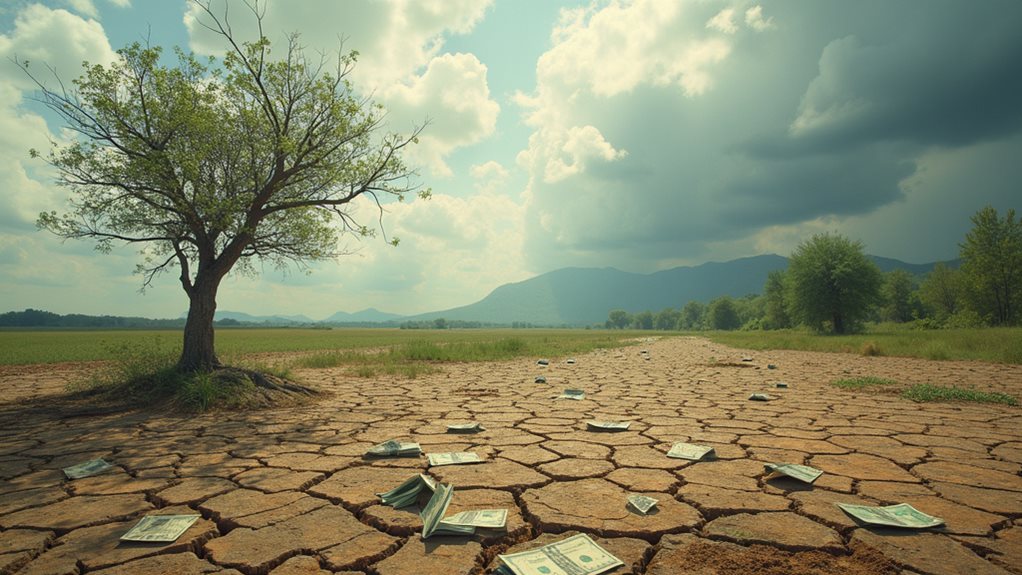

The shocking reality of carbon credits reveals that a staggering 84% don’t actually cut emissions. Think of it like a magic trick gone wrong; what looks impressive often turns out to be a smoke and mirrors show. Many projects, especially in forestry and renewable energy, promise big but deliver little, much like a chocolate teapot. With corporate giants like Delta caught in the act, the need for genuine climate action has never been clearer. Discover the story behind these ineffective offsets and their lasting impact.
The Truth About Carbon Credits: A Wake-Up Call
Have you ever wondered just how effective those carbon credits really are?
The answer might surprise you, revealing a world riddled with what experts call “junk carbon credits.”
These are offsets that, despite their shiny packaging, fail to deliver genuine emissions reductions.
Recent analyses indicate that a staggering 84% of investigated carbon credits don’t cut emissions as promised—yikes!
A shocking 84% of carbon credits fail to deliver the emissions cuts they promise—what a wake-up call!
In the domain of the voluntary carbon market, junk credits have flourished like weeds in a garden.
Many high-profile projects, including forestry schemes and renewable energy initiatives, have been discovered to be less effective than a paper straw in a hurricane.
Imagine investing in a project that claims to save the planet, only to find out it’s about as useful as a chocolate teapot.
More than $1.16 billion has been traded in projects later branded as likely junk or worthless.
The fundamental failings of these projects are alarming.
They often exaggerate climate benefits, claiming reductions that simply don’t exist. Less than 16% of investigated carbon credits constitute real emission reductions.
In some cases, they overlook potential environmental harms, making them as reliable as a weather forecast in a monsoon.
Poor transparency and a lack of independent verification make evaluating the outcomes of these initiatives nearly impossible.
Common technical issues, like double counting and over-crediting, further tarnish their credibility.
Corporate giants like Delta and Disney have dabbled in these junk credits, only to retreat as the truth surfaced.
Their retreat underscores the waning trust in the carbon offset market, which now faces immense pressure to prove it’s not just a greenwashing gimmick.
As high-profile investigations unearth the ineffectiveness of these offsets, companies are reevaluating their climate strategies. A recent joint analysis revealed that 39 of the top 50 emission offset projects are considered “likely junk”.
Ultimately, the market is left grappling with the fallout—an urgent need for genuine climate action looms larger than ever.
In a world craving accountability, it appears the age of junk carbon credits may soon be coming to an end.