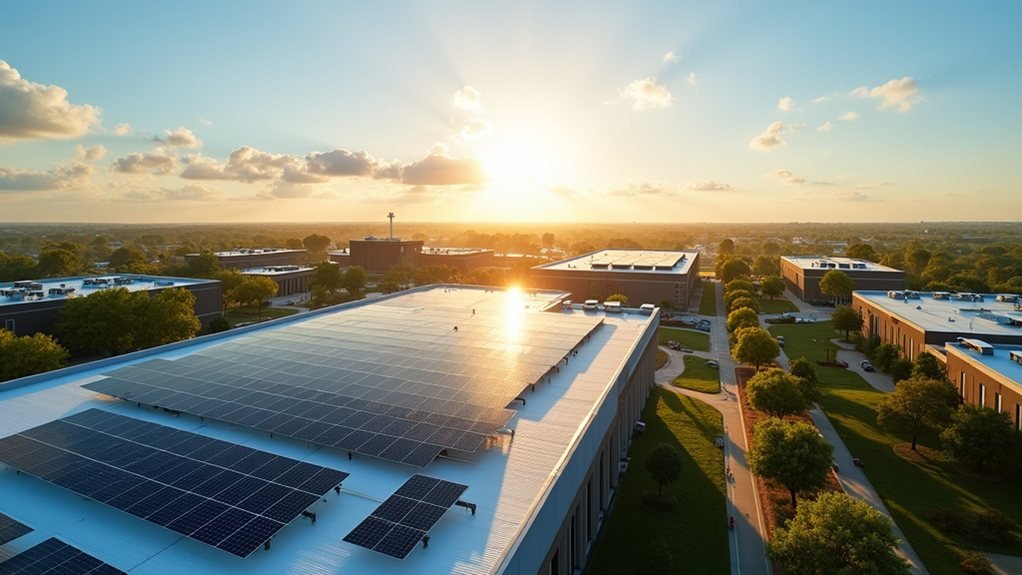

Walmart’s latest initiative features 74 rooftop community solar projects designed to bring affordable, renewable energy to low-income towns. These solar setups, utilizing commercial rooftops, aim to deliver power to approximately 3,600 homes, with half of that energy allocated to low- and moderate-income households. This environment-friendly move not only reduces reliance on fossil fuels but also promotes social equity, generating about $1 million in benefits. Curious about Walmart’s larger renewable energy vision? There’s more to uncover!
Quick Overview
- Walmart aims to achieve 2 GW of community solar capacity by 2030, contributing to its global goal of 10 GW clean energy by 2030.
- The 74 community solar projects in Maryland and Illinois provide nearly 43 MW of power, enough for over 3,600 homes.
- These projects prioritize low- and moderate-income households, allocating 50% of energy generated to these communities.
- Collaborations with Solar Landscape and Nexamp enhance multistate solar development, aligning with Walmart’s broader renewable energy goals.
- The initiatives promise around $1 million in financial benefits, delivering cheaper energy to low-income towns and reducing fossil fuel reliance.
Overview of Walmart’s Solar Initiative
In the grand arena of renewable energy, Walmart is stepping into the spotlight with its ambitious solar initiative, showcasing a commitment that’s as bright as the sun itself.
With a target of adding 10 GW of clean energy globally by 2030, Walmart plans to harness community solar as a key tool for local generation. 74 community solar projects will be developed in Maryland and Illinois, with a combined capacity of nearly 43 megawatts. Additionally, this initiative follows a successful collaboration with Nexamp and Walmart on multiple community solar projects across five states.
Their goal includes 2 GW of community solar projects by the decade’s end, aiming for 100% renewable energy by 2035. These efforts highlight the environmental benefits of transitioning away from fossil fuels toward sustainable energy solutions.
The Scope of the Rooftop Community Solar Portfolio
Walmart’s rooftop community solar portfolio shines brightly with its innovative approach to harnessing solar energy.
Spanning 74 projects in Maryland and Illinois, this initiative taps into nearly 43 MW of capacity, enough to power over 3,600 homes. Think of it as Walmart’s solar playground, using commercial rooftops instead of green fields, making it both eco-friendly and space-efficient. About 50% of the energy generated targets low- and moderate-income households, promising around $1 million in annual bill savings. With a smart strategy focused on densely populated areas, Walmart is not just going green; it’s also helping communities save some green. These projects exemplify the critical energy transition movement toward sustainability that benefits both the environment and local economies. These projects are expected to enhance domestic community solar initiatives, further solidifying their impact on local economies. Furthermore, this initiative highlights rooftop projects as a vital asset for expanding renewable energy access across communities.
Investment Details for 74 Projects
A whopping 74 rooftop community solar projects are currently under construction in Maryland and Illinois, representing a significant leap towards cleaner energy.
With nearly 43 megawatts of capacity, this investment by Walmart is no small fry—think of it as a solar power buffet! Backed by Solar Landscape, these projects promise about $1 million in annual bill savings for subscribers, especially low- and moderate-income households.
Construction is underway, with an impressive 342,000 person-hours estimated for installation. That’s like having a small army of solar warriors! These projects aim to provide electricity to local communities and power over 3,600 homes. The initiative aligns with recent IEA projections that show accelerated growth in renewable energy adoption globally. The aim is to strengthen the local grid and drive job creation, contributing to the overall economic impact of the initiative.
All this aligns with Walmart’s strategy for sustainable energy, ensuring brighter days ahead for local communities.
Expected Solar Capacity and Community Impact
The solar landscape in Maryland and Illinois is set to undergo a remarkable transformation with the impending launch of 74 community solar projects, promising to harness nearly 43 megawatts (MW) of clean energy. This rooftop revolution will not only power over 3,600 homes annually but also tackle energy costs for low- and moderate-income households, saving an estimated $1 million each year. Additionally, these projects contribute to Walmart’s goal of 2 GW of community solar planned for online by late 2030. These initiatives represent a significant advancement in smart grid integration, enabling more efficient distribution of renewable power while reducing transmission losses. By utilizing existing retail rooftops, these projects sidestep the “greenfield” dilemma while enhancing grid efficiency. Furthermore, this initiative aligns with Walmart and Nexamp’s collaboration to deploy 31 community solar projects across five states, demonstrating a broader commitment to sustainable energy solutions. It’s like turning your roof into a mini power plant—clean, local, and ready to help communities thrive while reducing reliance on fossil fuels.
Powering Homes With Renewable Energy
Harnessing the sun’s power is like discovering a hidden treasure in the backyard—only this treasure can light up homes, reduce bills, and even save the planet.
In 2023, renewables supplied about 30% of U.S. electricity, with community solar leading the charge. This innovative approach allows renters and low-income households to join in, even if their roofs aren’t suitable for solar panels. By subscribing to offsite arrays, they can save an average of 10% on their bills, with community solar projects delivering financial benefits to multiple customers in a specific area. Plus, these projects create local jobs and boost community funds—turning sunshine into savings and community empowerment. Community solar initiatives also aim to reduce greenhouse gas emissions through clean energy generation. Who knew the sun could be so generous?
Effective implementation of these solar initiatives represents one of many carbon reduction strategies that can transform our energy systems while supporting economic development in vulnerable communities.
Construction Timeline for Project Energization
Amidst the buzz of solar innovation, a remarkable timeline is unfolding for Walmart’s community solar projects, aiming for energized rooftops in 2024 and 2025.
With 74 rooftop projects in Maryland and Illinois, Walmart is setting the stage for substantial renewable energy output, contributing to its goal of achieving 50 percent renewable energy by 2025.
The construction process is already underway, following meticulous pre-construction development.
Each rooftop, averaging 0.5–0.6 MW, is expected to complete construction within a few months.
Following this, utility interconnection testing will confirm readiness to energize.
As the projects align with state regulations, Walmart’s ambitious two-year timeline promises to illuminate low-income communities with clean energy.
Benefits for Low- and Moderate-Income Households
How can community solar projects truly transform the lives of low- and moderate-income households? By slashing energy bills!
With average savings of around 10%—or even up to 20%—these programs lighten the financial load, allowing families to spend more on essentials like food and healthcare. Over 49,000 facilities awarded allocations help drive this change, providing more access to clean energy options.
Average savings of 10% to 20% empower families to prioritize essentials like food and healthcare.
Plus, renters and those in multifamily homes can finally join the solar party, breaking down barriers that once kept them outside. Community solar projects reach groups underserved by traditional solar markets, ensuring that everyone can benefit.
Imagine trading high energy costs for stability, all while supporting clean energy initiatives.
Community solar not only brightens homes; it empowers communities, proving that affordable energy can be a reality for everyone.
Structure of Community Solar Subscriptions
The structure of community solar subscriptions is akin to a well-orchestrated symphony, where each player has a distinct role yet contributes to a harmonious whole.
Typically, a three-way arrangement unfolds: the project owner sells energy to the utility, while subscribers receive bill credits through a separate agreement. Subscribers don’t own panels, but pay a fee for energy output, ensuring their participation aligns with their energy needs—no one wants to pay for power they won’t use! Low-income customers qualify for many programs, broadening access to affordable solar energy for underserved communities.
Minimums and maximums keep things fair, preventing any one subscriber from hogging the spotlight. Think of it as sharing the sun’s bounty, together.
Projected Energy Bill Savings for Subscribers
Subscribers to Walmart’s community solar projects can look forward to significant savings on their energy bills, making participation in these initiatives not just a bright idea, but a financially savvy one as well.
With projected annual savings of around $1 million for approximately 3,600 households, each home can expect about $275 off their bills.
That’s like finding a crisp $20 bill in last winter’s coat!
Plus, since about half the savings are aimed at low- and moderate-income families, these projects guarantee that everyone can bask in the glow of affordable energy.
It’s solar power with a heart! Furthermore, this initiative involves community solar projects that support local jobs and tax revenue, contributing to the economic growth of these communities.
Expanding Access for Renters and Multifamily Residents
What if renters and multifamily residents could tap into the benefits of solar energy without needing a rooftop or a hefty investment?
Thanks to community solar models, they can!
By subscribing to offsite solar arrays, renters can enjoy savings on their utility bills without installing panels.
Renters can save on utility bills by subscribing to offsite solar arrays, all without the need for rooftop panels.
Walmart’s partnerships guarantee that at least half of the solar capacity serves low- and moderate-income households.
With simple online enrollment and no upfront costs, these programs cater to those living in apartments.
Supporting Equitable Clean Energy Transition
As the sun sets on the old ways of energy production, new opportunities are rising for everyone, especially those historically left in the shadows. Communities of color and low-income areas have long faced energy inequities, often living near pollution-heavy fossil-fuel plants. Walmart’s community solar projects aim to flip the script. By prioritizing clean energy access, they align with frameworks like the Justice40 Initiative, which seeks to direct 40% of climate benefits to disadvantaged groups. This equitable approach not only promotes health but also enhances livelihoods, inviting communities to co-create solutions that brighten their futures—no magic wands required, just authentic collaboration. Ultimately, this initiative addresses energy system inequities, paving the way for a more just energy landscape. By focusing on 100% renewable electricity, these projects can help ensure that all communities benefit from the clean energy transition.
Economic Impact of the Rooftop Solar Projects
While it may not come with a cape or superpowers, the economic impact of Walmart’s rooftop solar projects is making waves in communities across the nation. By harnessing sunlight, these 74 projects deliver an impressive $9 million annually in bill savings, mostly benefiting low- and moderate-income households. Walmart’s investment in 19 solar projects significantly boosts renewable energy production, further enhancing local economies. Imagine freeing up funds for groceries instead of utility bills! Plus, by generating power close to where it’s needed, they reduce the costly need for new infrastructure. Additionally, these projects support Walmart’s environmental and sustainability goals, demonstrating a commitment to both economic and ecological health.
With Walmart’s backing, developers can access capital more easily, paving the way for even more clean energy initiatives. Talk about a sunny outlook for local economies!
Job Creation in Local Communities
Job creation in local communities is becoming a shining beacon of hope, courtesy of Walmart’s community solar initiatives.
These projects are not just about harnessing sunlight; they’re lighting up job opportunities.
With “good union jobs” sprouting in densely populated areas, local construction and installation roles are booming.
As Walmart partners with Solar Landscape, over 100 new positions are expected in 2024 alone. Additionally, ongoing operations and maintenance roles will support long-term employment.
Plus, training programs are transforming under-resourced residents into skilled solar technicians, ready to tackle rooftop challenges. These projects involve over 3 million square feet of rooftop community solar projects, enhancing local economies even further. This initiative supports the deployment of more than 200 commercial rooftop solar installations.
It’s a win-win: cleaner energy and thriving local economies!
Person-Hours Required for Construction
When it comes to constructing community solar projects, the person-hours required can be quite the eye-opener—think of it as the behind-the-scenes work of a blockbuster film, with every role critical to the final product.
A typical 1 MWdc rooftop installation demands 15,000 to 25,000 labor-hours, with the majority dedicated to the physical installation—imagine a team of electricians and laborers racing against the clock. Driven demand for 650,000 labor hours, equivalent to 325 full-time jobs, emphasizes the significant workforce involved in these projects. Development phases eat up another 15-25% of those hours, while post-construction tasks wrap things up. In 2024, the solar industry employed over 280,000 workers, highlighting the extensive labor force needed for such initiatives.
A 1 MWdc rooftop installation can require 15,000 to 25,000 labor-hours, showcasing the intense teamwork and effort behind the scenes.
Each project is a unique puzzle, where efficiency gains and smart planning can save both time and effort, much like a well-rehearsed dance.
Workforce Opportunities in the Solar Sector
Solar energy is not just brightening our days; it’s opening up a dazzling array of workforce opportunities that could rival the excitement of a surprise birthday party.
With over 4.9 million solar jobs globally and a projected 40% growth in the U.S. workforce by 2025, the sector is booming. 355,000 workers will be needed in the industry by 2026, highlighting the urgent demand for skilled labor in this expanding field. This surge in job openings is largely driven by the anticipated 50% increase in demand for experienced solar installers over the next five years.
Installation roles dominate, making up 64% of jobs, while mid-level technical positions are in high demand.
Community colleges are stepping up, offering hands-on training without the four-year commitment.
As these roles blossom, they promise not only stability but also career advancement—because who wouldn’t want to climb the solar ladder?
Long-Term Lease Benefits for Property Owners
How can property owners turn their rooftops into reliable income streams?
By entering into long-term solar leases, they can transform unused space into stable revenue sources. These leases, often spanning 20 to 25 years, offer predictable payments that function like new rental income, boosting cash flow without the usual headaches. With developers covering installation costs, owners enjoy maintenance-free benefits while increasing property value. Plus, the presence of a long-term solar tenant can make properties more appealing to investors. Community Solar offers a non-CapEx solution, making it even more attractive for property owners to engage in this model. It’s like having a reliable roommate who pays rent while taking care of all the chores—win-win!
Amplifying Local Economic Activity
These projects generate savings that ripple through neighborhoods, especially low- and moderate-income areas. With Walmart’s initiatives projected to save subscribers about $1 million annually, that’s money freed up for local dining or shopping—talk about a win-win! Construction and operation of these solar sites also create jobs, with over 1,500 roles anticipated. Plus, they boost local tax bases, supporting schools and public services. Think of it like a solar-powered economic engine, quietly humming away, fueling everything from small businesses to infrastructure, making communities brighter—both literally and figuratively! Additionally, Walmart is committed to 10 GW of total clean energy capacity by 2030, further reinforcing its role in fostering economic growth.
Additional Job Creation Through Other Partnerships
While exploring the landscape of community solar initiatives, it becomes evident that Walmart’s partnerships are not just about harnessing sunlight; they are also about generating a bright future of job opportunities.
With projects spanning five states, the demand for skilled labor is soaring.
For instance, Walmart’s collaboration with Pivot Energy will create jobs in construction, engineering, and operations. Walmart secured tax equity investment for 15 community solar projects across the US, which further enhances the job market. Imagine this: 342,000 person-hours needed for 43 MW of solar capacity! That’s like filling a stadium with workers, all powering local economies.
As Walmart aims for 2 GW by 2030, the job market in solar energy is set to shine brighter than ever.
Grid Resilience and Infrastructure Improvements
In an era where energy stability is as essential as a well-timed coffee break, Walmart’s community solar projects stand out as a beacon of hope for grid resilience and infrastructure improvements.
By decentralizing energy generation, these rooftop initiatives limit outages and enhance voltage regulation, akin to avoiding a traffic jam by taking side streets. This approach reduces pollution and carbon emissions through increased clean energy from community solar projects, contributing to a healthier environment.
With solar plus storage, critical facilities can keep running during blackouts, much like a light staying on during a thunderstorm. Shared solar arrays enable access for those without suitable rooftops, further expanding the benefits to low-income communities.
Smart inverters provide essential services, ensuring that the grid dances smoothly.
This innovative approach not only boosts reliability but also prolongs the life of aging infrastructure, making everyone’s life easier.
Distributed Generation Benefits
How can something as simple as harnessing sunlight transform communities and save money?
Community solar projects deliver electric bill savings of 5–15% for participants, making energy costs lighter on wallets. By engaging low- to moderate-income households, these initiatives broaden access to clean energy, even for those without rooftops to host panels. Furthermore, they stimulate local economies, creating jobs in construction and maintenance, while keeping energy dollars circulating within communities. With reduced infrastructure costs and enhanced system efficiency, distributed generation not only empowers residents but also strengthens local economies—like a solar-powered superhero for cash-strapped communities. Independent analysis shows that community solar projects can deliver benefits exceeding costs by millions, reinforcing their value to local economies. Additionally, credits distributed based on subscriber’s contracted share ensure that all participants receive fair compensation for their solar contributions.
Reducing Dependence on Fossil Fuels
The shift away from fossil fuels is not just a trend; it’s becoming an essential part of how communities power their lives. Walmart’s commitment to solar energy is a game changer, reducing emissions substantially—think of it as trading in a gas-guzzler for a sleek electric car. With over 1 GW of solar projects, Walmart is helping to displace tons of CO₂, cutting demand for coal and gas. These community solar initiatives not only brighten homes but also clean the air, making neighborhoods healthier. It’s like swapping out stale bread for fresh, crusty rolls—everyone benefits from the upgrade! Walmart’s investment in 74 community solar projects enhances local grid infrastructure and supports low- and moderate-income households.
Accelerating Deployment Timelines
Why rush when it comes to solar energy? Walmart is speeding up deployment with strategic partnerships and standardized processes.
By teaming up with developers like Solar Landscape and Nexamp, they’ve transformed negotiations into a streamlined assembly line.
Imagine batch permitting as a fast-food drive-thru—quick and efficient! With nearly 1 GW of projects lined up, Walmart’s approach guarantees continuous construction from 2024 to 2026. Targeting states with friendly policies, they’re reducing red tape faster than a kid tearing through wrapping paper. This coordinated effort not only maximizes resources but also brings affordable solar power to low-income communities, proving that a little urgency can go a long way! Additionally, Walmart has completed agreements for more than 50 solar projects across various states, reinforcing their commitment to renewable energy. This initiative includes community solar initiatives that specifically target low- and moderate-income households.
Walmart’s Net-Zero Emissions Commitment
In a world increasingly aware of climate change, Walmart has boldly stepped up to the plate with a net-zero emissions commitment that’s as ambitious as it is crucial.
By 2040, Walmart aims for zero emissions in its operations—think stores and trucks—without leaning on carbon offsets, which is like running a marathon without taking shortcuts. The company has already reduced Scopes 1 and 2 emissions by 19.3% from its 2015 baseline by the end of 2023.
The company is also pushing for 100% renewable energy by 2035, while electrifying its entire vehicle fleet. Vehicle electrification, including long-haul trucks, is a key part of their strategy to achieve this goal.
With targets set for 2025 and 2030, Walmart is not just aiming for greener pastures; it’s setting the bar high for the retail industry.
Role of Community Solar in Renewable Strategy
Community solar has emerged as a powerhouse in the quest for renewable energy access, acting like a bridge that connects those who can’t install solar panels on their rooftops with the benefits of clean energy. By harnessing shared offsite solar arrays, it opens doors for renters and multi-unit dwellers. This not only boosts solar capacity but also aligns with equity goals by prioritizing low-income participants. With bill savings of 10–15%, community solar makes energy affordable while reducing reliance on fossil fuels. It’s like a buffet of clean energy, serving up sustainability to everyone, no rooftop required! As of December 2024, total installed capacity of community solar projects exceeds 10 GW-AC, demonstrating its growing impact on the energy landscape. Furthermore, energy equity ensures that clean, renewable energy benefits all, regardless of income or housing.
Recognition in Solar Procurement
Walmart’s impressive strides in solar procurement have not gone unnoticed, earning the retail giant a spot among the elite ranks of corporate solar users in the United States.
With over 1 GW of solar projects and a whopping 5.3 TWh of clean energy consumed annually, Walmart showcases its commitment to renewable energy.
The company has rapidly expanded its renewable portfolio, constructing more than 2 GW since 2020.
Its ambitious plans for 2 GW of community solar capacity further solidify its leadership position.
Dual Focus on Climate Action and Affordability
A remarkable dual focus on climate action and affordability is shaping the future of energy in local communities.
Walmart’s community solar projects aim to combat climate change while lightening the financial load for low-income households.
By adding nearly 43 MWdc of solar capacity in Maryland and Illinois, these initiatives provide clean energy without requiring rooftop installations.
Imagine this: families saving millions collectively—$6 million annually, to be exact—without needing to fork over cash for solar panels.
It’s like getting your cake and eating it too, all while helping the planet. Who knew saving the Earth could also save you money?
Geographic and Programmatic Diversification
In the expansive landscape of renewable energy, diversification proves to be the secret sauce that enhances both reach and impact.
Walmart’s community solar initiatives span multiple states, boasting a mix of rooftop, offsite, and distributed generation projects. By targeting both established solar markets like Illinois and emerging ones like Colorado, they guarantee robust program uptake. The blend of community solar options—whether on commercial rooftops or in offsite farms—allows Walmart to provide cleaner power without traditional grid constraints. This smart strategy minimizes regulatory risks and maximizes benefits, proving that a varied approach can truly brighten the energy future for low-income communities. Moreover, the completion of 6.5 MW solar energy systems at seven Walmart stores in California exemplifies their commitment to expanding renewable energy access.
Leading Corporate Participation in Community Solar
Corporate participation in community solar is shaping up to be a game-changer, much like how smartphones transformed our daily lives. Companies like Walmart, Target, and IKEA are sprouting as anchor subscribers, providing stability and financing for projects.
These corporate giants aren’t just about profits; they’re also tackling sustainability goals by locking in renewable energy at competitive rates. Their involvement extends beyond retail, drawing in food, logistics, and real estate sectors. With corporate subscribers covering 20-60% of project capacity, they’re not just reducing risks; they’re also fostering energy equity, making renewable power accessible for low-income communities. Now that’s a win-win! Additionally, these initiatives aim to improve access to clean energy options for underserved communities, further enhancing the impact of corporate participation in community solar. Notably, the efforts of programs like Pennsylvania’s Solar for All target low-income residential solar installations, which significantly contribute to this movement.
Broader Community Solar Ecosystem Overview
Community solar is becoming a vibrant tapestry of opportunity and innovation, weaving together various stakeholders to create a more sustainable future.
With the U.S. capacity soaring from 3 GW to a projected 20 GW by 2025, this market is ripe for growth. 3 GW installed in US by end of 2020 has already demonstrated the potential for significant impact in powering households. About 42% of households can’t host solar panels, making community options essential.
The U.S. community solar capacity is set to skyrocket from 3 GW to 20 GW by 2025, signaling immense growth potential.
States are stepping up, with 24 supporting these programs, often including low-income benefits. The cherry on top? Participants can enjoy 5-20% savings on bills while fostering local economic growth.
As solar spreads its wings, it’s proving that access to clean energy can be a community affair.
Complementing Other Community Solar Initiatives
While many might picture solar energy as a sun-drenched field of panels, the reality is that integrating rooftop solar projects into existing community solar initiatives can be just as impactful—if not more so.
Walmart’s rooftop ventures align with federal and state low-income programs, enhancing savings for millions.
By tapping into established policies and utility frameworks, these projects reduce complexity for low-income subscribers, making solar more accessible. Community solar programs offer various subscription and purchase plans that cater to diverse needs. This approach not only expands access but also guarantees that no one is left in the dark, literally and figuratively, as CSS programs enable multiple community members to benefit from solar energy without needing personal installations.
Think of it as adding a cherry on top of a sundae—delicious but also beneficial!
Scaling Community Solar Across Multiple States
How can a single concept like community solar create such a buzz across multiple states?
With 24 states plus D.C. officially on board, it’s like a solar-powered party where everyone wants an invite.
Yet, 75% of the action is happening in just four states—Florida, New York, Massachusetts, and Minnesota—leaving others in the shade. New York leads with 1,203 installations providing 2.4 GWac, showcasing the significant impact of community solar. Community solar lowers electricity bills for renters, small businesses, and low- to moderate-income households as it expands access to renewable energy for those who need it most.
As new legislation emerges in places like California and Michigan, the excitement grows.
However, not all states play by the same rules—think of it as a game of Monopoly where the properties vary wildly.
Coordinated planning among regulators and utilities is essential to avoid any solar fumbles.
Focus on Low-Income Customers
Low-income households often find themselves in a precarious situation when it comes to energy costs, a reality that feels more like a game of financial whack-a-mole than a fair competition.
With nearly 43% of U.S. households falling into this category, many face an energy burden that can eat up about 8.1% of their income—three times more than median-income families.
Community solar offers a lifeline, potentially slashing bills by 10% to 20%.
Community solar can be a game-changer, cutting energy bills by 10% to 20% for struggling households.
However, barriers like upfront costs and credit checks limit access.
Imagine trying to catch a break while juggling flaming torches; Walmart’s initiatives aim to help ease that struggle.
State Community Solar Program Requirements
Exploring the landscape of community solar programs can feel a bit like assembling a jigsaw puzzle without the picture on the box.
Each state crafts its own rules, defining who can join the solar party—residential, commercial, or even municipal subscribers, often capped at a certain size.
Picture a neighborhood block party, where too many guests might spoil the fun.
Many programs also require a minimum number of participants to keep the benefits from clustering with a few big fish. In Massachusetts, there’s a requirement of at least 10 subscribers per project to ensure broader participation.
And just like a good dance floor, subscribers can often switch partners—if they stay within the same utility territory, that is!
Projected Growth of U.S. Community Solar Installations
Community solar installations in the U.S. are on the brink of a significant evolution, and the outlook is both intriguing and a bit unpredictable.
By late 2024, the installed capacity is projected to reach 7.8 to 10 GW, with a cumulative capacity of over 16 GWdc by 2030.
By the end of 2024, community solar capacity is set to soar to an impressive 7.8 to 10 GW.
However, a hiccup in 2025, with a projected contraction of 29%, might slow the momentum.
Think of it as a race; some runners might stumble, but the finish line still beckons.
With favorable policies, this sector could thrive, but hurdles in tax rules and state support could dampen the excitement.
Buckle up!
Leading Markets for Community Solar
The landscape of community solar is evolving, with several states leading the charge in installed capacity and innovative policies. New York tops the chart with a whopping 2.4 GWac from over a thousand installations—talk about solar supremacy! Maine and Minnesota follow closely, showcasing their commitment to harnessing the sun’s power.
Massachusetts and Illinois also hold significant shares, though they are playing catch-up.
With over three-quarters of community solar capacity sitting in just a handful of states, it’s clear that legislation drives growth. As new states like California gear up, the competition for solar bragging rights is heating up!
Impact on Local Commercial Real Estate
Rooftop solar panels are not just sun-catching marvels; they’re turning commercial real estate into financial powerhouses.
By converting underutilized roof space into income-generating assets, property owners can enhance their net operating income (NOI).
Walmart’s impressive portfolio of leased rooftops signifies a replicable model across retail and logistics.
Walmart’s extensive rooftop solar model showcases a lucrative opportunity for retail and logistics sectors alike.
These solar arrays don’t just serve tenants; they also export energy to the grid, creating an extra revenue stream.
With long-term contracts boosting risk-return profiles, lenders and investors are taking notice.
Essentially, solar isn’t just green; it’s the golden ticket for savvy commercial real estate ventures.
Benefits to Historical Underserved Communities
Solar power isn’t just for sprawling estates or sunny rooftops; it’s also reshaping the energy landscape for historically underserved communities.
Community solar projects offer considerable savings on energy bills, with low-income families potentially enjoying reductions of 5–20%.
Imagine cutting your electricity bill while helping the environment!
With no upfront costs, renters can finally join the solar party, leaving past ownership barriers in the dust.
California and Nevada initiatives specifically target disadvantaged neighborhoods, ensuring that everyone shares in the clean energy pie.
Essentially, community solar is the superhero of energy equity, swooping in to save the day for those who need it most.
Engaging With Local Stakeholders
How can companies like Walmart effectively engage with local stakeholders to foster community solar projects?
By collaborating with partners like Solar Landscape, Walmart navigates the local landscape smoothly.
They work with state programs in Maryland and Illinois to guarantee equitable access to solar power.
This means involving local governments and utility companies in discussions, which is like getting the neighborhood on board for a block party—everyone wants in!
Outreach efforts target low- and moderate-income households, guaranteeing that the benefits reach those who need them most.
With strategic partnerships, Walmart aims to light up communities, one rooftop at a time.
Importance of Renewable Energy in Urban Areas
Cities are bustling hubs of activity and innovation, yet they also bear the weight of significant environmental challenges.
With urban areas generating about 70% of carbon emissions, harnessing renewable energy is vital to combat climate change.
Urban areas contribute 70% of carbon emissions, making the shift to renewable energy crucial in the fight against climate change.
Think of it as cities transforming into eco-friendly superheroes—cleaner air and reduced pollution are their superpowers.
By adopting renewable energy, cities can cut greenhouse gases from heating, cooling, and transportation.
Plus, community solar projects sprinkle energy independence throughout neighborhoods, boosting resilience.
As urban populations grow, the push for renewables becomes not just strategic, but essential, keeping cities livable and vibrant for future generations.
Sustainable Practices in Construction
In the domain of modern construction, sustainable practices are not just a trend; they are the blueprint for a future where buildings harmonize with the environment.
With buildings responsible for 37% of global energy-related CO₂ emissions, energy efficiency is vital. Innovations like advanced insulation and passive design strategies—think natural ventilation and smart shading—reduce energy demand.
Simultaneously, the shift to low-carbon materials, such as recycled aggregates, helps slay embodied carbon.
Combine this with savvy waste management and water conservation strategies, and you’ve got a recipe for a greener world.
Sustainable construction isn’t just smart; it’s essential for our planet’s health.
Collaboration With Solar Landscape
A partnership with Solar Landscape marks a significant leap forward in Walmart’s commitment to community solar initiatives.
This collaboration launches 74 rooftop solar projects across Maryland and Illinois, boasting nearly 43 MW of capacity—enough to power over 3,600 homes.
With approximately half of the projects focused on low- and moderate-income households, subscribers can enjoy guaranteed bill discounts.
Picture it: clean energy sourced right from your rooftop, cutting energy bills by an estimated $1 million annually!
As these projects energize between 2024 and 2025, Walmart and Solar Landscape aim to explore even more community solar opportunities.
Solar power, everyone’s new best friend!
Partnerships With Nexamp and Pivot Energy
Exciting advancements in community solar initiatives are underway as Walmart teams up with Nexamp and Pivot Energy, marking a significant expansion in its renewable energy efforts.
Together, they plan 50 projects, with Nexamp contributing 31 projects across five states, generating over 120 MW of capacity.
Pivot Energy adds 19 projects, including 15 community solar initiatives, totaling 72 MW.
This partnership not only supports nearly 15,000 households but is also expected to create 1,500 jobs.
With bill savings projected at over $8 million annually, these collaborations promise to brighten both rooftops and bottom lines in local communities.
Addressing Energy Inequities
While the sun shines brightly on the potential of renewable energy, shadows linger where energy inequities cast their long reach.
Low-income households often face energy burdens up to three times higher than their wealthier counterparts, spending an alarming portion of their income on energy.
Low-income families bear energy costs three times heavier, sacrificing a significant slice of their income just to stay powered.
Picture living in a drafty old home, where 30% of your hard-earned energy just slips away like a sneaky thief.
Historic redlining and poor infrastructure compound these issues, leaving vulnerable populations—especially in rural areas—struggling.
It’s not just about dollars; it’s about health, as limited access to cooling leads to heat-related illnesses, making the energy equity gap a vital concern.
Long-Term Sustainability Goals
Walmart’s long-term sustainability goals resemble a grand blueprint, intricately designed to reshape the future of retail and energy consumption.
Targeting net-zero operational emissions by 2040, Walmart aims for impressive reductions in greenhouse gases, targeting for a 65% decrease by 2030.
With renewable energy as a key ingredient, they plan to source 100% of their electricity from renewables by 2035—think of it as their green power buffet.
Additionally, their ambitious Project Gigaton is set to avoid a staggering 1 gigaton of CO₂ emissions by 2030, showcasing Walmart’s commitment to a cleaner, greener future—one rooftop solar panel at a time.
Community Engagement Strategies
In the world of community solar, engaging local residents is as essential as the sun’s rays to the panels themselves.
Walmart employs a variety of strategies to bring communities into the fold, from multilingual mailers to educational workshops.
Imagine a friendly neighborhood gathering at a Walmart, demystifying community solar for renters and small businesses alike!
With partnerships spanning local governments and nonprofits, they prioritize low- and moderate-income households through targeted outreach.
Innovations in Solar Technology
How can the latest innovations in solar technology not only brighten our future but also revolutionize the way we harness energy?
Imagine this: high-efficiency panels now boast conversion rates exceeding 25%. Enter perovskite cells, the new kids on the block, dazzling with over 30% efficiency when paired with silicon.
Meanwhile, bifacial panels soak up sunlight from both sides, like a solar sponge, boosting energy yields by up to 30%.
And let’s not forget smart inverters that optimize each panel’s output, ensuring no sunlight goes to waste.
It’s a thrilling time for solar, where every rooftop can become an energy powerhouse!
Environmental Benefits of Solar Energy
The emergence of solar energy stands as a beacon of hope in the quest for a cleaner, healthier planet.
Unlike fossil fuels that belch out harmful emissions, solar panels emit only 20–50 grams of CO₂ per kilowatt-hour—practically a breath of pure air!
By 2022, solar energy helped offset over 140 million metric tons of CO₂ globally, while also preventing premature deaths from pollution.
Plus, these solar plants sip water like a sparrow, using only a fraction of what coal or gas requires.
With recycling rates as high as 97%, solar energy not only powers homes but also protects our precious Earth.
Future of Community Solar in America
Community solar in America is at a fascinating crossroads, where promise meets challenge in a landscape reshaped by shifting policies and market dynamics.
Following a record-breaking 2024, installations plummeted 36% in early 2025, with a projected 29% contraction for the year.
Despite these setbacks, over 9 GWdc of projects are still in development, showcasing resilience.
However, the share serving low-to-moderate income subscribers has dwindled, revealing that accessibility remains a puzzle.
With federal uncertainty and capacity constraints looming, the future of community solar hinges on innovative legislation and a collective push to harness the sun’s power for all—especially those who need it most.
Lessons Learned From Project Implementation
Success in community solar projects often hinges on a few key lessons learned from implementation.
First, aligning with local grid policies can streamline processes and enhance reliability, like finding the perfect playlist for a road trip.
Next, tackling rooftop design issues—think HVAC equipment as the uninvited party crasher—requires creative layouts and structural assessments to guarantee long-term safety.
Finally, fostering community engagement transforms these projects into local treasures, providing bill savings and job opportunities.
Vision for a Cleaner Energy Future
Envisioning a cleaner energy future is like dreaming of a world where every rooftop becomes a mini power plant, generating sunshine while saving the planet and households money.
Walmart’s ambitious plan includes over 2 GW of community solar, targeting low- to moderate-income neighborhoods, where savings can reach up to $6 million annually.
Walmart’s community solar initiative aims to empower low- to moderate-income neighborhoods with $6 million in annual savings.
With 74 rooftop projects, they aim to power 3,600 homes and create over 1,500 local jobs.
This strategy not only strengthens local grids but also champions equity in clean energy access.
Imagine, your roof could soon rival the sun’s power—talk about shining rooftops!