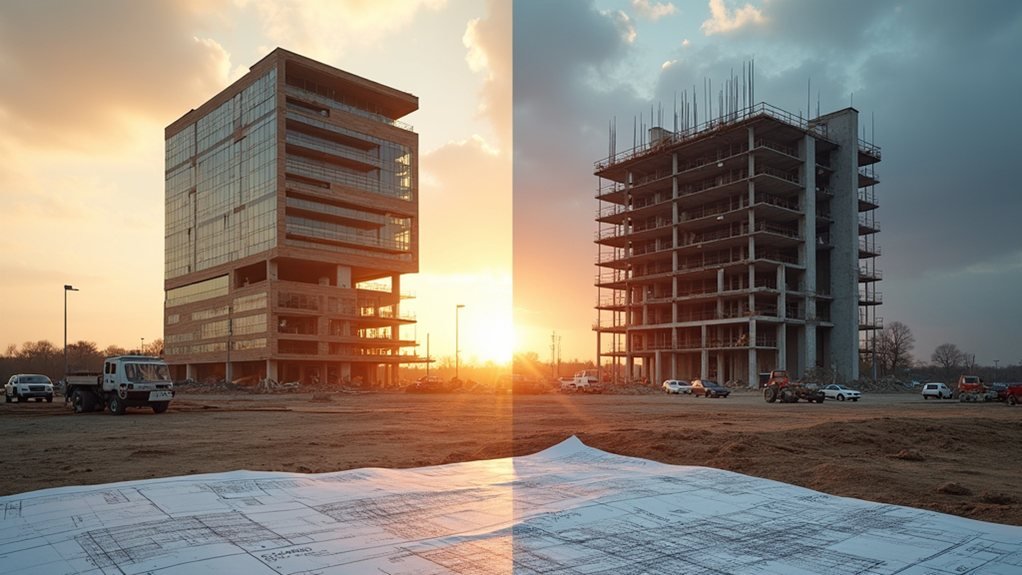

The US Department of Energy’s recent rescission of its zero-emissions building (ZEB) definition has sparked quite the debate. On one side, real estate groups cheer, celebrating a potential reduction in costly regulations. Meanwhile, environmentalists raise eyebrows, fearing this move undermines important climate goals. This shift may lead to a messy patchwork of local codes, making it tricky to balance cost savings with sustainability. Curious about how this shake-up impacts future building standards? There’s plenty more to unpack!
Quick Overview
- The DOE’s rescission of the zero-emissions building definition occurred on December 3, 2025, following Executive Order 14057’s ambitious goals.
- Industry groups welcomed the change, citing reduced regulatory costs and compliance burdens for builders.
- Environmental advocates criticized the rescission, claiming it undermines federal climate action and decarbonization efforts.
- The lack of a federal benchmark may lead to inconsistent state and local building codes, complicating compliance for developers.
- The decision raises concerns about potential stagnation in clean technology innovations and financing uncertainties in sustainable construction.
Background and Timeline of the ZEB Definition
In the ever-evolving world of energy policy, the journey toward defining a zero-emissions building (ZEB) resembles a thrilling race where every twist and turn matters.
Sparked by Executive Order 14057 in December 2021, this initiative aimed for a net-zero emissions building portfolio by 2045. With buildings as major carbon culprits, the U.S. Department of Energy (DOE) sought public input from over 1,000 stakeholders to craft a performance-based, technology-neutral definition. This definition serves as a standard to guide the construction industry toward new zero-emissions buildings, ensuring that they must be energy efficient and powered solely from clean energy. These efforts align with established green building ratings that promote sustainable construction practices across the industry.
Industry Reactions to the Rescission
How exactly do industry players react when the federal government pulls the rug out from under a highly anticipated zero-emissions building (ZEB) definition?
Reactions are as mixed as a salad bar.
Major real estate groups cheer, viewing the rescission as a way to dodge costly regulations. Meanwhile, environmental advocates cry foul, arguing it undermines long-term climate goals. State energy offices lament losing a federal benchmark just as local codes gain momentum. Builders fret over rising costs and compliance woes, while clean-tech supporters warn it could stall innovation. Implementing passive design strategies could help the industry meet energy efficiency goals even without federal definitions. In a related development, the Federal Register notice indicates that the definition is no longer available for public inspection. This follows the DOE’s rescission of the definition on December 3, 2025.
In short, the industry landscape resembles a tug-of-war between cost savings and sustainability.
Implications for Future Building Policies and Standards
As the dust settles from the U.S. Department of Energy’s recent decision, the future of building policies and standards appears murky.
Without a federal zero-emissions definition, a patchwork of state and local codes may emerge, creating confusion akin to assembling furniture without instructions. States might adopt performance-based codes, but the lack of a guiding benchmark could lead to longer debates over standards. This regulatory uncertainty comes at a time when sustainable construction using cross-laminated timber and other innovative materials could significantly reduce building emissions. Investors may shift focus to cost-effective efficiency rather than ambitious zero-emission goals, complicating financing. Ultimately, this change could widen the gap between regions prioritizing low costs and those aiming for deep decarbonization, with unpredictable consequences for the environment. The decision to withdraw the zero-emissions framework highlights the administration’s shift towards prioritizing affordable energy over stringent environmental mandates.