
The UK government is making waves—literally—by investing £21.7 billion to tap into ocean power for carbon capture. Their centerpiece, the SeaCURE project, pulls carbon dioxide from seawater, where the gas hangs out way more than it does in the air. It’s like fishing for CO2! Plus, there are other clever ideas, like seaweed farming, to soak up carbon. Curious how these innovations might change our future? There’s plenty more to explore!
Harnessing Ocean Power for Carbon Capture
In a world increasingly aware of climate change, the UK’s innovative approach to ocean power for carbon capture is making waves—quite literally.
The government has laid down a staggering £21.7 billion for initial Carbon Capture, Usage, and Storage (CCUS) projects, targeting both Track-1 and Track-2 clusters.
Among these, the SeaCURE project stands out, operational since early 2025, a collaboration involving the University of Exeter and other esteemed institutions.
This pilot project aims to extract carbon dioxide directly from seawater, tapping into a resource that has CO2 concentrations 150 times higher than air.
Now that’s what you call an in-depth exploration into carbon capture!
The SeaCURE project processes an impressive 3,000 liters of seawater every minute.
Processing an astonishing 3,000 liters of seawater per minute, the SeaCURE project is making significant strides in carbon capture innovation.
It removes an estimated 100 tonnes of CO2 per year, albeit on a pilot scale.
The process is something akin to a science fiction movie: seawater is acidified to release dissolved CO2 as gas, which is then captured and compressed for storage.
The treated seawater is rebalanced and returned to the ocean, ensuring that this aquatic ballet doesn’t upset the marine ecosystem.
But wait, there’s more!
Startups like Carbon Kapture and SeaGrown are pioneering seaweed farming, which can absorb CO2 at a rate 30 times faster than traditional reforestation.
Imagine a field of seaweed working hard to fight climate change while you enjoy your beach day.
Meanwhile, the UK Centre for Ecology and Hydrology is researching coastal habitats, recognizing that blue carbon—carbon stored in the ocean—plays a vital role in our climate strategy.
This approach complements traditional forest management techniques that have been used for carbon sequestration for decades.
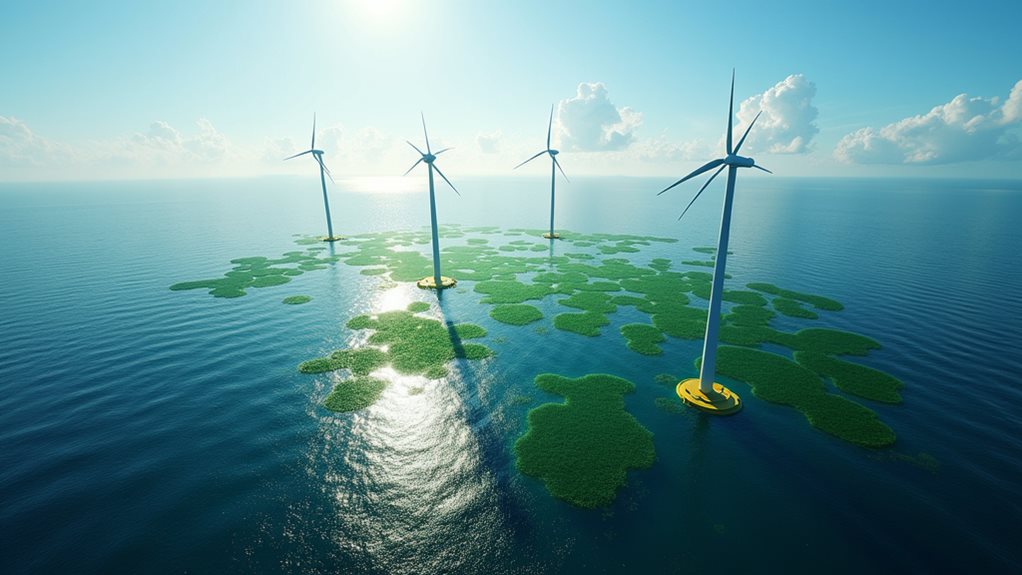
Additionally, the SeaCURE project traps and concentrates CO2 into a near-pure stream for compression and storage. Furthermore, the UK is also experiencing a rise in offshore wind generation, contributing to renewable energy sources needed for these projects.
Yet, with all this excitement comes challenges.
The energy demands of these projects are significant, requiring a shift to renewable sources.
The UK is not just riding the wave; it’s crafting a whole new oceanic narrative in the battle against climate change.