
Recent revelations indicate that emissions from Canadian tar sands operations are a jaw-dropping 6,300% higher than officially reported figures. That’s like claiming your friend ate one slice of pizza when they actually finished the whole pizza party! This discrepancy poses severe health risks, particularly for Indigenous communities, whose traditional foods are contaminated by heavy metals like arsenic and mercury. As regulatory frameworks struggle, the push for transparency and accountability becomes even more urgent. Stay tuned to learn what’s next in this unfolding saga!
Quick Overview
- Actual emissions from Canadian tar sands operations are reported to be 6,300% higher than previously claimed figures.
- Advanced aircraft sensors have revealed significant discrepancies in emissions reporting, indicating systemic issues.
- Air pollution levels near tar sands sites can be up to 64 times greater than reported.
- Indigenous communities are severely impacted, facing health risks due to contaminated traditional foods and water sources.
- Regulatory frameworks are inadequate, with minimal enforcement on emissions violations and insufficient accountability for pollution.
Discrepancies in Reported vs. Actual Tar Sands Emissions
As researchers explore the murky waters of tar sands emissions, they uncover a shocking truth: the numbers on paper don’t quite match the reality swirling in the air. This highlights failures in greenhouse gas reporting standards used to measure emissions. Actual emissions tower over reported figures—think 6,300% higher. While companies tout their cleanliness, air pollution levels can be 64 times greater than claimed. It’s like saying your friend’s cooking is “fine,” when in reality, it’s a culinary disaster. Using advanced aircraft sensors, scientists reveal that these discrepancies aren’t mere oversights; they’re alarmingly systemic. This isn’t just a minor hiccup; it’s a major pollution scandal hiding in plain sight, with actual emissions equivalent to all other sources of emissions across Canada combined. The reliance on advanced techniques to identify discrepancies highlights the urgent need for transparency in environmental reporting.
Health Risks From Tar Sands Emissions on Indigenous Communities
While Indigenous communities have long thrived on the land, the encroaching shadow of tar sands pollution is threatening their very way of life. Integrating sustainable forest management practices could help protect biodiversity and traditional resources near impacted areas.
Elevated toxins like arsenic and mercury are showing up in traditional foods, making moose and fish less appealing on the dinner table—unless one enjoys a side of heavy metals. Heavy metals leach into groundwater, raising alarming concerns about the safety of water sources downstream from tar sands development. The operations divert 652 million cubic meters of fresh water annually, exacerbating the scarcity of clean drinking water for these communities.
With cancer rates soaring, especially among those who consume traditional diets, it’s like playing roulette with health.
Air quality? Let’s just say it’s worse than a campfire on a windy day.
The cultural fabric of these communities frays as they shift from wild game to store-bought options, losing essential nutrition.
Accountability in Tar Sands Management Policies
In the ever-evolving landscape of tar sands management, accountability often resembles a game of hide-and-seek, where the stakes are high and the rules can feel a bit fuzzy. Evaluating impacts across product lifecycles can clarify responsibility at each stage.
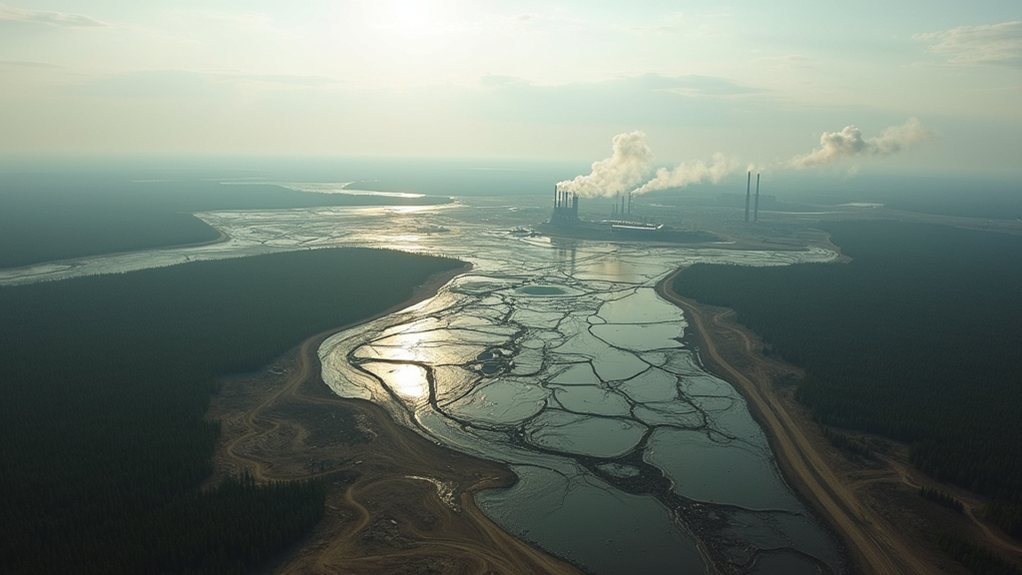
Alberta’s hard cap on tar sands emissions aims for 100 megatonnes, yet enforcement is a ghost—less than 1% of violations are acted upon. The 2008 reform introduced a carbon fee and offset system via Specific Gas Emitters Regulation (SGER), but it achieved only a 3% reduction in emissions from 2007 to 2014. Tailings ponds, sprawling like neglected swimming pools, lack proper regulation, and water licenses flow freely without cleaning. The oil sands process-affected water produced in these operations contains harmful compounds that pose serious environmental risks.
Alberta’s elusive enforcement of its 100 megatonne emissions cap leaves violations largely unchecked, haunting the regulatory landscape.
As regulatory proposals emerge, including stringent effluent standards, the question remains: can accountability rise from the ashes of past laxity, or will it continue to flounder in a murky pond of compliance?