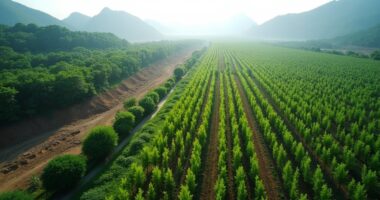

Over the past 25 years, global reforestation has turned barren patches into lush green landscapes, soaking up millions of tons of CO2. Young forests, especially, are like nature’s superheroes, absorbing 25% more carbon than their older counterparts—think of them as the energetic kids in gym class who never tire. Success stories like China’s Grain-for-Green and Kenya’s Hongera Project show that planting trees not only benefits the planet but also local communities. Curious about what’s next in this green revolution?
Quick Overview
- Over 25 years, reforestation initiatives have significantly increased CO2 absorption, with young forests absorbing 25% more than older trees.
- Successful programs, like China’s Grain-for-Green, have transformed millions of hectares into thriving forests, enhancing carbon sequestration.
- Innovative techniques, such as drone seed dispersal, have accelerated reforestation efforts and improved carbon capture rates.
- Protecting young forests ensures sustained CO2 absorption and biodiversity, crucial for long-term environmental health.
- Economic opportunities in sustainable forest management highlight the financial benefits of reforestation while addressing climate change.
Impact of 25 Years of Reforestation on CO2
As scientists and environmentalists marvel at the power of nature, they can’t help but notice that the first 25 years of reforestation can be like a high-energy dance party for carbon dioxide (CO2). These recovering lands also support ecosystem services that benefit people and wildlife.
Young forests, especially those under 140 years, absorb 25% more CO2 than their older counterparts, turning sunlight and air into nature’s own version of an eco-friendly smoothie. Forests bind large amounts of carbon, making them crucial in our efforts to mitigate climate change. Immediate natural regeneration in reforestable areas maximizes carbon removal potential, further enhancing the impact of these young forests.
With secondary forests aged 20-40 years removing carbon up to eight times faster, these rejuvenating woodlands play an essential role in our fight against climate change.
Protecting these young green gems guarantees they continue their tireless CO2-sinking dance for decades to come.
Highlighting Transformative Reforestation Success Stories
Reforestation success stories are akin to the best plot twists in an engrossing novel, revealing how communities and innovative technologies come together to heal the Earth. Implementing sustainable forest management practices ensures restoration maintains biodiversity while providing timber and other resources. China’s Grain-for-Green Program has transformed vast landscapes, turning 28 million hectares of barren land into thriving forests. A/R projects restore ecosystems, enhance biodiversity, and support community livelihoods. Meanwhile, Kenya’s Hongera Project engages locals, planting over 10 million trees and capturing 340,000 tonnes of CO₂ annually. Innovative tech like drone seed dispersal speeds up planting, while initiatives in the Amazon restore native biodiversity. These efforts are complemented by global partnerships on forest restoration, showcasing the power of collaboration, proving that with a little ingenuity and elbow grease, nature can rebound spectacularly.
What’s Next for Global Reforestation Efforts?
What might the future hold for global reforestation efforts? Preserving biodiversity through habitat protection will be crucial to ensure long-term success. As nations ramp up commitments, like India’s ambitious goal to restore 26 million hectares by 2030, the stage is set for a greener tomorrow. However, tree-planting isn’t the magic bullet; industrial decarbonization is essential, according to the UN. With 195 million hectares identified for potential reforestation, there’s room for optimism—if we balance ecosystem preservation with climate goals. Notably, global deforestation rates peaked in the 1980s, highlighting the importance of sustained efforts today. The financial incentives are juicy, too, with a projected $230 billion in sustainable forest management opportunities. Furthermore, reforestation’s cost-effective CO2 removal solutions offer a promising avenue for climate action. It’s a complex puzzle, but with smart strategies, the future could indeed be lushly green.