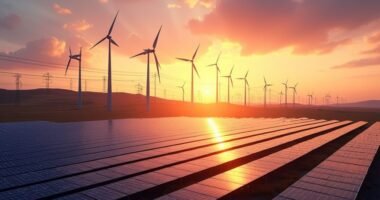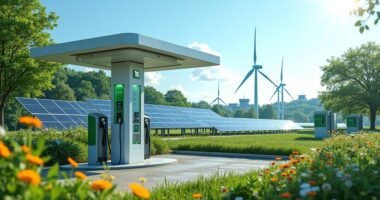
The EU’s journey to a low-carbon economy is like a high-stakes game of financial Jenga. Without the crucial investment in biomass, they risk toppling over into an abyss of steep costs—about €169 billion annually! Biomass is a superstar, providing nearly 59% of renewable energy and decarbonizing heating like a pro. Ignoring it may just make achieving net-zero goals harder than finding a needle in a haystack. Curious to see what strategies might turn the tide?
The Critical Role of Biomass in EU’s Energy Transition
How can the European Union hope to achieve its ambitious net-zero goals without embracing biomass investment?
The reality is that the EU faces a staggering financial mountain to climb, requiring over €29 trillion (that’s right, trillion) by 2050 to shift to a low-carbon economy.
To put that into perspective, they need to almost double their annual low-carbon finance, climbing from €330 billion in 2022 to a jaw-dropping €530 billion by 2030.
Yet, here’s the kicker: there’s an estimated investment gap of around €800 billion each year for green initiatives!
Now, enter biomass—the unsung hero of the energy mix, currently accounting for nearly 59% of renewable energy consumption.
It’s like that dependable friend who always shows up with snacks at a party.
Biomass isn’t just about burning wood; it plays an essential role in decarbonizing heating, enabling carbon dioxide removal through Bioenergy with Carbon Capture and Storage (BECCS), and supporting energy security. BloombergNEF estimates €29 trillion needed to achieve the EU’s climate goals, highlighting the critical importance of diversified investment. Additionally, its sustainability core value ensures that biomass production adheres to important environmental standards, making it a vital component in the EU’s energy strategy.
It’s versatile enough to power everything from industry to transport fuels, making it a key player on the EU’s climate team.
But if the EU decides to sideline biomass, they’d be looking at an extra €169 billion in system costs annually—yikes!
That’s akin to tossing aside wind power and expecting to still host the best energy party in town.
Excluding biomass could make the shift a staggering 14% more expensive, not to mention the alternative solutions like direct air capture that are much pricier and energy-hungry.
With investment misallocation favoring mature sectors, the EU must prioritize funding for harder-to-abate areas like buildings and agriculture.
Effective forest management approaches represent one of the most accessible and cost-effective carbon capture methods available in the EU’s toolkit.
If they continue on this path of neglecting biomass, the ambitious net-zero goals could remain just that—ambitious but unachievable, leaving the EU scrambling for energy like a chef missing key ingredients for a signature dish.