Cargill’s supply chain issues expose a grim reality: deforestation fuels child labor crises. Imagine trees being cut down, robbing the land of resources and forcing families into poverty. With dwindling food sources, kids are pulled from school to work. Cargill’s practices in places like Bolivia have led to massive habitat loss and left communities struggling. To tackle both environmental and social problems, accountability and sustainable practices in supply chains are essential. Stick around to uncover more layers to this complex issue!
Quick Overview
- Cargill’s deforestation practices in Bolivia have significantly increased food insecurity, pushing families to rely on child labor for income.
- The loss of trees from Cargill’s operations has degraded soil health, negatively impacting agricultural productivity and forcing children out of school.
- Deforestation in the Cerrado, exacerbated by Cargill, is nearly three times higher than in the Amazon, worsening local communities’ struggles.
- Weakening of Cargill’s no-deforestation pledge allows sourcing from previously deforested land, perpetuating the cycle of poverty and child labor.
- Increased demands for transparency in supply chains highlight the need for accountability in companies like Cargill to combat environmental and social issues.
The Link Between Deforestation and Child Labor
While it may seem like an odd couple, deforestation and child labor are, unfortunately, linked in a complex dance of desperation and survival.
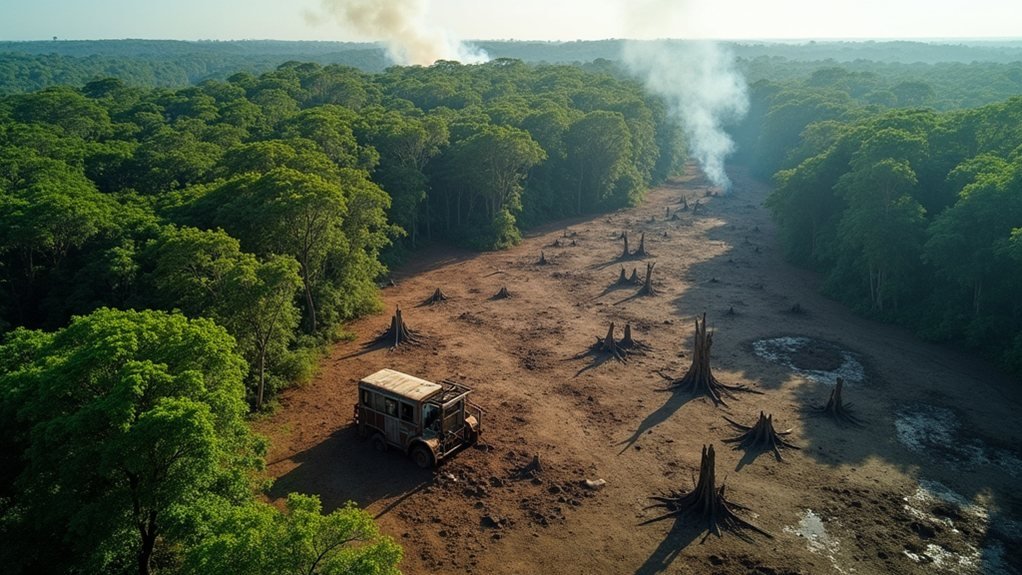
As forests vanish at alarming rates—like 50 football fields a minute—food insecurity rises, pushing families to rely on inadequate nutrition. The loss of trees not only contributes to soil health decline but also exacerbates the struggle for sustainable farming.
With agricultural productivity dwindling, children are often pulled into labor, working to make up for lost income.
This cycle of poverty is relentless; parents withdraw kids from school to meet labor demands, perpetuating a grim intergenerational loop.
Implementing sustainable practices could help restore agricultural productivity while preserving natural resources for future generations.
In this harsh reality, nature’s loss becomes a heavy burden, and children bear the weight of grown-up responsibilities far too soon.
Cargill’s Role in Environmental and Social Exploitation
Cargill, a giant in the global food supply chain, finds itself at a crossroads where environmental responsibility and social ethics collide, much like a car skidding on a slick road. The company’s actions in Bolivia alone have led to significant deforestation, with areas clear-cut exceeding the size of Minneapolis. Meanwhile, Cargill’s cozy relationship with the “Terrible Trio” has resulted in over 133,000 hectares of Cerrado savannah lost. Their weakened no-deforestation pledge raises eyebrows, allowing them to buy from land previously stripped of trees. As profits soar, questions linger: at what cost to the environment and communities? Cargill’s sourcing from remote areas poses a risk to 3 million hectares of standing forest. The stakes couldn’t be higher, especially as deforestation in the Cerrado is nearly three times higher than in the Amazon. This destructive approach directly contradicts the principles of sustainable forest management which aims to preserve biodiversity while responsibly harvesting timber resources.
The Need for Accountability and Sustainable Practices
In the high-stakes world of global supply chains, accountability isn’t just a buzzword; it’s the lifeline that can rescue both ecosystems and communities from the brink. Platforms like Connected4Change foster transparency by enabling suppliers to self-report compliance, ensuring ethical practices aren’t just wishful thinking. With tailored training and performance assessments, suppliers can address issues ranging from child labor to environmental degradation. The C4C approach transforms compliance into a competitive sport, encouraging improvement. Supply chain evaluation methodologies allow companies to systematically assess environmental and social impacts across their entire value chain. As a result, Cargill’s palm oil sourcing program exemplifies how proactive engagement can enhance supplier accountability and drive sustainable practices across the supply chain. As 3 in 5 consumers in Europe actively research environmental pledges, brands must adapt to meet this growing demand for transparency.