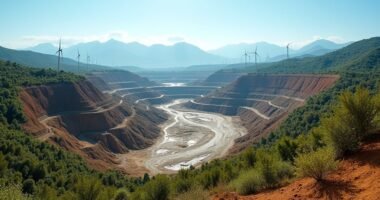

Imagine the U.S. and EU jamming together like an international rock band, reworking critical minerals trade policies to dampen supply chain jitters, and shaking off China’s monopoly hold. Their alliance, born from a 2026 memo, aims for independence by swapping Chinese backing vocals for diverse sources. With environmental and social spotlights, plus some geeky standards, they’re creating a resilient symphony. Curious about their backstage strategies? The real show is just beginning to unfold.
Quick Overview
- The US-EU Strategic Partnership focuses on reducing reliance on China-heavy supply chains for critical minerals.
- A Critical Minerals Action Plan was established to secure materials essential for technology and defense systems.
- The partnership emphasizes alignment in standards and regulatory harmony to prevent operational disruptions.
- Strategies include diversifying sources and partnerships to strengthen supply chain resilience.
- Collaborative agreements aim to tackle supply challenges and fulfill increasing global demand for critical minerals.
What Is the US-EU Strategic Partnership on Critical Minerals?
In a world where geopolitical chess games are played with critical minerals, the US-EU Strategic Partnership stands as a sentinel promising a more secure supply chain for these coveted resources. This alliance, born from an April 2026 memorandum signed by Marco Rubio and Maros Sefcovic, also features an ambitious Critical Minerals Action Plan. Imagine a high-stakes board game where industrial policy, clean energy, and defense preparedness all play essential roles. Here, the US and EU maneuver together to reduce reliance on concentrated, China-heavy supply chains. They aim to secure materials crucial for everything from tech gadgets to sophisticated defense systems. Evaluating suppliers across environmental and social performance criteria has become a critical component of building resilient and responsible mineral sourcing strategies. As global demand for critical minerals rises, the importance of stable supply chains is underscored, focusing on the strategic materials needed for future industries.
What Are the Key Trade Measures to Improve Critical Minerals Security?
How do nations guarantee their tech-driven future doesn’t face a critical minerals shortage crisis? Enter trade agreements.
The U.S. negotiates with nations like Australia and Japan, crafting memorandums akin to backstage passes for minerals. Tariffs? Think of them as protective force fields; they’re slapped on key minerals like cobalt and nickel to fend off overdependence. Allies share economic concerns, cooking up import restrictions in tandem. However, with great power comes great price floors—setting minimums to stabilize tricky market seesaws. To strengthen their coalition, the U.S. focuses on building a resilient supply chain among trading partners such as Europe, which emphasizes the need for a secure and diversified network. To further this strategy, the U.S. has underscored the importance of alliances with trusted partners in ensuring mineral security, as outlined in the Executive Order signed by President Trump. Slick moves, but coordination and diversification are still needed to make sure tech dreams don’t vanish in a mineral mirage.
Beyond trade agreements, nations are increasingly recognizing that climate-related disruptions can further destabilize critical mineral supply chains, making it essential to build resilience against both environmental and geopolitical pressures.
How Do Joint Standards and Cooperation Drive Supply Chain Resilience?
Envision this: The U.S. and the EU rolling up their sleeves and diving into the complex choreography of standards development. They’re not practicing a waltz; they’re creating harmony in critical minerals supply chains. Imagine this: technical cooperation, like two best pals syncing their GPS to avoid detours. These standards are jazzed up to dodge supply chain hiccups created by less-than-cooperative policies elsewhere. Regulatory harmony smooths the path, making transatlantic trade as seamless as zipping down an autobahn. By aligning standards for mining and processing, the duo builds resilience, ensuring critical minerals flow like a well-rehearsed symphony, no matter what the world throws at them. Just as species diversity within an ecosystem strengthens its ability to withstand environmental pressures, a diverse and cooperative network of trade partners reinforces supply chain stability against global disruptions. Despite the nonbinding nature of the agreement, the U.S. and EU are signaling a firm intent to collaboratively address critical mineral supply challenges, showcasing the importance of this partnership. The U.S.-EU Action Plan aims to address non-market policies distorting these supply chains, reinforcing the commitment to a stable and fair trade environment.