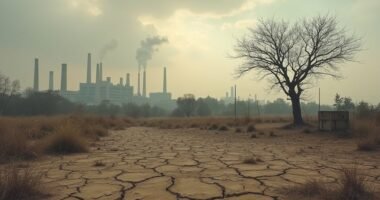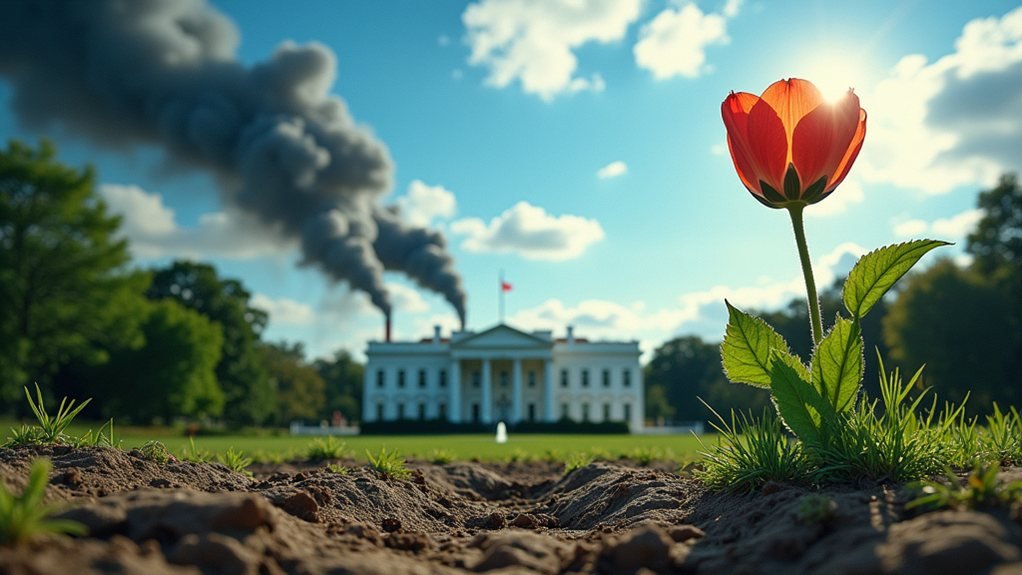

The White House is currently in the hot seat, facing significant blows to environmental protections and essential climate research institutions. These assaults threaten everything from precise weather forecasts to public health safeguards. Without well-funded research, communities risk higher asthma rates and increased vulnerability to extreme weather. It’s like trying to predict a storm while driving blindfolded. As tensions rise, curious minds might want to explore the deeper implications of these actions on society and our environment.
Quick Overview
- The White House has implemented significant rollbacks on environmental protections, threatening public health and safety.
- Dismantling climate research institutions undermines critical weather forecasting and climate event preparedness.
- Economic analysis shows that public costs from environmental rollbacks outweigh corporate savings, leading to increased health risks.
- Public support for stricter environmental regulations contradicts the current administration’s efforts to weaken protections.
- Ongoing climate research is essential for developing effective public health responses and sustainable environmental policies.
Impact of Dismantling Climate Research Institutions on Public Safety and Policy
While one might think that dismantling climate research institutions like the National Center for Atmospheric Research (NCAR) is merely a bureaucratic shuffle, the reality is far more alarming—it’s akin to pulling the fire alarm in a crowded theater only to discover the sprinklers have been turned off.
The loss of NCAR jeopardizes critical weather forecasting, putting public safety at risk. Without precise predictions of storms and climate events, warnings become muddled. Additionally, the closure of NCAR’s Mesa Laboratory threatens vital functions like weather modelling and supercomputing. Furthermore, the dissolution of NCAR means that the U.S. withdrawal from over 60 international organizations will further isolate American research from global scientific collaboration.
Furthermore, dismantling NCAR disrupts essential research that informs environmental policies. Imagine losing the brain behind climate strategies; the consequences could leave communities scrambling like a cat on a hot tin roof. The distinction between mitigation and adaptation is vital to prioritize how remaining research resources are allocated.
How Dismantling Climate Research Institutions Increases Health Risks
As the curtain falls on climate research institutions, the health risks associated with this dismantling are beginning to resemble a horror movie plot—one where the audience is left in the dark, unaware that the “boogeyman” is lurking closer than they think.
Without vital funding, investigations into heat-related mortality and air pollution are fading into obscurity, leaving communities vulnerable to extreme weather effects. Imagine a world where asthma rates soar and deadly diseases spread unchecked, all while essential research on climate impacts vanishes. The recent discontinuation of NOAA’s Billion-Dollar Disasters Database is just one example of how the loss of this knowledge isn’t just a plot twist; it’s a chilling reality that threatens public health. As funding for studies on the health effects of climate change ceases, the impact on active grants only deepens the crisis. International standards for measuring and reporting greenhouse gases, such as those outlining scope definitions, are critical for tracking emissions trends and informing public-health responses.
Impacts of Attacking Environmental Protections on Society and Environment
Attacking environmental protections might seem like a move to lighten the regulatory load on businesses, but the consequences ripple far beyond the boardroom.
With nearly 200,000 projected premature deaths due to air pollution, the stakes are alarmingly high. Daily, over 10,000 asthma attacks are reported, and cancer risks from unchecked pollutants like benzene loom large. Projected premature deaths will strain our healthcare system and contribute to long-term public health deterioration. Furthermore, a majority support for stricter regulations exists in 29 states and D.C., indicating a public demand for action that contradicts the push to weaken protections.
The economic balance tips dramatically, with $6 in public costs for every dollar saved by corporations. As drinking water quality plummets and climate change accelerates, society faces mounting health risks and economic burdens, proving that these regulatory rollbacks aren’t just bad for the environment—they’re bad for everyone. Air pollution includes particulate matter and other pollutants that are monitored to assess health risks.