
Seabed mining is like a high-stakes game of Jenga that threatens to topple delicate ocean ecosystems. It destroys vast areas of the seabed, risking the extinction of countless marine species, many of which we haven’t even named yet! With uncharted deep oceans and their unique habitats at risk, regulations like the American Seabed Protection Act are essential. These protections help balance economic gains with the health of our oceans. Want to explore what more these regulations could mean for our seas?
Quick Overview
- Seabed mining poses a significant threat to marine ecosystems, risking the extinction of species through habitat destruction.
- The American Seabed Protection Act seeks to impose a moratorium on deep-sea mining to safeguard ocean health.
- Sediment plumes from mining operations can smother vital coral and sponge habitats, disrupting marine biodiversity.
- Strong regulations are essential to balance economic interests with the preservation of delicate marine environments.
- The International Seabed Authority is developing a Mining Code to ensure environmental compliance and protect unexplored deep-sea regions.
The Urgent Need to Address Seabed Mining’s Impact on Ocean Ecosystems
As the world dives deeper into the murky waters of seabed mining, it becomes increasingly clear that this trend isn’t just a treasure hunt for precious metals; it’s a potential wrecking ball for delicate ocean ecosystems.
Mining operations can ravage up to 9,000 square kilometers of seabed, destroying habitats with the finesse of a toddler with a crayon. The unintended consequences? Extinction risks for countless species and long-lasting scars on the ocean floor. With polymetallic nodules growing at a snail’s pace—think millions of years—restoration seems like waiting for your favorite show to return from cancellation. Polymetallic nodules are estimated to be 5 to 10 times greater than global terrestrial reserves, emphasizing the urgency of addressing these impacts. Furthermore, the extraction of these minerals occurs in areas that are critical for marine biodiversity, posing risks to deep-sea ecosystems.
Achieving sustainable growth requires balancing economic interests with preservation of marine health, especially when considering irreversible seabed exploitation.
Time is running out; action is vital.
Understanding How Seabed Mining Disrupts Marine Biodiversity
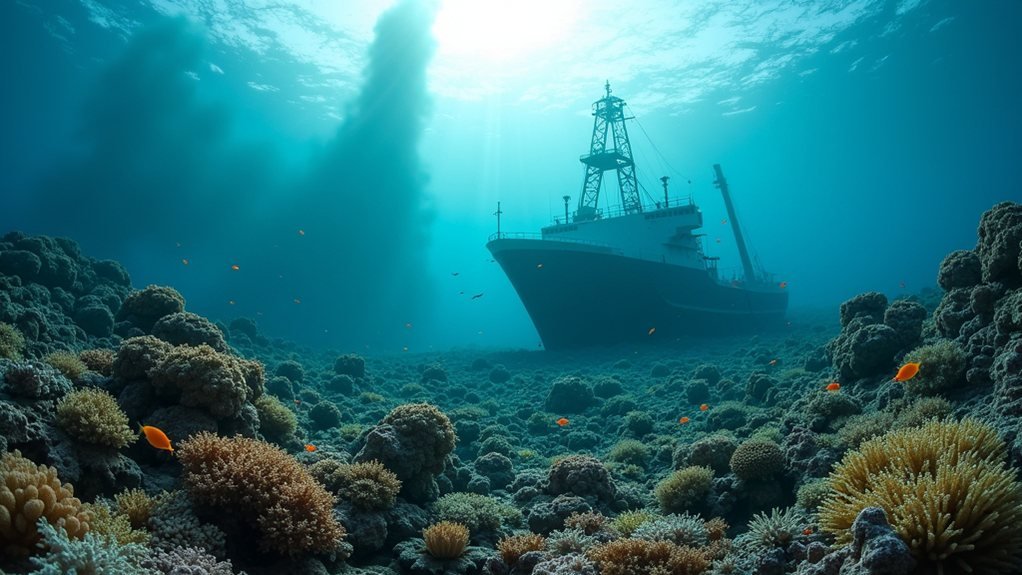
Seabed mining resembles a high-stakes game of Jenga, where each reckless pull threatens to topple not just the tower but the intricate web of marine life below. As mining operations strip away seafloor sediment, they obliterate habitats and push species to the brink of extinction before scientists even have a chance to study them. The degradation of vulnerable deep-sea ecosystems resulting from these activities is a significant concern for the health of our oceans. Recent studies suggest that over 5,000 unnamed benthic species could be lost before they are even identified due to these destructive practices. The resulting sediment plumes smother delicate corals and sponges, causing chaos in their once serene homes. Meanwhile, noise and light pollution disrupt communication among marine creatures, altering their behavior. Sustainable fisheries remain threatened by these mining activities as they disturb crucial breeding grounds and food sources. It’s a recipe for disaster—one that could wipe out centuries-old ecosystems and render unique species mere memories.
What Regulations Are Needed to Protect Our Oceans From Mining Threats?
How can we shield our oceans from the looming threats of seabed mining? Strong regulations are essential, like a superhero cape for marine life.
The American Seabed Protection Act, for instance, proposes a moratorium on deep-sea mining until we fully grasp the environmental impacts. Deep oceans are largely unexplored and contain fragile ecosystems, making immediate protective measures critical.
Meanwhile, the International Seabed Authority is crafting a Mining Code to ensure compliance with global environmental requirements while balancing economic needs with rigorous environmental standards.
Regulations like the Deep Seabed Hard Mineral Resources Act and NOAA oversight guarantee responsible exploration.
With enforcement mechanisms in place, these regulations act as a lifeline, protecting our oceans while we figure out how to responsibly harness their resources.
Similar to sustainable forest practices, seabed regulation must prioritize biodiversity preservation while allowing for carefully managed resource extraction.