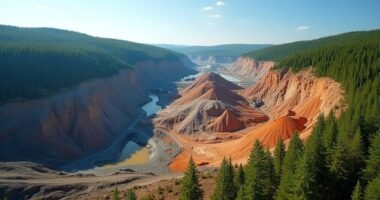

New Brunswick’s mining strategy is stirring a lively debate akin to a potluck where everyone’s unsure of what’s cooking. On one plate, there’s promise for economic growth fueled by 21 critical minerals; on the other, concerns over Indigenous rights getting sidelined like unwanted garnish. Critics liken the strategy’s purported collaboration to a magician’s disappearing act, where true Indigenous engagement vanishes. Tailings and toxic waste highlight the environmental woes. Stick around for insights as this mineral saga unfolds.
Quick Overview
- New Brunswick’s mining strategy faces criticism for insufficient Indigenous engagement and repeated past consultation mistakes.
- Environmental concerns like toxic waste and wildlife displacement challenge the province’s focus on economic growth.
- The strategy is perceived as prioritizing economic development over Indigenous rights and environmental stewardship.
- Regulatory processes risk undermining environmental accountability with past projects highlighting potential ecological dangers.
- Indigenous and environmental stakeholders express concern over genuine collaboration and long-term resource sustainability.
Indigenous Engagement: New Opportunities or Familiar Patterns?
How does one paint a fresh picture on an old canvas without muddying the colors? New Brunswick’s mining strategy claims it will do just that with Indigenous engagement, but are these truly new opportunities or echoes of past missteps? Provincial commitments promise to support Indigenous careers and champion economic ventures, like a shiny new toolbox. However, gaps in consultation processes loom, hinting at the same pitfalls of neglect. Critics have noted that local organizations like the Conservation Council of New Brunswick were excluded from key consultations, raising concerns about the strategy’s inclusiveness. Some wonder if genuine collaboration is missing in action, much like a magician’s vanished rabbit. With 21 of Canada’s critical minerals occurring in New Brunswick, the province’s mineral wealth could better support both economic and community development. While the federal side touts FPIC — keeping promises and potential slightly out of sync.
Environmental Impact: Balancing Growth and Preservation?
Why does the tug-of-war between economic growth and environmental preservation often feel like choosing between a rock and a hard place? Because mining, by its very nature, is a bit of a bull in a china shop, smashing ecosystems left and right.
Toxic waste, water contamination, and wildlife displacement are just appetizers on a menu of unavoidable consequences. And while modern best practices try to minimize the damage, they’re like putting a band-aid on a landslide. Enhanced regulatory processes may not only fail to prevent these issues but could also undermine long-term environmental accountability, as seen with past projects like the Sisson mine. New Brunswick’s current strategy lacks clear communication about community and environmental risks associated with mining operations.
With the looming threat of tailings impoundment failures, as witnessed in British Columbia, risks to watersheds and communities underscore the precarious balance at play. Before any shovel breaks ground, a thorough environmental impact assessment should evaluate potential ecological consequences and establish measurable benchmarks for protecting affected landscapes.
Economic Growth vs. Indigenous Rights: A Delicate Balance
While New Brunswick’s mineral strategy positions a robust economic engine in the bustling marketplace of resource development, it navigates a delicate tightrope between progress and the rights of its Indigenous peoples. The government’s commitments to Indigenous involvement resemble a playbill filled with character-driven dialogue, but lacks the act of giving them the spotlight. Think of the strategy as a GPS, guiding the province to economic prosperity while, unfortunately, skipping a few road signs of Indigenous approval and environmental caution. Critics argue that accelerated regulation processes risk becoming a joyride that breezes past the essential pit stop of Indigenous engagement. Ensuring that mineral extraction practices prioritize long-term resource availability is essential to preserving both the environment and the well-being of future generations. Moreover, the report was unveiled at the mining and petroleum industry conference in Fredericton, highlighting the government’s push for economic development through projects like the proposed Sisson mine.