The UK Land Use Framework is a strategic guide harmonizing farming, nature, and sustainability. It aims to transform land management by balancing housing, agriculture, and biodiversity. Think of it as a recipe for success: a dash of high-yield farms, a sprinkle of nature recovery, and a generous helping of tech-savvy solutions. With the potential for 1.6 million hectares to shift by 2050, it’s all about adapting while keeping the environment cozy. Want to learn how this affects farming? Keep exploring!
Quick Overview
- The UK Land Use Framework promotes a balance between agricultural productivity and environmental sustainability, addressing competing land demands.
- It designates areas for high-yield farmland while preserving semi-natural spaces to enhance biodiversity.
- The framework encourages regenerative farming practices that improve soil health and reduce emissions, supporting nature recovery.
- Technology, such as precision agriculture, optimizes resource use, enhancing both farming efficiency and environmental conservation.
- By 2050, the framework anticipates significant land use changes to create a sustainable balance between food production and ecological health.
What You Need to Know About the UK Land Use Framework
The UK Land Use Framework stands as an essential blueprint for steering the intricate dance of land management, much like a skilled conductor harmonizing diverse instruments in an orchestra.
This framework addresses competing demands—housing, agriculture, energy, and nature recovery—all while ensuring food security and climate resilience. It aims to improve spatial planning for agriculture, housing, energy, and nature recovery without being prescriptive. A commitment to rewilding initiatives is essential in promoting biodiversity and addressing the climate crisis.
It’s a non-prescriptive guide, supporting existing planning systems rather than replacing them.
By utilizing data-driven decision-making, it promotes a multifunctional land approach, balancing social, economic, and environmental objectives. The framework increasingly incorporates indigenous knowledge that has proven effective in sustainable ecosystem management over centuries.
Think of it as a game plan for land use, where trade-offs are managed like a tightrope walker balancing priorities without toppling over.
How the UK Land Use Framework Affects Farming Practices?
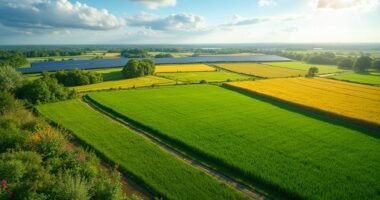
Farming practices in the UK are on the brink of a transformation, driven by the innovative UK Land Use Framework. This framework reimagines land usage, designating areas for diverse functions like semi-natural spaces and high-yield farmland. While 9% of agricultural land may shift to non-agricultural purposes, farmers are encouraged to adopt regenerative practices and productivity enhancements. It’s not about strict rules but a flexible strategy that allows farmers to balance food production with environmental benefits. These approaches emphasize soil health maintenance as a cornerstone of sustainable agricultural systems. This approach is essential for addressing diverse land demands while ensuring sustainable practices in agriculture. By 2050, an estimated 1.6 million hectares of land use change is needed to achieve these goals. Think of it as giving farming a modern makeover, where sustainability and productivity can strut down the same runway, hand in hand.
Effective Practices for Sustainable Agriculture and Nature Conservation
A remarkable shift is underway in the domain of agriculture, where effective practices for sustainable farming and nature conservation are becoming the norm rather than the exception.
Agri-environment schemes have expanded greatly, covering over 5.8 million hectares and boosting payments to £1.1 billion in 2024. The UK has seen a stable production to supply ratio for indigenous foods, highlighting the importance of balancing domestic production with sustainable practices. Organic farming thrives with 503,000 hectares dedicated to it, while regenerative agriculture enhances soil health and reduces emissions. This growth is part of a larger trend, with the UK sustainable agriculture market projected to reach USD 1,177.88 Million by 2033.
Precision agriculture employs tech like AI and smart irrigation to optimize resources. Many of these agricultural approaches incorporate forest management principles that maintain biodiversity while still providing valuable timber and other resources. As the sustainable agriculture market booms, farmers are not just growing crops but cultivating a greener future—one that even Mother Nature would cheer for!