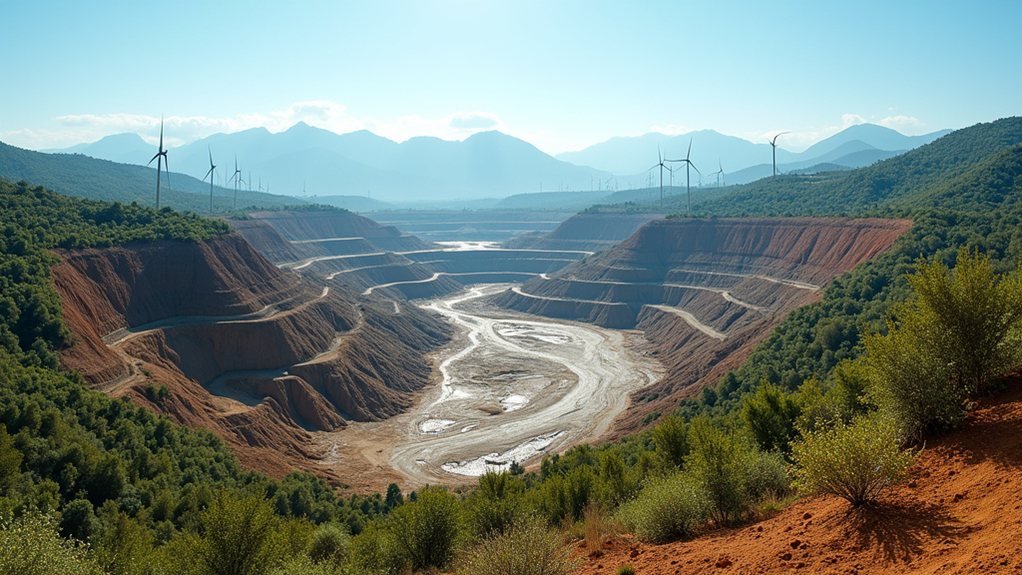

The U.S. is ramping up its quest for critical minerals from the Global South, building partnerships with countries like Argentina and Morocco by March 2026. Think of it as an international treasure map highlighting resilient supply chains designed to outsmart supply chain vulnerabilities and combat PRC dominance. These efforts include modern mining techniques and sustainable practices that balance current needs with future preservation. Curious about how it all shakes out? Stay tuned for an inside look at this evolving landscape.
Quick Overview
- The FORGE initiative enhances U.S. partnerships with Global South countries, aiming to secure critical mineral resources by March 2026.
- New bilateral agreements focus on reducing supply chain vulnerabilities and promoting resilient sourcing of minerals essential for technology and defense.
- U.S. strategy emphasizes diplomatic relations, fostering alliances to strengthen mineral supply networks against China’s market influence.
- Innovations in sustainable mining techniques are anticipated, ensuring environmental assessments are prioritized in critical mineral extraction and processing.
- Circular economy initiatives are emerging, promoting recycling efforts to bolster supply chains and reduce dependence on new mineral sourcing.
How the US Plans to Secure Critical Minerals From the Global South
In a strategic move that resembles a high-stakes game of chess, the United States is rolling out an ambitious plan to secure critical minerals from the Global South.
The FORGE initiative, recently launched, aims to collaborate on policies that guarantee diverse mineral sourcing, much like a recipe requiring various ingredients for a well-rounded flavor.
With 21 new frameworks signed, including partnerships with Argentina and Morocco, the U.S. seeks to create resilient supply chains.
These partnerships are designed to build resilient supply chains that can withstand climate-related disruptions and geopolitical trade shifts.
Significant US Agreements to Enhance Mineral Supply With Global South Nations
Strategic partnerships are the name of the game as the United States rapidly expands its agreements with Global South nations in a quest for critical minerals.
Recently, 11 new bilateral frameworks were signed, featuring countries like Argentina and the Philippines, enhancing an existing roster of strategic allies.
This influx of agreements aims to address supply chain vulnerabilities and bolster cooperation, reminiscent of assembling a diverse team for a championship game.
With a focus on up-stream investments, these pacts allow the U.S. to counterbalance PRC dominance, ensuring a robust mineral supply while making friends in unexpected places.
By prioritizing upstream investments, the U.S. strengthens mineral supply chains while fostering unexpected alliances.
Who knew diplomacy could be so valuable?
Effective sustainable resource management requires balancing current extraction needs with the preservation of these critical minerals for future generations.
Exploring Supply Chain Impacts and Market Dynamics in 2026
A vibrant landscape of supply chain dynamics is evolving around critical minerals as the world edges closer to 2026.
The U.S. and EU are scrambling to build alternatives to China’s stronghold, though new ventures are more like a toddler in a race than a track star.
Trade tensions have exposed fragility in sectors from automotive to defense, while the focus shifts toward enhancing processing capabilities.
Circular economy initiatives are gaining traction, recycling old tech to bolster supplies.
As old mining methods fade, companies touting efficient, eco-friendly techniques are ready for federal funding—because in this high-stakes game, every bit counts!
Evaluating environmental and social performance across these supply chains requires comprehensive methodologies to assess sustainability impacts from extraction through processing.