
The UK is diving headfirst into the critical minerals race, blending strategy and wit to boost its economic muscles. With a cunning plan akin to a chess grandmaster’s, they’re fast-tracking lithium production, eyeing to meet half of their EV demand by 2030, all while stashing minerals like squirrels in autumn. This isn’t just about keeping the lights on; it’s about staying ahead in a competitive global game. There’s more beneath this mineral surface worth uncovering.
Quick Overview
- UK aims to stockpile critical minerals to secure supply chains and enhance defense capabilities.
- Domestic lithium projects, like Cornish Lithium, target substantial production to meet significant EV demand.
- Strategic initiatives focus on reducing reliance on China through increased domestic sourcing by 2035.
- GBP1.79 billion investment supports mining and processing efforts to boost the UK economy.
- Emphasis on sustainability ensures responsible sourcing and minimal ecological impact in UK lithium projects.
UK’s Strategic Approach to Critical Minerals
Let’s plunge into the UK’s strategic approach to critical minerals, a game plan that reads like a blueprint for grand adventure.
Positioned as the backbone of its green growth saga, the Vision 2035 framework paints a vivid ten-year tale. Picture demand for copper nearly doubling, while lithium scales new heights—a whopping 1,100% jump! As part of this transformative journey, the UK aims for 10% domestic production of critical minerals and 20% recycling by 2035. In addressing geopolitical risks, the strategy ambitiously transforms vulnerabilities into opportunities by leveraging UK strengths in processing, recycling, and finance.
Two core missions: ramp up homegrown supply and fortify global mineral networks. Pegged on a pragmatic outlook, it earmarks GBP1.79 billion for the economy. These minerals are essential to expanding advanced electrical grid technologies that support greater renewable energy adoption and improved efficiency across the nation.
Boost domestic sources and strengthen global ties, with GBP1.79 billion fueling the mission.
Envisaging a mineral-imbued renaissance, it declares not to rely heavily on one nation. Rest easy, UK’s mineral map is diverse and daring!
Boosting Domestic Lithium Production
After showcasing its strategic vision for a mineral-rich future, the UK commences on the exhilarating endeavor of boosting its domestic lithium production—a mission with ambitions as grand as Cornish cliffs.
With Cornish Lithium’s Trelavour plant leading the charge, the aim is to transform granite into 10,000 tonnes of lithium hydroxide by 2029.
But that’s just the tip of the battery-powered iceberg.
Imerys British Lithium adds to the symphony with pilots that promise to make the Queen envy their sustainability. No commercial lithium production currently exists in Europe, making the UK’s efforts to develop its own resources critical for supporting its future technologies reliant on lithium-ion batteries.
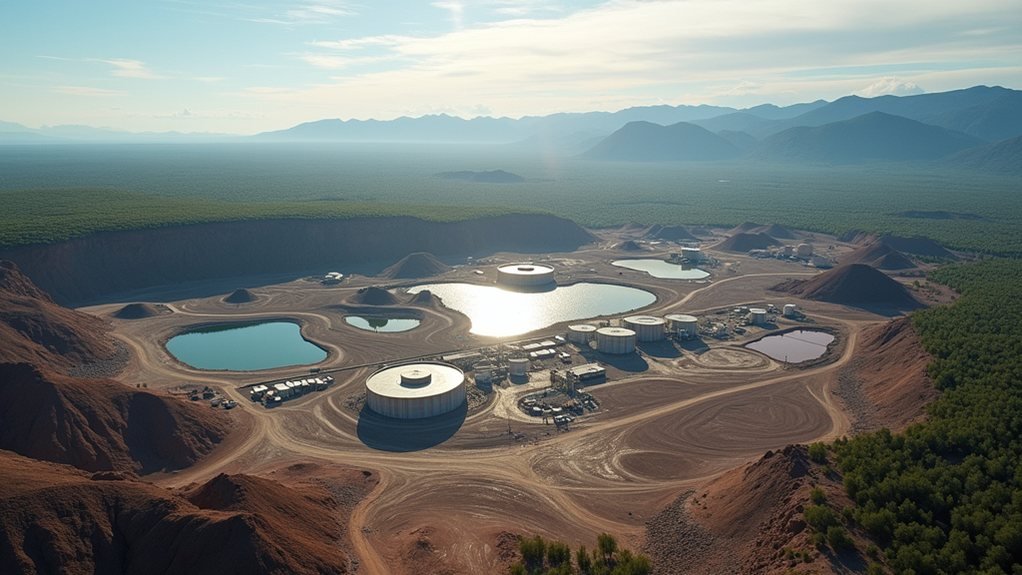
While the UK’s lithium dreams face supply challenges, they’re in a race not just to keep up, but to lead. The production at the repurposed china clay quarry in Cornwall demonstrates the potential to meet 50% of the UK’s EV demand by 2030. Responsibly sourcing these minerals requires careful land stewardship, much like the principles of sustainable forest management that balance resource extraction with preserving the surrounding ecosystem and biodiversity.
Stockpiling for Defense and Supply Chain Security
In a world where minerals are as coveted as the crown jewels, the UK’s plan to stockpile critical resources feels like assembling a superhero team for the defense sector. By hoarding essential minerals, they’re not just collecting shiny rocks. They’re fortifying the defense supply chain like a knight tightening armor. Reliance on China is a dragon they’re keen to tame, aiming to source at least 30% domestically by 2035. This mineral strategy is part of the AUKUS pact, with allies Australia and the U.S. joining forces. The UK government has announced funding of up to £65.58 million to support this strategy, ensuring that their ambitions are backed by substantial resources. With copper and lithium demand soaring, stockpiling isn’t just smart—it’s a strategic necessity. Building geopolitical trade resilience into the supply chain is increasingly recognized as essential for nations seeking to protect critical industries from disruption. In addition, the UK is placing an emphasis on domestic processing, which underscores the necessity of reducing foreign reliance and bolstering the local mining industry.