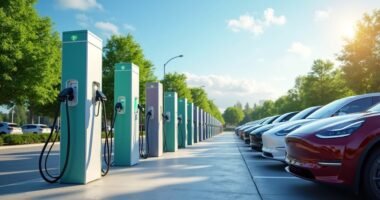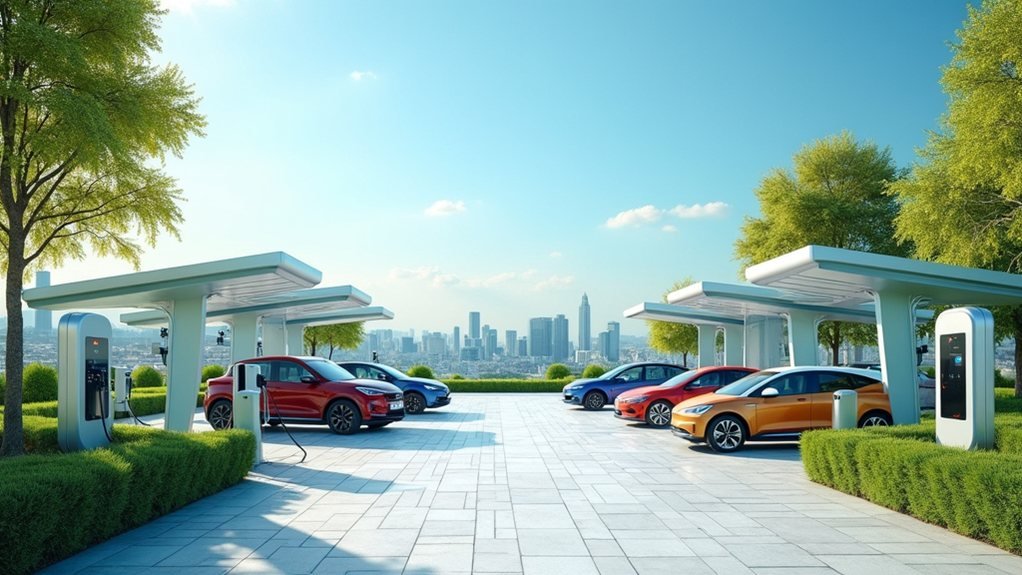

The United States has powerfully snagged third place in the 2025 Global EV Charging Index, thanks to a boom in fast-charging stations and a surge in electric vehicle enthusiasts. With nearly 60,000 fast-charging ports deployed and high public satisfaction, the U.S. is revving its engines for a greener future. However, challenges like rising charging costs still linger. Curious about how the U.S. stacks up next to its neighbors in North America? There’s more to uncover!
Quick Overview
- The U.S. ranks third in the 2025 Global EV Charging Index, boosted by increased fast-charging station availability.
- Nearly 60,000 fast-charging ports have been deployed, with 11,687 stations available as of Q2 2025.
- A significant surge in EV adoption and NEVI program funding contributed to the U.S. ranking improvement.
- Public charging convenience improved to 82%, although rising charging costs impact overall satisfaction rates.
- Canada’s ranking improved to 11th, highlighting regional disparities in EV charging infrastructure across North America.
United States Achieves Third Place in Global EV Charging Index
In 2025, the United States proudly claimed third place in the Global EV Charging Index, a significant leap that has many cheering like fans at a championship game. This rise reflects a boost in fast-charging station availability and a surge in EV adoption, powered by strong federal funding, particularly from the NEVI program. Evaluating metrics like charger density and reliability, the index shows the U.S. outpacing several European and Asian markets. With nearly 60,000 fast-charging ports and a commitment to expanding infrastructure, the nation is clearly revving up for an electrifying future, leaving doubts about its charging capabilities in the dust. Furthermore, the total US fast charging stations reached 11,687 by Q2 2025, showcasing the rapid growth of the charging network. This expansion is highlighted by the over 7,600 new ports deployed in the first half of 2025, demonstrating the nation’s focus on enhancing EV infrastructure. The expansion of charging infrastructure coincides with major manufacturer commitments to phase out internal combustion engines in favor of electric vehicles in the coming decade.
Regional Performance and Infrastructure Development in North America
A vibrant tapestry of electric vehicle (EV) adoption and charging infrastructure is unfolding across North America, showcasing a mix of progress and challenges. Canada, ranked 11th, boasts a maturing market, while Mexico, sitting at 25th, is still finding its EV footing. Strikingly, 78% of North American drivers enjoy the luxury of home charging, far exceeding the global average. However, public charging remains strained, with high vehicle-to-charger ratios. Despite the home-centric model, the demand for fast public charging hubs persists, especially as infrastructure development faces challenges like grid capacity. In 2024, the region saw over 1.9 million EV sales, reflecting the growing interest in electric mobility. Notably, DC fast chargers are up 35% year over year, indicating a positive trend in charging infrastructure. The shift toward electric vehicles represents a critical step in sustainable mobility solutions that can significantly reduce transportation’s environmental footprint. North America’s journey is a thrilling ride, with plenty of twists ahead!
User Satisfaction Trends in Charging Experience and Costs
How satisfied are North American electric vehicle (EV) drivers with their charging experiences? Surprisingly high! A solid 53% express satisfaction, with the U.S. leading at 54%.
Home charging reigns supreme, covering 65% of miles, while public charging sees a commendable bump in convenience—82% feel it’s improved recently. Additionally, the U.S. added 37,000 charge points this year, reflecting an ongoing commitment to enhance accessibility. Canada’s success rates surpassed the U.S. for the first time in two years, illustrating a noteworthy shift in regional performance.
However, the cost of charging stirs mixed feelings, as rising prices become a sticking point for many.
J.D. Power notes that while reliability is on the upswing, overall satisfaction dips, primarily due to cost concerns.
It’s a classic case of “you get what you pay for,” but many are still keen to plug in again! The transition to renewable energy through EV adoption represents a critical step toward reducing carbon emissions and creating a more sustainable energy future.