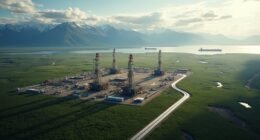
Direct Air Capture (DAC) is like giving Earth a giant vacuum cleaner, sucking CO₂ out of the atmosphere to help fight global warming. With technologies like solid sorbent DAC and liquid solvent DAC, these systems efficiently capture carbon, acting as climate superheroes. Leading companies such as Climeworks and Carbon Engineering are pioneering these innovations. However, challenges like high costs loom large. Curious how government policies can supercharge DAC’s potential? Stick around to uncover more!
Quick Overview
- Direct Air Capture (DAC) technologies efficiently remove CO₂ from the atmosphere, addressing climate change by functioning like a large-scale vacuum cleaner for carbon.
- Leading DAC systems include Solid Sorbent, Liquid Solvent, and Electrochemical methods, each utilizing different materials and processes for CO₂ capture.
- Companies like Climeworks and Carbon Engineering are pioneering DAC projects, capturing thousands of tons of CO₂ annually to help meet global emission targets.
- Financial incentives, such as the 45Q tax credit, are crucial for driving investment and expanding DAC technology adoption across industries.
- Integration of DAC with renewable energy infrastructure enhances operational efficiency and supports the transition to sustainable carbon management solutions.
What Is Direct Air Capture and Why Does It Matter?
Direct Air Capture (DAC) might sound like something out of a sci-fi movie, but it’s a very real and innovative technology that aims to tackle one of the biggest challenges of our time: excess carbon dioxide (CO₂) in the atmosphere.
Imagine a giant vacuum cleaner for the Earth, pulling CO₂ from the air and storing it safely underground. DAC boasts unlimited potential, capturing vast amounts of carbon efficiently—up to 12 tonnes per square meter annually, far surpassing trees. Additionally, DAC systems can be deployed in various locations, independent of emission sources, enhancing their effectiveness in carbon removal. This technology allows for precise measurement of captured CO₂, ensuring reliable carbon accounting.
With no need for arable land and global deployment options, DAC is a flexible, scalable solution poised to make a significant impact on climate change. DAC is increasingly considered alongside other key technologies like carbon capture and green hydrogen in corporate net-zero strategies.
How Direct Air Capture Works: The Science Behind the Technology
While the concept of capturing carbon dioxide from the air might sound like something out of a futuristic fantasy, it’s actually grounded in solid science.
Direct Air Capture (DAC) begins with fans that pull air into a facility, where CO2 binds to specialized materials—think of it as a clingy friend that won’t let go. The rest of the air escapes, while the saturated material undergoes a treatment to release pure CO2. DAC technology is designed to separate CO₂ from ambient air, making it essential for addressing the rising atmospheric CO₂ levels. With the IPCC emphasizing the need to remove 10 billion tonnes of CO2 annually, DAC plays a crucial role in combating climate change. Many DAC systems can be paired with carbon storage methods like geological reservoirs to permanently keep CO2 out of the atmosphere.
Techniques vary, from porous solids to liquid solutions, but all aim to isolate CO2 efficiently. Once captured, this greenhouse villain can be compressed and stored, paving the way for a cleaner future.
Seven Game-Changing Direct Air Capture Technologies
As the world grapples with the urgent need to reduce carbon emissions, innovative technologies are stepping up to the plate, ready to tackle the challenge of climate change head-on. Among them, Solid Sorbent DAC captures CO₂ with engineered materials, while Liquid Solvent DAC uses alkaline solutions for large-scale operations. Electrochemical DAC, an emerging player, harnesses electricity for efficient separation. Hybrid systems like Avnos HDAC capture CO₂ and water simultaneously. Mineralization techniques, including Heirloom and Capture6, convert CO₂ into stable carbonates. Each technology brings unique strengths, proving that in the battle against climate change, variety is indeed the spice of life. Additionally, Carbon Capture Inc. recently launched the Leo Series of DAC systems, showcasing the growing demand for carbon removal credits. Notably, DAC companies aim for scalability and efficiency in carbon capture solutions, focusing on reducing energy costs associated with CO₂ capture. Governments and industries are increasingly exploring cross-sector strategies to integrate these technologies across energy systems and economic sectors.
Leading Players in Direct Air Capture
In the ever-evolving landscape of climate technology, a select group of pioneers is making waves with their innovative approaches to Direct Air Capture (DAC).
Climeworks, with its modular systems and impressive Orca plant, captures 4,000 tons of CO₂ annually. [The global market for CCUS technologies is projected to grow significantly, with a CAGR of 23.1% from 2024 to 2029, driven by the increasing demand for measurable climate outcomes.]
Climeworks is leading the charge in carbon capture with its Orca plant, removing 4,000 tons of CO₂ each year.
Carbon Engineering’s STRATOS project, backed by Occidental Petroleum, aims for a staggering 500,000 tons per year. Meanwhile, Avnos Inc. is turning heads with its water-positive HDAC technology. Capture6, a public benefit corporation, is on a mission for gigaton-scale removal. These players are not just capturing carbon; they’re shaping the future of our planet—one molecule at a time!
Challenges Facing Direct Air Capture: What Are the Risks?
Direct Air Capture (DAC) technologies, despite their potential to combat climate change, face a myriad of challenges that could make even the most optimistic environmentalist furrow their brow.
High costs plague DAC; capturing a tonne of CO2 can be pricier than traditional methods. Energy demands are massive, as facilities require abundant renewable sources to operate. Environmental justice concerns arise from the toxic impacts of chemical absorbents used in DAC, highlighting the need for a more equitable approach. Furthermore, the current projections suggest the need to build approximately 30,000 DAC factories to meet ambitious emission targets.
Scalability poses further hurdles, needing thousands of factories to meet targets. Ties to fossil fuels complicate the narrative, with critiques about delaying real emissions cuts.
Ultimately, environmental risks loom, from water strain to toxic byproducts, all while trying to save the planet. Businesses can combine reductions with carbon offsets as part of broader strategies to balance emissions. Quite the juggling act!
How Do Government Policies Boost Direct Air Capture?
While many might view climate change as a formidable challenge, government policies are stepping up to the plate, swinging for the fences with Direct Air Capture (DAC) technologies.
With a whopping $3.5 billion from the Bipartisan Infrastructure Law, four DAC hubs are set to capture over a million tons of CO2 each annually. Eighteen DAC plants currently operating globally show the growing commitment to this vital technology. Recent innovations have reduced costs and increased options for CO2 removal, paving the way for further advancements in DAC.
The enhanced 45Q tax credit, now worth up to $180 per ton, acts like rocket fuel for investment, while state initiatives, like California’s Climate Crisis Act, keep the momentum rolling.
Together, these policies create a supportive ecosystem, turning ambitious DAC dreams into tangible solutions for a cooler planet. Grid modernization is also helping integrate DAC facilities efficiently by enabling advanced grid technologies that support variable loads and renewable energy.
Future Outlook for Direct Air Capture Technologies
As the world grapples with the pressing need to tackle climate change, the future of Direct Air Capture (DAC) technologies appears brighter than ever, promising to transform the way carbon dioxide is managed. With market projections showing explosive growth, from $0.11 billion in 2025 to $0.69 billion by 2029, DAC is set to capture attention—and carbon! Major projects like STRATOS and innovations using limestone-based materials signal a leap toward gigaton-scale removal. This growth is driven by a projected market growth rate of 56.7% CAGR for Direct Air Capture. As verified DAC credits become increasingly sought after due to corporate climate pledges, companies like Microsoft invest in DAC credits, this technology offers a promising pathway to meet net-zero targets, proving that managing CO2 might just be the next big thing.