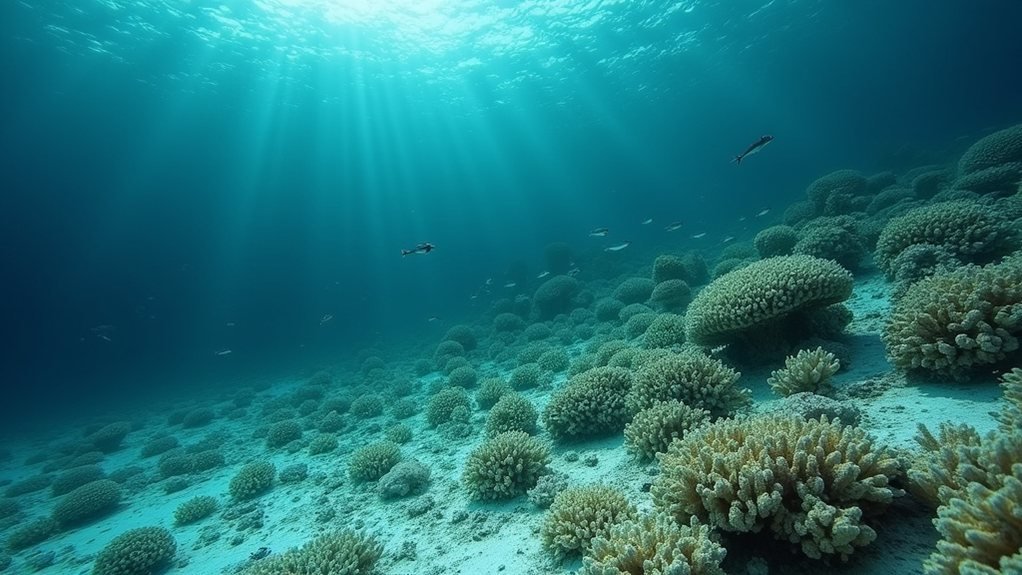

Coral reefs, the bustling highways of ocean life, may be facing a catastrophic collapse by 2026. With over 80% of reefs feeling the heat of rising ocean temperatures, these vibrant ecosystems are under intense stress. If global temperatures exceed critical thresholds, coral bleaching and loss could reach a point of no return, putting countless marine species and human livelihoods at risk. But don’t hang up the snorkeling gear just yet—there’s still room to explore solutions before the tide goes out.
Quick Overview
- Over 84% of coral ecosystems have experienced bleaching, with rising ocean temperatures threatening their survival.
- Predictions indicate mass dieback of coral reefs could occur by 2026 if conservation efforts are not intensified.
- Global ocean temperatures have already increased by 1.4°C, surpassing critical thresholds for coral health.
- Coral reefs are vital for biodiversity, supporting 25% of marine life and nearly 1 billion people’s livelihoods.
- Immediate actions, including establishing Marine Protected Areas and reducing local stressors, are essential to prevent reef collapse.
What’s Happening to Coral Reefs Around the World?
What on earth is happening to coral reefs around the globe? Since January 2023, over 84% of coral ecosystems have succumbed to bleaching, with a staggering 80% of reefs affected across oceans.
It’s like a global coral spa day gone horribly wrong, as the ocean warms by 1.4°C, breaching a vital tipping point. The heat-sensitive corals are waving goodbye, replaced by algae that smothers potential new growth. With frequent disturbances pushing temperatures higher, these underwater cities are crumbling. An estimated 30%-50% of coral reefs have already been lost over the past few decades, and if recovery windows keep shrinking, 2026 could be the year we witness widespread collapse.
Coral reefs need help—fast!
Urgent Actions to Protect Coral Reefs
Revitalizing coral reefs isn’t just a noble aspiration; it’s a necessity that demands immediate action. Marine Protected Areas (MPAs) serve as lifeguards, shielding reefs from overfishing and pollution, while ambitious initiatives aim to restore coral cover from a mere 2% to 25%. Think of coral gardening as nature’s version of landscaping—outplanting and nurturing resilient corals. Innovative technologies, like solar-powered buoys and autonomous drones, monitor reef health and remove pesky invasive species. With global commitments and local stressor reductions, the tide can turn. It’s critical to remember that coral reefs provide habitats for 25% of all marine life. Moreover, nearly 1 billion people rely on coral reefs for their livelihoods, highlighting their immense importance. It’s time to roll up sleeves and plunge into action—after all, coral reefs are the party hosts of the ocean! Coral reefs are facing multiple threats, including warming seas, acidification, and pollution, underscoring the urgency of integrated ocean protection strategies.
The 2026 Tipping Point for Coral Reefs
As the globe continues to warm, the fate of coral reefs hangs precariously in the balance, with 2026 looming as a potential tipping point that could seal their destiny. With global temperatures already 1.4°C above pre-industrial levels, corals are facing widespread bleaching—over 80% have succumbed in just two years. Warm-water corals are expected to pass a point of no return, likely even under scenarios limiting global warming to 1.5 degrees Celsius. This isn’t just a vacation gone wrong for these underwater cities; it’s a catastrophe. By 2026, scientists predict an irreversible decline, threatening not just the reefs but the billion people relying on them for food and protection. The latest reports indicate that mass dieback risk may become a reality if urgent conservation measures are not implemented. If we don’t act fast, it may be lights out for coral reefs worldwide. Biodiversity supports ecosystem services and resilience in marine systems, underscoring the critical need to safeguard reef habitats and the communities that depend on them.