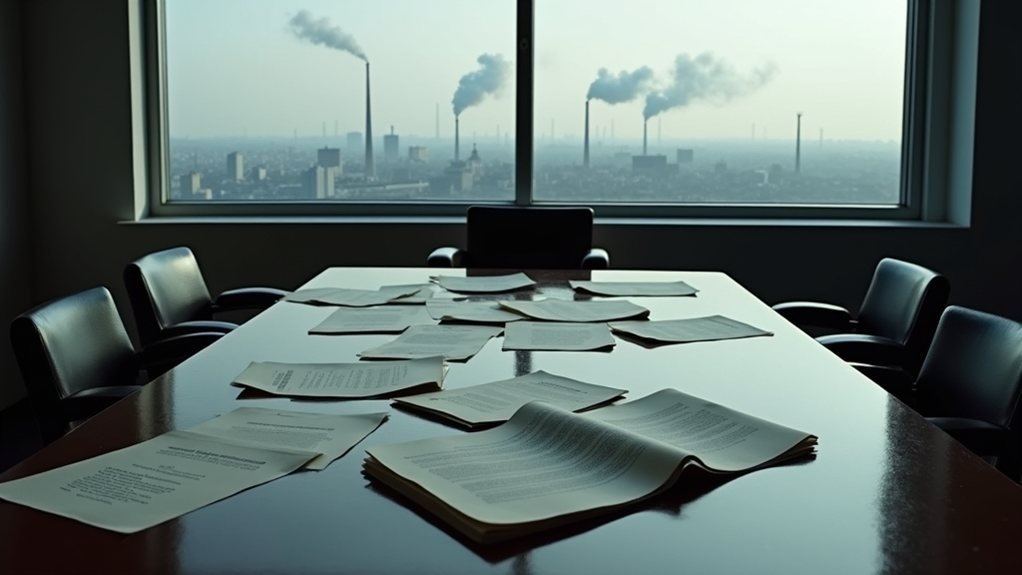

Internal documents reveal the Carney government knew carbon capture technology had its limitations, despite the industry’s glowing promises. It’s like being sold a gourmet burger and only getting the buns. Misalignment between policy and actual progress was evident, with hefty tax credits filling the industry’s wallet. Meanwhile, public perception was being charmed by industry storytelling. Yet, beneath all the corporate hoopla, a world of knowledge gaps called for an honest examination, inviting curious minds to explore further.
Quick Overview
- Internal documents reveal government awareness of carbon capture’s technical and economic limitations by 2026.
- Sparse data on feasibility and costs highlighted, contradicting optimistic public narratives from policymakers.
- Despite knowledge gaps, government policies remained heavily influenced by oil industry lobbying efforts.
- Regulatory and infrastructure challenges for carbon capture implementation were recognized but inadequately addressed.
- Public funding continued to favor fossil fuel maintenance, not reflecting the limitations of carbon capture technology.
Unveiling the Pathways Alliance Project: Is Progress Happening?
Is the Pathways Alliance Project the superhero cape Alberta’s oil sands industry needs to leap toward a more sustainable future? This ambitious endeavor aims to wrestle the carbon beast by proposing a CO2 transportation network and storage hub covering over 650 kilometers. Think of it as Alberta’s underground internet, but instead of data, it’s routing carbon to a sandstone inbox 1,000 meters deep. In addition to acting as a carbon repository, the sandstone formations can offer insights into innovative methods such as direct air capture technologies. With a cool $35.2 million budget, it plans to capture 4.2 Mt CO2 yearly by 2030, targeting a net zero by 2050. The job market in Alberta is set to benefit, with new employment opportunities arising in the carbon capture and storage sectors. It’s geology-meets-engineering in a caped crusade against climate change—no flashy tights required. As of December 20, 2024, the timeline for designation request has been suspended, putting the project’s progress temporarily on hold.
Government Knowledge Gaps in Carbon Capture Technology
As the Pathways Alliance Project dreams big with its subterranean plans to tackle Alberta’s carbon conundrum, the reality of government knowledge gaps looms large like an uninvited storm cloud. The Carney government’s briefing notes revealed a dearth of data regarding the project’s costs and technical feasibility. Much like baking a cake with no recipe, front-end engineering studies and basic estimates were scant. Despite these knowledge gaps, the government aligned its policies with oil industry demands, reflecting its economic focus over climate commitments. Regulatory frameworks and infrastructure requirements can pose significant hurdles, adding to the complexity of implementing CCUS projects. A successful strategy to cut carbon emissions should include not merely tax credits but also enhancements across economic sectors for multifaceted emission reduction efforts. Yet, they extended carbon capture storage (CCS) tax credits in the 2025 Budget through 2035. A federal claim of low carbon-intensity barrels seemed ambitious, as real groundwork such as pipeline planning remained conspicuously absent, all mirroring whimsical optimism.
How Industry Lobbying Shapes Carbon Capture Policy
While the dream of efficient carbon capture technology dances in the heads of governments and corporations alike, industry lobbying often writes the script behind the scenes. Imagine carbon capture as a hefty prize in a carnival game, and the oil giants are masters at tilting the scale. Since 2021, lobbying on carbon removal has doubled, with ExxonMobil and friends finessing millions into federal ears. Their tactics? A cocktail of PR campaigns, regulatory footnotes, and persuasive CEO narratives. Critics point out the humor: projects underachieve and overpromise, like trying to juice an apple out of an orange. Over two dozen organizations have targeted federal policymakers by 2023, reflecting the aggressive push to ensure that corporate interests align with the development and funding of direct air capture initiatives. Some of these misleading efforts, known as greenwashing, aim to paint unsustainable practices as environmentally friendly. The concentrated influence of the fossil fuel industry directs public funding towards prolonging fossil fuel use rather than prioritizing clean energy transitions. Reality check? Fossil fuel lifeline secured.