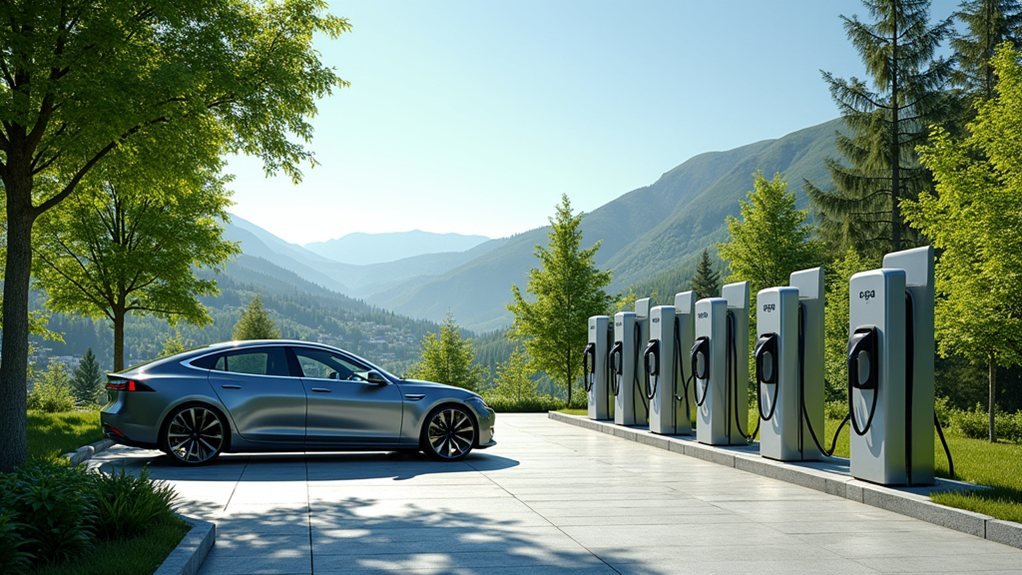

Canada is making a stellar move with a hefty $1.2 billion investment to boost electric vehicle (EV) charging infrastructure across the nation. This funding aims to fill the gaps in both public-access and fleet charging options, making EVs more accessible than ever. In addition to this, the plan features over 1,200 new charging points in strategic locations. It’s like the government’s giving a high-five to sustainability, right? Stick around to discover the exciting details behind this electrifying initiative!
Quick Overview
- Canada has allocated $1.2 billion since 2016 through NRCan to enhance electric vehicle charging infrastructure across the nation.
- The investment aims to address gaps in public-access and fleet charging infrastructure, ensuring wider EV adoption.
- Plans include over 1,200 new charging points in public places, workplaces, and recreational areas by 2029.
- The Zero Emission Vehicle Infrastructure Program (ZEVIP) supports cost-sharing for charger installation, capping federal contributions at 50%.
- A focus on sustainable innovations in EV motor technology accompanies the federal investment to enhance efficiency and performance.
Overview of Federal Funding for EV Charging Infrastructure
The landscape of federal funding for electric vehicle (EV) charging infrastructure in Canada resembles a well-placed power outlet in a bustling café—essential, accessible, and buzzing with potential.
Since 2016, over $1.2 billion has been allocated, primarily through Natural Resources Canada (NRCan).
This funding addresses gaps in public-access and fleet infrastructure, employing capital contributions, tax incentives, and financing tools to ease project costs. No mention of the ZEVIP program for EV charging infrastructure in Budget 2025 underscores the importance of ongoing investment and support for charging solutions. Additionally, the government has announced over $10 million in federal funding to further support EV adoption and infrastructure expansion.
Programs like the Zero Emission Vehicle Infrastructure Program (ZEVIP) aim for a cost-sharing model, capping federal contributions at 50%.
With ambitious targets for 2029, Canada’s EV charging future is bright, and the investment is as crucial as your morning coffee. The expansion aligns with global market growth projections as manufacturers increasingly commit to phasing out traditional combustion engines.
New Initiatives and Deployment Plans
While it may seem challenging to imagine a future where electric vehicle (EV) chargers dot the landscape like coffee shops on every corner, Canada is rolling out a series of new initiatives and deployment plans that promise to make this vision a reality.
With over 1,200 new charging points planned, the focus is on accessibility—think chargers where people live, work, and play. To support this effort, the ZEVIP funding for owners/operators program is open for applications, emphasizing the deployment of EV chargers in public places and workplaces. This infrastructure expansion represents a critical step toward reducing carbon emissions from the transportation sector.
With 1,200 new charging points planned, accessibility is key—envision chargers conveniently located where we live, work, and play.
Federal investments are fueling this drive, with $400 million allocated for large-scale projects. The goal? 84,500 chargers and 45 hydrogen stations by 2029. Additionally, the government has allocated $3.8 million for EV charging expansion to enhance regional connectivity and accommodate growing EV usage.
It’s a bold plan, aiming to make EV charging as common as a cup of coffee!
Innovations in EV Motor Technology and Supply Chains
As Canada revs up its electric vehicle (EV) infrastructure, the spotlight shifts to the innovations powering these vehicles beneath the hood.
Next-generation motor designs like axial flux and integrated drive units are revolutionizing performance and efficiency, making EVs more compact and powerful—like squeezing a lion into a house cat’s body. Axial-flux motors feature a flat, disc-like design that allows for higher torque in a shorter package, which is crucial for performance in space-constrained applications. Additionally, the dominance of permanent magnet (PM) motors is reshaping the motor landscape as automakers increasingly adopt these efficient designs.
Meanwhile, material advancements are reducing reliance on rare-earth elements, with savvy alternatives like switched-reluctance motors stepping up to the plate. Manufacturers are developing resilient supply chains to ensure consistent production despite geopolitical tensions and climate-related disruptions.
As automakers juggle various motor types, the landscape is shifting to meet both performance demands and sustainability goals, ensuring that EVs aren’t just smart; they’re also savvy.