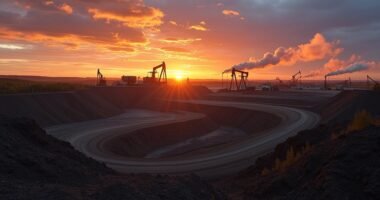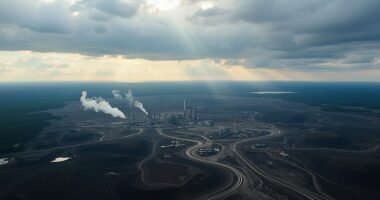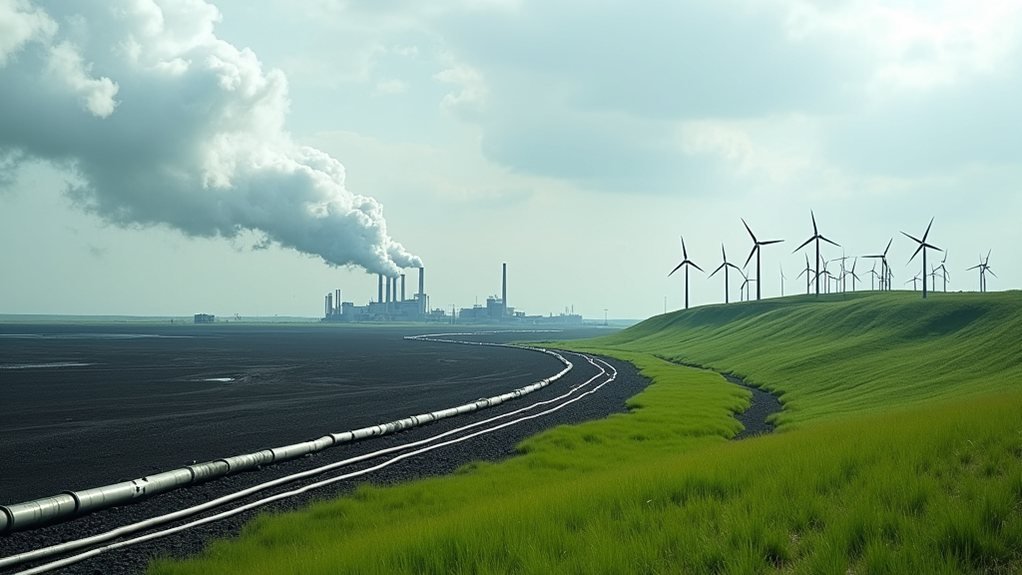

Recent federal policy changes are giving oil sands a climate-friendly makeover. Imagine an emissions cap as a stylish new hat limiting carbon output to 100 Megatonnes, with room for growth. Add a $30 per tonne carbon price, and you’ve got operations paying for their carbon ‘sins.’ Companies can buy offsets, much like guilt-free snacks. All in pursuit of net-zero emissions by 2050. Dive deeper into balancing industry growth and climate goals to find the juicy details.
Quick Overview
- A new emissions cap limits oil sands to 100 Megatonnes, previously unlimited, allowing for increased production but capped growth.
- A $30 per tonne carbon price is introduced, encouraging companies to meet performance benchmarks and reduce emissions.
- Cap-and-trade systems are established to incentivize emissions compliance, with the option to purchase offsets.
- Federal and provincial climate agreements collectively address emissions challenges, aiming for a reduction to 106 Megatonnes by 2030.
- Carbon capture targets and strict methane regulations are implemented to enhance compliance and support emissions reductions.
Recent Federal Policy Changes Impacting Oil Sands Emissions
While some folks might think of oil sands as the black sheep of Canada’s climate mission, recent federal policy changes are stepping up to change that narrative. Alberta’s legislated emissions cap is akin to a stern parent setting curfew. Oil sands operations are now under an unprecedented cap of 100 Megatonnes annually. With no existing limit on emissions for oil sands, both facility-wise and industry-wide, this new approach marks a significant shift. But wait, there’s wiggle room—about 30 Megatonnes—inviting production growth, like a dessert you can indulge in without guilt. Complemented by a $30 per tonne carbon price, based on performance benchmarks, these laws promote innovation. Across broader energy systems, carbon reduction strategies span multiple sectors, from improving energy efficiency to deploying cleaner technologies at scale. It’s a structured dance between federal and provincial climate agreements, clearing Canada’s emissions hurdles. Reflecting on the largest deregulatory action in U.S. history, perspectives on climate policy are shifting, emphasizing consumer choice and economic growth alongside environmental considerations.
How Policy Changes Affect Oil Sands Production and Emissions
In the world of oil sands production, policy changes dance in a grand ballroom of regulations and incentives, reshaping the landscape with every step. Canada’s master plan is like a choreographed routine. The emissions cap goes from 171 to as low as 106 Mt by 2030, with companies allowed to “purchase offsets,” fundamentally paying their way through the dance. Meanwhile, a cap-and-trade system is like paying for extra ballet shoes. Enter the carbon capture stars, with a heroic 22 Mt annual target. Alberta hosts a performance under strict methane regulations. Here, production aims to shine without stepping out of tune. Businesses operating within these frameworks may also pursue carbon reduction strategies such as investing in renewable energy projects or improving operational efficiency to meet their emissions targets. Concerns arise from the industry’s strategic lobbying, which has influenced Canadian climate and energy policy by pressuring the government to withdraw key regulations. However, there is a concern regarding Alberta’s inaction as it has not yet implemented the proposed emission reduction strategies, potentially hindering efforts to align with the federal framework.
Finding Better Ways to Balance Growth and Climate Goals
Balancing growth with climate goals is akin to juggling flaming torches while riding a unicycle; it’s bold, it’s risky, but with the right skills, it can dazzle the crowd. Oil sands operators aim to bridge these ambitions through emissions intensity cuts and smart tech solutions. Cenovus, for instance, aims for a one-third reduction in greenhouse gases per barrel by 2026. Alberta’s emissions cap demands evolving technology, like Carbon Capture and Storage (CCS), loved by engineers and carbon nerds alike. Pathways Alliance leads the charge with a seductive promise: net-zero by 2050. It’s a marathon of innovation, not a sprint. Some industry observers also point to small modular reactors as a promising low-carbon energy source that could one day power oil sands operations with significantly reduced emissions. Cenovus collaborates with COSIA, enabling technology sharing and innovation among oil sands producers to tackle environmental challenges collectively. As the oil sands sector contributes 13% of Canada’s national emissions, Pathways Alliance’s commitment to net-zero operations by 2050 becomes crucial in aligning industry practices with national climate objectives.