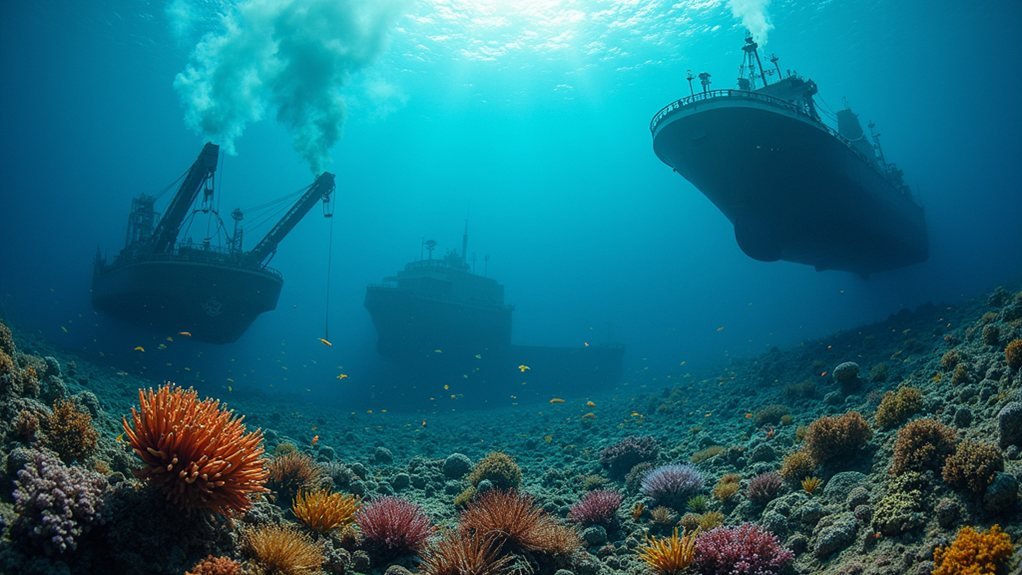
In March 2026, the deep sea mining debate hit a vital turning point. Over 40 countries, along with indigenous groups and scientists, rallied for a moratorium on underwater resource extraction. This urgent call aims to address the environmental disasters and geopolitical rivalries brewing beneath the waves. Imagine digging up gold, but instead, you release chaos on ocean life! With competing nations eyeing these underwater treasures, the stakes couldn’t be higher. Curious about what this means for the oceans?
Quick Overview
- Over 40 countries, including major economies, advocate for a moratorium on deep sea mining to protect fragile ecosystems and promote sustainable practices.
- Environmental risks like sediment plumes and habitat destruction could cause irreversible damage, prompting urgent calls for comprehensive habitat protection strategies.
- Deep sea mining fuels geopolitical rivalry, particularly between the U.S. and China, impacting global power dynamics and economic influence in resource acquisition.
- Ethical concerns regarding profit distribution from deep-sea mining highlight the need for equitable economic frameworks that benefit all stakeholders, including indigenous communities.
- Diverse stakeholders, including UN experts and corporations, emphasize the importance of collaborative discussions to ensure responsible deep-sea mining policies before irreversible actions are taken.
The Urgency of a Deep Sea Mining Moratorium
As discussions around deep sea mining heat up, a growing chorus of voices is urging a moratorium on this controversial practice.
With support from 40 countries, including heavyweights like France, Germany, and New Zealand, the call is remarkably loud. Indigenous groups, scientists, and even major corporations have joined in, highlighting environmental and social concerns.
Picture a team of superheroes—UN experts and fishing groups are rallying, too! They believe that a pause would give lawmakers and researchers time to sort through the scientific, legal, and ethical mess before diving deeper.
After all, hasty decisions in fragile ocean ecosystems can have catastrophic ripple effects.
Similar to how forest conservation requires balancing economic interests with environmental protection, ocean floor preservation demands careful consideration before irreversible extraction begins.
Why We Can’t Ignore Environmental Risks of Deep Sea Mining
While it may be tempting to tap into the ocean’s depths for valuable resources, the environmental risks associated with deep sea mining are anything but trivial.
Disturbing the seabed creates sediment plumes that can drift like confetti, harming marine life far beyond the mining zone.
Imagine vacuuming the floor and sending dust swirling up into the air—it’s a mess that hangs around.
The destruction of habitats can collapse food webs, with recovery taking decades, if it happens at all.
Habitat destruction can disrupt food webs, leading to recovery timelines stretching over decades, if recovery occurs at all.
With 80% of the seabed still unmapped, we’re sailing into uncharted waters, risking biodiversity and cultural heritage along the way.
Protecting these vulnerable deep sea ecosystems requires the same comprehensive habitat protection strategies that have proven effective in preserving terrestrial and coastal environments.
The Geopolitical Stakes of Deep Sea Mining: Who Wins and Who Loses?
The underwater domain, rich in untapped resources, has sparked not just scientific curiosity but also a fierce geopolitical contest.
Nations like the U.S. and China vie for rare earth elements, raising the stakes for global dominance. While China’s substantial ISA leases bolster its economic leverage, the U.S. seeks to streamline regulations and bypass international norms to assert its position.
Pacific Islands stand at a crossroads, balancing potential wealth against sovereignty threats. With morale on the line and environmental concerns simmering, the question remains: who truly profits as this deep-sea drama unfolds?
One’s gain might just be another’s loss in this underwater chess game. Different ethical frameworks shape how nations justify their extractive ambitions, from viewing oceans as resources for human use to recognizing intrinsic value in marine ecosystems.