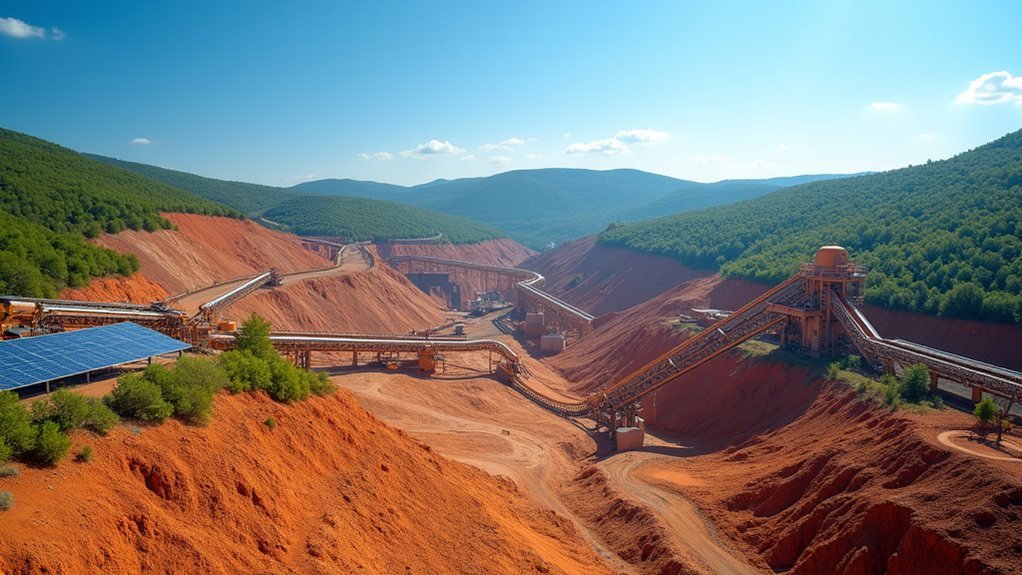

Canada’s recent $165 million investment in critical minerals is a game-changer for domestic production in 2026. With the goal of enhancing sustainability and resource management, this funding supports 22 projects aimed at boosting mineral resource development. It’s all about securing high-grade materials, like rare earth elements, while addressing environmental concerns—kind of like shopping for eco-friendly gadgets. This funding not only strengthens industry resilience but also sets the stage for exciting developments in mineral security and economic growth. Curious about how this will shake out?
Quick Overview
- The U.S. government announced a $165 million investment to enhance domestic production of critical minerals in 2026.
- Funding supports 22 projects across eight provinces, targeting sustainable resource management and future availability.
- The initiative aims to strengthen supply chains for over 40 minerals, reducing dependency on imports.
- Investments are expected to catalyze an additional $434 million in project capital, promoting economic growth.
- Emphasis on recycling technologies and stakeholder engagement seeks to address environmental concerns and production efficiency.
Overview of the $165M Critical Minerals Funding
In a world where the demand for critical minerals is skyrocketing—think of them as the unicorn horns of the mining industry—Canada is stepping up its game with a fresh investment of over $165 million, announced by Energy and Natural Resources Minister Tim Hodgson on March 3, 2026.
This hefty funding aims to boost 22 projects, rapidly advancing the planning and development of critical mineral resources. The investment, revealed at the bustling Prospectors and Developers Association of Canada Convention, is expected to catalyze an impressive $434 million in project capital across eight provinces, enhancing both economic growth and domestic mineral security. Effective sustainable resource management practices will be essential to ensure these critical minerals remain available for future generations while meeting current industrial demands.
Focus Areas for Domestic Mineral Production
With the recent surge in funding for critical minerals, the spotlight shines brightly on the focus areas that will drive domestic mineral production forward.
Initiatives tagged for battery minerals, including a $500 million grant, aim to boost processing and recycling technologies, while innovative methods promise efficiency like never before.
High-grade rare earth elements, like those from Montana’s Sheep Creek deposit, are being targeted for production to meet defense and industry needs.
High-grade rare earth elements from Montana’s Sheep Creek deposit are essential for fulfilling defense and industrial requirements.
Additionally, stockpiling efforts, backed by the Department of Defense, guarantee that essential materials like tungsten and graphite are readily available, fortifying supply chains for the future.
Effective stakeholder engagement will be crucial to ensure these production initiatives address environmental concerns while meeting strategic supply objectives.
Expected Impacts on the Critical Minerals Industry
A remarkable transformation is unfolding in the critical minerals industry, driven by an urgent quest for supply chain resilience and heightened national security.
With the U.S. reliant on imports for over 40 minerals, the push for domestic production is more pressing than ever. Recent investments aim to stabilize volatile prices, essential for attracting private capital.
The proposed $2.5 billion Strategic Resilience Reserve could be the safety net the industry needs. As military and AI demands surge, these initiatives promise not just a stronger economy, but also a fortified stance against global uncertainties—think of it as armored protection for the mineral supply!
As domestic production scales up, companies will need to navigate conflicting ESG standards between U.S. and EU regulatory frameworks to maintain market access.